The Great Suicide Deception – Part IV – What purpose is served by spurious statistics?

Dan Waugh-Regulus Partners May 2024

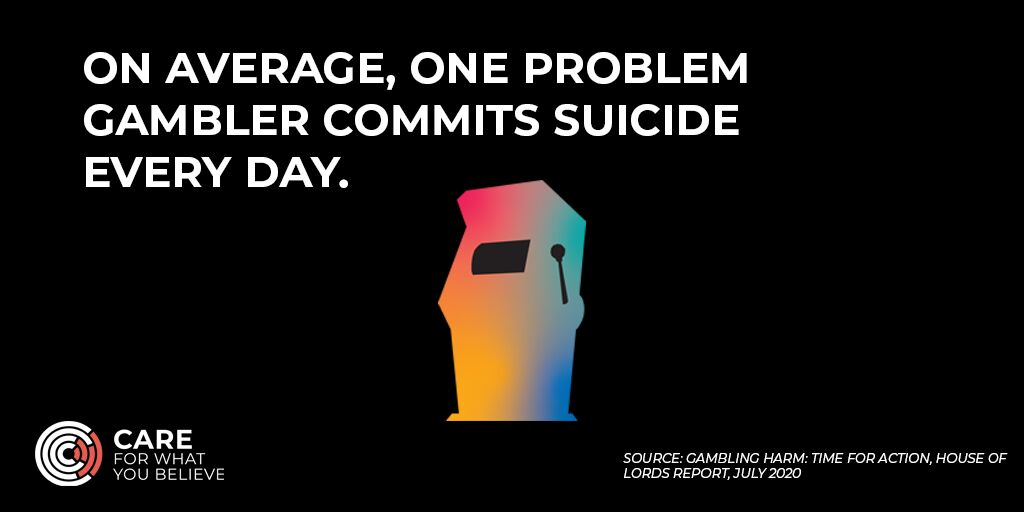
This is the fourth and final article in our series on attempts by state bodies to claim widespread suicide mortality associated with problem gambling. In the first three articles we demonstrated why estimates prepared by Public Health England and the Office for Health Improvement and Disparities were irretrievably flawed; we examined the conduct of PHE and OHID, including evidence of bias and inappropriate behaviour; and we considered the role played by the Gambling Commission, the Advisory Board for Safer Gambling and others in either propagating the PHE-OHID claims or withholding concerns about their reliability. We conclude by addressing the wisdom of attempts to boil down a matter as complex as suicide to any single factor.

It has long been understood that people with gambling disorder are at elevated risk of death by suicide. The DSM-5 (the American Psychiatric Association’s ‘bible’) comments on elevated rates of suicide ideation and attempts among people in treatment for gambling disorder (and makes similar observations in relation to a large number of other mental health conditions, including alcohol use disorder). Concerns in relation to gambling disorder and self-harm – and what might be done to prevent suicide by people with the disorder – are entirely valid.

It is also widely accepted that suicidality is a complex matter. In their 2016 meta-analysis of 50 years of suicide research, Franklin et al. made the following observation: 

“…any individual with nearly any type of mental illness (i.e. internalizing, externalizing, psychotic, or personality disorder symptoms), serious or chronic physical illness, life stress (e.g. social, occupational, or legal problem), special population status (e.g. migrant, prisoner, nonheterosexual), or access to lethal means (e.g. firearms, drugs, high places) may be at risk for [suicidal behaviours and thoughts]. A large proportion of the population possess at least one of these risk factors at any given time, with many people possessing multiple factors.”   

Understanding that people with a gambling disorder are at elevated risk of suicide is helpful when it comes to devising self-harm prevention strategies. For example, Hakansson & Karlsson (the Swedish researchers relied upon by PHE-OHID) conclude their 2020 study with the following recommendation:

“The findings call for improved screening and treatment interventions for patients with gambling disorder and other mental health comorbidity.”

It is questionable however whether studies of discrete associations between any single activity or human characteristic and death by suicide should – by themselves – be used to justify state controls on that activity.  By way of illustration, a 2021 study on the prevalence of suicidal behaviour in a group of patients with behavioural addictions (Valenciano-Mendoza et al.) found: 

“the highest prevalence of suicide attempts was registered for sex addiction (9.1%), followed by buying–shopping disorder (7.6%), gambling disorder (6.7%), and gaming disorder (3.0%).”

These findings may be useful for addressing risk of self-harm within population groups suffering from these mental health conditions. They do not – by themselves – justify bans on sex, shopping or playing video games. A 2017 study of young adults in England (aged 20-24 years, n=106) by Appleby et al., found that four deaths by suicide were linked to ‘gambling problems’; and this has been used to suggest that 250 deaths by suicide each year are ‘gambling-related’. The study also found that 44 of those who had died “had a reported history of excessive alcohol use. Illicit drug use was reported in 54 (51%)”; sevenwere reported as experiencing problems related to being a student” (including five experiencing “academic pressures”. One might therefore estimate (using the same methodology as for gambling problems) that around 3,200 suicides are related to illicit drug use; 2,625 to excessive alcohol use; and 440 to academia. Such findings should prompt concern and policy responses; but it is questionable whether these should extend – for example – to complete bans on advertisements for beer or universities.

Some activists have called for coroners to assess, as a matter of routine, the possible involvement of gambling in deaths under investigation – the Bishop of St Albans has doggedly pursued a Private Members Bill to mandate this. At first blush it seems to be a reasonable suggestion. The problem is that it places an additional requirement on already over-burdened coroners; and risks distortion if other known factors are not also investigated with the same degree of rigour. The presence of Adverse Childhood Experiences (‘ACEs’) is a well-documented antecedent of suicide with one study (Dube et al., 2001) finding that as many as 80% of suicide cases analysed had a history of ACEs. There are also well-documented associations between relationship breakdown and self-harm. The practicality and wisdom of asking coroners to probe into every corner of the deceased’s life should be carefully considered.

Those determined to produce figures on the prevalence of gambling-related suicide should first set out a clear operationalised definition of what this term means. How is the relationship to be characterised (e.g. does the individual need to have gambled in the prior 12 months? Does he or she need to have a diagnosis of gambling disorder?) and to what extent is there evidence of causal contribution to death (e.g. was gambling disorder a significant factor or a minor factor?). Finally, they should be required to contextualise their findings by reference to other risk factors.

Running through some of the institutional responses to PHE-OHID is the idea that unreliable estimates of mortality serve a valid purpose pending the production of more robust statistics – something along the lines of ‘fake it until you can make it’. The chair of the Gambling Commission’s Advisory Board for Safer Gambling (‘ABSG’), Dr Anna van der Gaag, for example has written that: 

“Good research, especially if it is on an under-researched area like this one, tends to begin and end in a different place, prompting challenge, replication, debate, and the research in this important area is no different.”

It is a view that overlooks four important points. First, the PHE-OHID work on the cost of gambling harms is riven with errors (including mathematical mistakes) and should not be considered “good research”. Second, the ABSG specifically called for “action” as a result of the PHE estimates – with no suggestion of the need for caution or refinement. Third, rather than welcoming challenge, the ABSG has engaged in ad hominem disparagement of those attempting to apply scrutiny to the PHE-OHID claims (likening this, without substantiation, to the activities of Big Oil). Fourth, it is questionable how far we should trust ‘better research’ if those responsible for it have propagated or tolerated misinformation in the past. As we saw during the Covid pandemic, the production of misleading statistics may in fact set back the cause of harm prevention by undermining trust in authority. 

Suicide risk among people with a gambling disorder is a legitimate issue and warrants an intelligent response; but this is unlikely to be achieved through the publication of spurious estimates of prevalence. As the US economist, Professor Douglas Walker has observed; 

“If researchers continue to offer social cost estimates, they should estimate costs that are measurable. But for other costs such as psychic costs that cannot be measured…let us identify them without providing spurious empirical estimates. Offering methodologically flawed cost estimates does not improve our understanding nor does it promote sound policy…In areas where research is still quite primitive, perhaps no data would be better than flawed data.”

Coda

We are aware that some individuals and organisations will resent this series of articles on PHE-OHID (not least the OHID researchers themselves). Our intention in writing them has not been to hurt or insult – but to shine a light on the way that some statistics are created and the distortive effect that ‘bad statistics’ can have on government policies. The application of scrutiny to research is an important part of the scientific process; and where state bodies are concerned, an important part of the democratic process too. It is entirely consistent to be concerned about a particular issue (e.g. risk of self-harm in a gambling context) and at the same time to believe that research into that issue should be conducted with honesty, openness and in accordance with scientific principles. In this way, we may hope to reduce the stigma associated with self-harm (such that gambling firms and other businesses gain the confidence to openly confront it); and that, over time, we may apply greater intelligence to the prevention of suicide in a gambling context and more generally. 

Unreliable Suicide Claims in Gambling: ABSG’s Questionable Stance

The Great Suicide Deception. Part III – Conspiracy of Silence

Dan Waugh, Regulus Partners. May 2024

The Great Suicide Deception. Part III – Conspiracy of Silence

This is the third in a series of articles examining claims made by state bodies in England about rates of suicide associated with ‘problem gambling’. In the first we demonstrated that estimates of suicide mortality produced, first by Public Health England (‘PHE’, 2021) and then by the Office for Health Improvement and Disparities (‘OHID’, 2023) were irretrievably flawed. In the second, we looked at the behaviour of PHE and OHID, finding indications of a priori bias or inexplicable negligence and unsound governance. In this third article, we examine the conduct of others in positions of authority and ask why so many people who knew that PHE and OHID’s claims were unreliable decided to look the other way. We also recognise those who were prepared to apply critical analysis. Once again, we observe that, while gambling disorder has been recognised as a risk factor for self-harm for more than 40 years, efforts to tackle this are unlikely to be advanced by the use of junk science.

1. Why did the Gambling Commission not ‘do the right thing’?

By April 2022, Britain’s Gambling Commission knew that estimates of suicide mortality published by PHE were “unreliable” and based on “inaccurate” assumptions. This may have been a somewhat uncomfortable finding, given that the regulator had previously described the review as “important and independent”. It had arrived at this opinion despite not having received anything more than an executive summary (which it had not read when it agreed to provide “a supportive quote”). It also knew that PHE was far from “independent”, having been made aware of its intention to apply tobacco-style controls to participation in betting and gaming.

At a meeting in March 2022, Gambling Commission officials admitted that they did not understand how PHE had arrived at some of its estimates (no-one could have been expected to – given the fact that the calculations were mathematically incorrect). In April, these officials circulated a highly critical review of the PHE report, in which they noted that the suicide claims were not based on “reliable data”. The Commission however, elected not to take the matter up with the OHID (which had subsumed PHE upon the latter’s disbandment) or to inform the Secretary of State. The market regulator – which counts “doing the right thing” among its corporate values – elected to suppress its critique. In one rather sinister coda to the Commission’s critique, one official speculated that PHE’s claim of more than 400 suicides might be rescued, if only future prevalence surveys showed a higher rate of ‘problem gambling’ in the population. At this point, the Commission had started work on a new Gambling Survey for Great Britain in the expectation that – as a result of methodological issues – would produce a higher rate of ‘problem gambling’ than reported by tNHS Health Surveys.


When asked by journalists whether it considered the PHE claims to be reliable, the Gambling Commission responded that it was not its role to review the work of other state agencies; but failed to mention that this is precisely what it had done. As late as 2023, its chief executive, Andrew Rhodes continued to defend the PHE-OHID estimates, despite being aware of the problems with them; and it seems likely that the market regulator has been involved in disseminating the misinformation via approval of regulatory settlement funds.

2. the ABSG and the irrelevance of accuracy

In the summer of 2022, the OHID wrote to the Gambling Commission’s Advisory Board for Safer Gambling (‘ABSG’) to ask for its opinion on criticism of PHE’s suicide analysis. In her response, the ABSG’s chair, Dr Anna van der Gaag appeared to agree that there were indeed a number of issues. She wrote: “I see their point about basing calculations on the Swedish hospital study leading to an over estimation of the numbers”. She then proceeded to suggest that accuracy in such matters was unimportant and that attempts to apply scrutiny was “a distraction from what matters to people and families harmed by gambling”. This represented a change in attitude from three months earlier when the ABSG had described PHE’s highly exact estimate of 409 suicides associated with problem gambling as a “catalyst towards action”. The Gambling Commission allowed the ABSG to publish this opinion in the full knowledge that it was based on unreliable data. 

The following year, Dr van der Gaag was one of two co-adjudicators responsible for allocating around £1m in Gambling Commission (regulatory settlement) funding for the purposes of research into suicide and gambling. Applicants were specifically directed towards the OHID analysis (i.e. estimates that the ABSG knew were flawed) as well as claims by the activist group, Gambling With Lives (despite the fact that even the OHID had indirectly criticised one of GwL’s claims). One of the successful bids (a £582,599 award to a consortium led by the University of Lincoln) included Gambling With Lives as an active member of the research team. 

3. the Silence of the ‘Independents’

Among those who have supported the claims of PHE-OHID are a number of self-styled ‘independent’ researchers. These include academics from the universities of Cambridge, Hong Kong, Lincoln, Manchester, Nottingham and Southampton, as well as King’s College, London, who have cited the estimates uncritically in their work. Perhaps they considered (naively, if so) that research produced by the Government is unimpeachable; yet the errors made by PHE-OHID are so glaring that no researcher of any calibre could have failed to notice them. The failure to subject such serious claims to critical analysis before repeating them indicates – at the very least – an absence of intellectual curiosity. Much is made of the need for research independence (typically defined solely by an absence of industry funding, regardless of ideology or other affiliations); but independence has little value if it is not accompanied by intelligence and integrity. 

4. Breaking ground

A small number of groups and individuals have been prepared to apply scrutiny and challenge, despite the circumstances. The Racing Post and the think tank Cieo have published a number of our own articles on the problems with PHE-OHID (as well as other issues with research-activism); and a handful of journalists, including Chris Snowdon, Steve Hoare and Scott Longley have been prepared to challenge the PHE-OHID claims. Figures from trade groups, bacta and the Gambling Business Group have spoken out publicly on issues with PHE-OHID.

Officials at the Department for Culture, Media and Sport have displayed a capacity for critical analysis, notable by its absence elsewhere in Whitehall. Their White Paper on reform of the betting and gaming market acknowledged valid concerns about self-harm but conspicuously omitted the OHID figures. Lord Foster of Bath, a stern critic of the gambling industry, has acknowledged that the PHE-OHID claims are not reliable and – in a show of honesty and humility rare in the gambling debate – apologised for using the figures himself. He continues to make the case for self-harm to be treated seriously in a gambling context; but without recourse to spurious statistics. Philip Davies, the Conservative Member of Parliament for Shipley, has challenged unsound statistics in parliamentary debates; and Dame Caroline Dinenage’s select committee for Culture, Media and Sport noted concerns of reliability in its report on gambling regulation. 

One member of the Gambling Commission’s senior management team – Tim Miller – has been prepared to discuss and acknowledge problems with PHE-OHID; an attitude that contrasts sharply with that of his colleagues.

5. ‘Noble lies’ and consequences?

Underlying the PHE-OHID saga is a sense that some people in positions of authority consider it acceptable to publish inaccurate or misleading statistics if the cause is – in their opinion – just. Some have even suggested that scrutiny of misinformation is unethical, rather than its manufacture. In July this year, the Gambling Commission intends to publish statistics on the prevalence of suicidality amongst gamblers. Given its role in PHE-OHID (in addition to major issues with its new survey), it is questionable why anyone should consider these results credible. It has also – via Gambling Research Exchange Ontario – sponsored a programme of research into wagering and self-harm. Given that these studies have been explicitly grounded in the PHE-OHID deception – and the complicity of many of those involved – suspicions of bias will accompany publication. It is the publication of unreliable research – rather than scrutiny of those statistics – that undermines public trust in authority. Attempts to address health harms in any domain will be ineffective if they are based on inaccurate evidence.

An independent and open review should be carried out into the PHE-OHID deception; but it is difficult to see how this will happen. The Department of Health and Social Care and the Gambling Commission are unlikely to embrace scrutiny; and the DCMS will not wish to embarrass either its regulator or another government department. There are too many people in Parliament and the media who have played a part; and too few prepared to break ranks. The gambling industry meanwhile (with a number of notable exceptions) has shown little inclination to challenge. There is one hope – that the Office for Statistics Regulation will be prepared to take an interest in the integrity of public health estimates. Such an intervention would go somewhere at least towards restoring trust in public bodies.

A Very Public Deception: On the manufacture of mortality statistics in gambling

Part II – Why did public health get things so badly wrong?

n the first in this series of articles, we examined the problems with claims made by state bodies – specifically Public Health England (‘PHE’) and the Office for Health Improvement and Disparities (‘OHID’) that up to 496 deaths by suicide each year in England are associated with ‘problem gambling’. We demonstrated that the basis for these claims is irretrievably flawed. Analysis of the Swedish dataset upon which they rely concluded that “gambling disorder did not appear to be a significant risk factor for the increase in suicide” (Karlsson, 2023). PHE and OHID researchers overlooked critical research findings and clear warnings about the advisability of their approach. While gambling disorder has long been recognised as a risk factor for self-harm, the estimates published by PHE-OHID are categorically unsound.

Read Part One: Lost in Translation?

In this second article in the series, we attempt to understand why PHE and the OHID persisted in following such a clearly problematic approach in the face of strong evidence of its unsuitability; we examine a number of issues of governance; and consider whether officials may have deliberately misled policy-makers and the public.

The Tobacco Road: why did PHE make such unsound claims?

In May 2018, at the conclusion of its review into gaming machines and social responsibility, the British Government’s Department for Culture, Media and Sport asked PHE to “conduct an evidence review of health aspects of gambling-related harm to inform action on prevention and treatment”.  More than three years later, in September 2021, PHE responded with the publication of five reports on the subject. One of these reports (‘The economic and social cost of harms’) claimed annual costs of £1.27bn a year associated with ‘problem gambling’ – with roughly 50% attributable to deaths by suicide.

It was this rather speculative document, rather than PHE’s more robust quantitative review of evidence from NHS Health Surveys, that officials chose to emphasise – prompting Britain’s Gambling Commission to surmise that PHE’s goal was, “to ensure gambling is considered as a public health issue.”

The Gambling Commission had already been given a glimpse of what “a public health issue” would entail. In a draft press release (seen by the Commission), PHE officials called for:

“a public health approach to gambling…similar to how we tackle tobacco consumption or unhealthy food consumption…”.

In the summer of 2022, the PHE researchers (now transferred to OHID) spelt out what this tobacco-style offensive would involve. Their paper, published in the Lancet Public Health, contained 81 measures for state intervention in the gambling market. The list included prohibitions on: all gambling advertising and marketing (including at racecourses); all in-play betting; and the sale of wine, beer and spirits in bingo clubs and casinos. It also included limits on the number of people permitted on a website at any one time, annual tax increases above the rate of inflation and even ‘plain packaging’ for all gambling products (no colours, logos or images permitted on playing cards, gaming machines, National Lottery tickets and so on).

There were other indications that PHE’s endeavours were not entirely objective – or morally neutral. In 2020, for example, its project leader stated that “more research is required to support advocacy and action” against gambling – hardly a statement of impartiality or scientific rigour. Meanwhile, documents made available under the Freedom of Information Act (‘FOIA’) reveal that PHE had agreed to be part of a research group set up by the activist charity, Gambling With Lives (‘GwL’) during the review period – an engagement it failed to disclose within its report.

Thank you for reading CIEO. This post is public so feel free to share it.

Share

Why did OHID publish its report…and did officials mislead?

In January 2023, the Department of Health and Social Care (‘DHSC’) withdrew the PHE report and published an updated set of cost estimates – this time in the range of £1.05bn to £1.77bn a year (underpinned by a choice of 117 or 496 deaths). OHID described the decision to review PHE’s work as “a standard approach for previously published reports ”; but this seems to be untrue. The decision to re-examine the PHE cost estimates alone (none of the other four reports was reviewed – despite the presence of errors) was taken in July 2022 and announced to Parliament shortly afterwards. We have found no evidence that reviewing state agency reports within ten months of publication is a “standard approach” or that any such policy exists.

Disclosures made under FOIA reveal the true reason for review. On 26th July 2022, an unnamed DHSC official circulated a memorandum, stating:

“We are going to need to make changes to two of the evidence review reports as an error has been spotted, and as it’s a change to results, its [sic.] probably what you would classify as a major change.”

Given that the PHE report contained quite a few errors, it is difficult to know which particular mistake prompted re-examination; but the decision was certainly not part of a “standard approach”. This raises the possibility that OHID may have deliberately misrepresented the grounds for review.

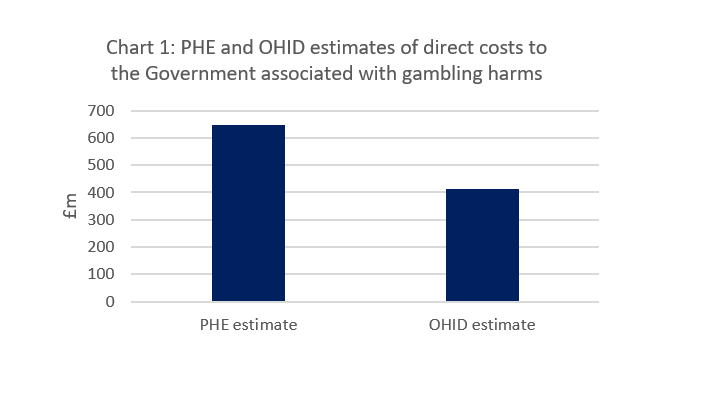
The Gambling Commission and the Advisory Board for Safer Gambling were both told by OHID researchers that “nothing in the report has changed substantially”; but this is incorrect. In fact, every single line item in the OHID cost estimate differed from the PHE version – in some cases substantially. Its estimate of direct costs to the Government was £234.1m lower than PHE’s – a reduction of more than one-third. This was masked by the introduction of a new area of intangible costs, relating to depression and several revisions to the suicide calculation. OHID’s estimates were also based on a ‘harmed population’ 59% smaller than in PHE. As chart 1 (below) shows, the claim that ‘nothing changed substantially’ appears misleading.

In August 2022, the then Health Minister, Maggie Throup MP advised Parliament that the PHE report would be reviewed and that the calculations underpinning its estimates would be published. The review however, has never been made public and – according to disclosures made under FOIA – no such document is held by the DHSC. Contrary to the minister’s pledge, the PHE calculations have still not been released. To do so would reveal a number of errors, such as the fact that PHE’s suicide figure was based on a 21% over-statement of the population prevalence of ‘problem gambling’.

The mystery of the OHID expert panel

OHID was at least prepared to admit – with a heavy dose of understatement – that its estimates were “uncertain”. It relied on a study of hospital patients in Sweden with a clinical diagnosis of gambling disorder (among many other health issues) to estimate the health risks for people in England with no diagnosed mental or physical health conditions whatsoever. In consequence, OHID leaned heavily on the opinion of its expert panel of health economists and academics who, it is claimed, approved the approach.

There are, however two problems where this opinion is concerned. The first is that one member of the expert panel, Dr Henrietta Bowden-Jones of the NHS had publicly criticised the PHE-OHID methodology. At a fringe meeting of the Conservative Party Conference in September 2022, Dr Bowden-Jones stated: “we cannot extrapolate from Swedish studies, from Norwegian studies – it doesn’t work”.

CIEO is a reader-supported publication. To receive new posts and support my work, consider becoming a free or paid subscriber.

Subscribed

The second issue is that the meeting of the expert panel – to discuss the most significant matter in the OHID report – is entirely undocumented. In February 2023, the DHSC admitted that:

“there was no agenda or papers shared before the meeting or minutes circulated afterwards”.

It is difficult to understand how this panel of experts might have been expected to review OHID’s work without access to any documents; and why officials did not consider it necessary to record the panel’s deliberations on this critical point.

Why did public health get things so badly wrong?

Inappropriate behaviour?

The task attempted by PHE-OHID was always going to be challenging, given the dearth of actual data available. This does not explain or excuse the large number of errors and omissions made by researchers and officials:

  • PHE and OHID ignored warnings by Karlsson & Håkansson about the representativeness of the sample in the 2018 Swedish study (upon which they relied);
  • PHE and OHID ignored findings in the 2018 study of high rates of mental and physical health comorbidities.
  • PHE and OHID ignored the follow-up study by the Swedish researchers (Håkansson & Karlsson, 2020), which found that risk of suicide attempt was significantly mediated by the presence of other disorders.
  • PHE and OHID ignored the opinion of Dr Anna van der Gaag, chair of the Gambling Commission’s Advisory Board for Safer Gambling, that the PHE calculation was likely to be inaccurate.

A large number of issues with the PHE-OHID reports were brought to the attention of its Director-General, Jonathan Marron in July 2022 and again in September 2023. On both occasions, Mr Marron promised to investigate. Last year, he wrote that he would provide “a proper explanation” for the errors and methodological flaws; but more than seven months later, none has been forthcoming. In what may well be a breach of the Civil Service Code, OHID officials resorted to ad hominem disparagement of their critics – including one national news media outlet – rather than engage constructively.

What is particularly disturbing about the PHE-OHID scandal is not the fact that researchers (presented with an unenviable task) made so many mistakes; but that state officials proved so unwilling to confront them – responding with hostility to legitimate scrutiny.

Next week, in our third article, we will consider the behaviour of others in positions of political or moral authority who variously connived in the deception or turned a blind eye to it. We will reflect on what this means for their future involvement in research and policy-making.

Dan Waugh

May 17th 2024

Regulus Partners

Response to SP regulatory commission

Response to SP regulatory system – consultation

Former NJPC chief exec Clive Reams,  recently penned a letter in response to the criticism levelled at the SPRC, after the Grand National, advocating ‘no change’ to the SP system.  When the current mechanism was devised in the 1990’s he argued vehemently against the then proposed system whereby 5 bookmakers could govern the SP returns – as ‘a bookies benefit.’

Of course he was at the time in violent disagreement with a system being proposed where the largest five firms produced the SP’s. And of course he would have been right. To permit those same firms to control the returns, when their off course empires were of such high worth in comparison to a veritable ‘cottage industry’ – would clearly disfavour punters. Any notion of those same organisations using their on course positions to actually bet competitively – and disfavour their huge shop and mobile empires, would have been nonsensical.

Yet now, we see that same official arguing in favour of the current mechanism. Despite the fact that same system has been modified several times, to permit now as low as three trading on course bookmakers, not only to provide an SP, but importantly the shows, otherwise known as board prices

Mr Reams hasn’t been seen in the betting rings for many years to the best of my knowledge.

It’s my conviction the SP mechanism – in its current form, was practicably out of date shortly after its inception and requires thorough modernisation. Not abolishment.

The commission, in its call for responses to the system, makes clear it supports little to no change to the system. That we are afforded a workable and simple mechanism, which provides for such as guaranteed odds against SP. Why the commission feels ‘board’ prices would disappear in any revisions is beyond my understanding. Perhaps to scare people into the false belief that show odds would be consigned to the bin.

We already utilise industry odds in some meetings – Meydan and Longchamp for example. There’s no argument to support the commission’s assertion a system based on track bookie’s odds- is the only one which would support guaranteed odds

It’s rather apparent the SPRC depends upon the advice and views as reported by the press association staff, tasked with returning a fair SP from the racetracks. They are neither witness nor party to discussions between bookmakers – and their customers. Their honesty is not in question here- but they clearly cannot have the ground level experience to report accurately what is really transpiring.

The commission will also consult with the FRB, namely Robin Grossmith for his advice. Whilst Robin is a respected colleague of many years’ experience, it should be remembered that an important part of his remit is to secure payments for on course bookmaker’s data. He would naturally argue the system as working in a satisfactory manner – and without any knowledge or understanding of how the mechanism, currently being employed, affects off track companies. Most track firms care little for the impact their activities have on the wider betting community

The dynamics of betting have fundamentally changed in the last 20 years, whence the current system was put in place. In that time changes have been few and limited in nature. 20 years ago a pitch at Sandown at the top of the rail would have been worth well in excess of £100,000 – and very hard to come by. These days – those same pitches can be purchased for less than a third of that value- and with minimal interest, most certainly not from someone trying to get into racecourse bookmaking as a career! In the same 20 years- the average turnover per race to on track firms would have declined to not less than 1/6th the value of the late 1990’s. Midweek racing has declined in interest to customers to attend. Rings are often ghost towns. Few punters turn up, and in a cashless society they have less to spend with bookies trading. Mobile betting apps have taken over – being more aggressive in nature, easy to use, from funded accounts and related to offers. Racetracks have taken over betting at some tracks –and this new competition to the business a track bookmaker is afforded will have significant impact on their very existence.

My average midweek turnover, as a leading layer, in strong betting positions, is now routinely less than £500 a race- if I bet in any way sensibly. A risible figure. For this reason I rarely attend midweek fixtures. Nor do many of my colleagues. The only way to buck such turnover figures is to exceed exchange odds, then to risk arbing from other bookmakers. If a bookmaker does not offer a pure exchange price on a ‘fancied’ runner- it’s difficult to field any appreciable money for it

Bookmaker numbers have been shored up by some firms operating multiple positions. One bookmaker (John White) operates three positions at Kempton – a small ring as you are aware. Kempton – for example, routinely operates with a sample of around six firms – they are providing prices for a huge off course industry, from a venue where few punters turn up to bet

At the same time as this decline has been evidenced- the off track firms have increased in size, technology advances, and power. Where once betting rings were vibrant and busy, with standard place terms, minimum lay to lose guarantees – and by extension a useful ‘guide’ to SP’s – now they are ripe only to cheap manipulation of their odds. Huge multi national betting concerns can control a weak market with veritable pennies. This imbalance would simply be outlawed in any other financial sphere. It is important for the SP commission to give this point full consideration.


VOLUME OF RACING

Since 1995, and importantly in the era of Peter Saville at the BHB in 2005, the volume of actual meetings has soared from around 1000 annually – to 1450 currently. Racetracks have also focussed their business more towards Saturdays and providing cheap funded product. This has had a thoroughly negative effect to the turnover on track and split the punters interest between meetings. Further a customer can now sit at home and watch either ATR or RUK on his satellite – even watch live streaming racing on the likes of Bet365. All have had an entirely negative effect to bookmakers on track. In the same period the expenses of running an on course business have soared. Many bookmakers have quietly retired from the ring

RACECOURSE DATA TECHNOLOGY

In the last 20 years or so most firms now utilise software provided for them by RDT. The build of their system and its layout is specifically designed to facilitate easy wagers to and from exchanges. A wager can be practicably negotiated faster than on a web browser, a whole set of prices backed, or an entire position closed out. RDT receive a commission from Betdaq for such activities. Such software did not exist in said advanced form when the SPRC devised the mechanism in the 1990’s. All bookmaker software on track is designed to facilitate wagers with exchanges. It has caused a sea change in how bookmakers engage in business on track. They differ from their off track colleagues in that instead of being viewed as traditional ‘layers’ – balancing books with real money, they have metamorphosed to ‘traders’

TRADING

What should also be considered is the wholesale change in the approach by on course bookmakers to betting. When the mechanism was put in play, the majority of firms were traditional in nature. That is to say they were in the business of framing a book and accepting risk. This has fundamentally changed. The vast majority now ‘trade’ many wagers away with exchanges to create margin and keep risk levels low. In order to engage sufficient liquidity to make this practice work – prices must virtually mirror those available on exchanges. For example – a firm will typically offer 4/1 a horse for any variance on an exchange from 4.9 to 5.4. If the operator is lucky, he will be able to trade at 4/1 and hedge at 5.4 – bookmakers have become the new ‘arbers’

There’s little discernible difference between ‘show’ odds and exchange odds for the more fancied runners

Off track firms are, by extension, accepting wagers – and risk, on shows therefore based almost purely on exchange odds. This is a far from healthy system – and a central plank for lower levy returns – down over 50% in recent times. Most bets are accepted at board odds- rather than the more ‘protected’ SP returns. Off track firms do not ‘trade’ wagers in the manner in which on course firms do. To boot, since the shows being returned are up to one minute behind changes in exchange odds, off track firms find themselves subject to arbing from punters. This business is unprofitable and most bookmakers close accounts from those engaged in this practice. Such moves are unpopular and leave firms open to unjustified criticism.

THE STARTING PRICE

Let us consider the actual SP – in practice most track firms have stopped trading aggressively, or at all – it’s often too risky to bet to exchange odds and risk a sizeable wager which a bookmaker cannot trade, with the exchange, in the limited time before the off. Prices are revised downwards throughout the ring – or unavailable. Most books are structured and the operator is loathe to change it. Large operators, such as William Hill on course, are naturally particularly mindful to ‘bet well’ with one eye understandably on their important off course entity.  In my experience their returns are given considerable weight in any return. SP’s are, in practice, more favourable to the industry for these simple reasons.

There’s habitually a considerable difference between exchange SP’s and Bookmaker Sp’s

PRICE REVISIONS

It is common in circumstances to hear criticism of course bookmakers for failing to balance books by pricing up horses which they have not significantly laid, at times when they take substantial monies from legitimate hedging activity happening fast and late throughout the ring. Through the year we will hear many examples- the Grand National being a notable one, of an overround which disfavours punters betting at SP.

This is fairly easy to explain- since most track bookmakers are less ‘layers’ than  ‘traders’ . When they do catch late funds for a selection, they are far more about dealing with trading the wager profitably on exchanges. In the 1990’s – most firms would have been trying to balance their books by raising the prices of other runners to compensate, if you will. This is no longer necessary with the advent of betting exchanges and software dedicated to trading

Further, the notion that bookmakers should counter raise odds when there are often no punters to offer those odds to, is fanciful.

Finally, large entities sending money back to the tracks place their wagers as late as practicable, certainly never 20 minutes before the race for example. Again such practices, as in the likes of FOREX, would be viewed as questionable. Is racing somehow different? I am not suggesting they are not fully entitled to boss the SP’s, but there are issues of scale and timing.


SAMPLE SYSTEM

The current mechanism employs a bank of up to 25 firms at the largest meetings. At the lesser meetings it is exceptionally difficult to find 25 firms, betting within the commission’s guidelines, to return an SP. The SPRC has revised the number of bookmakers required to return an SP to below the level which caused such upset between the NJPC and the commission in the 1990’s, when 66 questions were tabled on the subject The commission has also modified what it permits to return a show to below the accepted industry standard terms and without requirement for a minimum ‘lay to lose’ figure.

At York’s Dante meet recently, I was one of only six firms in the whole ring, to offer an industry standard ¼ the odds a place in two 16-21 runner handicaps on one day, whilst the rest of the ring were legitimately offering a 1/5th. A bookmaker betting to a fifth in said instance could offer 25/1 a horse – whereas I would only be able to offer as low as 16/1. How does the commission handle such anomalies? Or where the favourite is odds on and all but a couple of firms are betting win only? Once again the sample is nowhere near that required for a fair SP, nor takes into account it is supposed to mirror standard terms off track to be seen as accurate – that is if there were appreciable monies to bet to. There are many examples of such cracks in the system throughout the year, which would not be evidenced if we had a system properly balanced by the true weight of money wagered on a race

We are of course well aware that the Grand National return in no way accurately reflected a fair return. Whilst I would argue that 1.66% per runner is by no means excessive- the truth remains the show embarrassed bookmakers on course, and will lead to customers choosing not to wager at the racetrack at all. Many firms were offering 9/1 the favourite – which was returned at 6/1- at the same time the exchange was offering 14.5 on Shutthefrontdoor.

The simple fact is the use of ‘SP Samples’ as a methodology for returning prices (especially where 5 of the 25 firms in the show represent major off track business) is clearly far too easy, and inexpensive, to control. In practice it’s fairly evident who the firms are that are part of the sample

Bookmakers not included in the sample are routinely ignored. Bookmakers within the sample are often asked to accept wagers at less than the odds they are currently displaying. Particularly at small meetings. Is there clear and incontrovertible evidence that this goes on? No. It is however, quite routine to be asked to ‘co-operate’ on shows in return for the crumbs off of a large concern’s table. If you co-operate – you benefit.

IS this system of hedging fair? Not if a wager is proffered ‘with hooks’. Any discussions with other firms will confirm this is precisely what goes on. It is totally acceptable for a large concern to wager to control a price which reflects the full weight of money. But not where said concerns can control a the market for such a tiny outlay and by openly requesting the bookmaker to cut his odds in return for a nominal wager.

WEIGHT OF MONEY

What should concern the SPRC, is the effect on a fair mechanism of such large concerns wagering with such a tiny entity as three to eight bookmakers trading an all weather track for example. What also should engage thinking, is the possibility of manipulation of weaker exchanges on small markets. Especially when one considers RDT controls well in excess of 90% of on course firms and produces software designed specifically to encourage the practice of trading. In reality, it is Betdaq- the weaker exchange of two, who govern on course returns. In my view this could be viewed as a cartel. It takes a tiny movement of exchange money – typically less than £10, to be followed by several on course layers.

kempton

INDUSTRY PRICES

Why have off track concerns not called for control of their own SP’s to date? Two factors explain this anomaly

First, and rather obviously, where the SP itself is required to be revised downwards, it can be easily controlled in a market devoid of regular punters with a very small ‘hedging’ fund. Large concerns represented on course can constitute up to 50% of those available to govern an SP. Especially as the SPRC mandates that in the strongest rings at our festivals, only up to 25 firms are required to return the show. Hedging can therefore be restricted to just those firms. This is precisely what occurred at Aintree. Indeed one pivotal operator, running multiple pitches, informed me ‘where he was in the sample, he was 6/1, – where he was outside the sample – 9/1 about the favourite’.

If all operators are betting to the same commercial terms – there’s really no need to limit the number who return an SP, and it’s clearly a system which fails the means test in such areas.

Second – what concerns major operators off track, when one considers the issue of industry odds, is how their competitors would behave were the mechanism revised. Would, for example, an aggressive operator such as Paddy Power- buck the general acceptance of a new industry return by producing its own ‘enhanced’ SP. As things stand currently – everyone accepts the status quo, warts and all. Of course most firms would prefer an accurate industry SP, not based on exchange odds on course, but the elephant in the room remains their competitors

With the disappearance of John McCririck from television schemes – a major obstacle to industry odds has been removed

OVERVIEW

Centrally the landscape of betting is unrecognisable – were we to compare it with 1995.

The SP regulatory commission is recommending we keep a system where the ‘show’ odds for fancied horses directly mirror exchanges and where the SP is ‘protected’ by circumstances. Where small time traders – desperate for any bettors can be easily bullied by larger operators and where punters feel they are being cheated (unfairly) by track firms.

We are long overdue constructive change. I welcome this consultation

Proposals.

  1. On Course bookmakers to compile one fifth part of a new mechanism, only where there are an absolute minimum of 25 separate entities available to return an SP
  2. Those 25 firms must be betting to recognised tattersalls standards in every race they are engaged to return the SP. Modified terms can not be accepted
  3. At least 25 firms must be available offering a full each way service to return an SP
  4. Sample system to be totally abolished on course. All firms betting to standard tattersalls terms to be included in the returns
  5. Track bookmakers who wish to include their data in any new return, must undertake to lay any advertised price to a minimum of £100 – to include to other operators.
  6. Four fifths of the new mechanism to involve the 19 largest operators. These operators to include Betfair and racetrack bet
  7. Betfair’s SP can only be taken from their each way market
  8. Industry odds governed by weight of money and by provision of prices to SIS
  9. SPRC to consult with operators to produce a formula which most accurately reflects an operators liquidity – and therefore influence on the SP

Geoff Banks

10 June 2015

The BHA – Acting in the best interests of Racing or Stakeholders?

It’s become routine these days to hear and read informed commentators, pundits, industry experts discussing the issue of small fields in racing, indeed last year the BHA undertook an expensive consultation into fixture levels in an attempt to combat the issue of small fields and lack of competitiveness in racing.

The result? More fixtures in 2015

BHA announces races attracting small fields will be deleted from the programme

The result? No races removed, a three month trial period suddenly introduced, and one deleted race restored in the face of opposition from horsemen

9 new board members with little, or no experience running racing, at the BHA. Two of these new directors have been appointed to ‘bed in’ six of the others. Tell me you’re joking, or have the stakeholders grabbed two important ‘blockers’ on the board?

The BHA announces the scrapping of small field events to address the appeal of the sport.

The result? The BHA backs down in the face of opposition from the trainers involved in the race and the NTF. It goes further in placing an NTF official to the BHA Board. I’m sure he’ll be supportive of an initiative which followed an expensive consultation.

What’s the value in an authority that doesn’t govern the sport with its best face in mind? Someone tell me.

After the removal of the best politician we’ve ever had in charge, Paul Bittar, from the equation we’re left with an entiely new board, in every sense of the word. Opposing these new directors – the stakeholders. Betting, Owners, trainers and racetracks and their interests. And they’re clearly out for what’s best for them, even if the sport cannot progress

Do you care? Or would you classify yourself as one of the silent apathetic ones- to criticise the sport is wrong, it’s just not done. To my mind, constructive criticism is a requirement and you should get involved and stop taking the guided tour

BITTAR

Quite what the Australian did wrong or whether he had just had enough is unclear. Nobody is asking the question. I didn’t always see eye to eye with Bittar during his tenure, I’m always going to take issue with the pace of change, but it’s clear he shared many of the same concerns. Particularly in regards to ‘stakeholders’ and their negative impact on the sport, and integrity issues relating to low funded racing we seem determined to produce more thereof.  He was capable of pulling the disparate parties together given time. Continue reading “The BHA – Acting in the best interests of Racing or Stakeholders?”

Cheltenham Open Festival- The Bookies Eye

I know the National Hunt season doesn’t really end with Aintree, it burbles on without it’s stars through the summer. I’d like to see it curtailed for a month – perhaps in June when Racing is so resplendent with riches such as Ascot and Epsom. For me, though, the season really starts with Cheltenham’s excellent ‘Open’ Meeting.

It needs a new title, because Open doesn’t do it justice, and we need Festivals in the winter, perhaps they should call it ‘The Tweed’ – it’s the only venue which accepts folk in that ridiculous garb. Children point and stare  – you can’t blame them..

For me, it’s suits. I pack several to go with the alternating seasons Prestbury affords us. I pick up the delightful Miss King and head off into the rainstorm. I talk, she texts her boyfriends and updates her facebook. It’s an odd relationship. I’ve become dull

10411931_10154738849685012_2876135868607848212_n

There will be a few of you who accuse me of using sex to sell betting tickets. All true. Don’t write to your MP or call the cops. I admit it.

We stop at what used to be the Hotel De La Bere, to pad JP’s income.  I read the paper, Stephanie has a text argument with one of her spotty friends. The office bombard me with calls, on bets we shouldn’t be laying. Disappointingly for a Bookie who works indoors at 72 degrees ambient, the sun has come out, and will wreck my takings

The bastard.

Friday isn’t as busy as Saturday for the Bookies. We work hard at offering a service not only at Cheltenham, but at the ‘away’ meetings. I’m glad I had Mick and Vicky dedicated to paying out, because Wolverhampton was on.  Hitler should have bombed Dunstall, I wouldn’t have minded speaking German then.What I made at Cheltenham, i gifted back to those betting at Wolverhampton. The decent people of Jockey Club stop by for a chat, they’re comfortable in the product and with good reason. People vote with their feet, the attendances are good, and racing needn’t always be seen as a vehicle for the Ladbrokes Life. JCR are experts at Festival meetings and I admire their sense of decency.

I’d like one day to persuade this influential body to see exchanges outlawed from bookie software on course , it’s a thorough cancer on service, and emptying the sport of money it deserves. Make sure you support me here if you value the flavour of the betting ring or I will ignore you at parties.

As a sidebar, people who bet at the All Weather don’t wear tweed, they’re known as bonus junkies. They scout around for ‘free bets’, – never go racing, – just sit at home in their underpants ‘greening up’. Sand racing is for camels, but we’re stuck with it, it seems. Don’t blame me, I can’t stop the fascination with grunge. Saville is a sick man, he’s hoping Jesus makes a comeback and performs a loaves and fishes trick on field sizes, with rocking horses to bolster poor fields. I wouldn’t be surprised to hear 68 fixtures being awarded to Comet 506b  (taken from York.) I mean it does have the perfect racing surface..

It’s not busy on friday, so Mick finds time for a hug. He’s a charmer and ‘The Rinser’ doesn’t work that hard. Here’s one of her, not on her phone, with my main man

10411931_10154738848795012_9165484243064064907_n

Friday night is a predictably boozy night in a gorgeous country pub. Everyone tells stories, – mostly lies. My favourite is telling everyone I was in the SAS, which I think everyone believes. Mick orders the fishcakes and is crestfallen when they offer us free fishcakes, by way of canapes, at the bar. He doubles up anyway.

Saturday dawns, The Morning Line tips all the favourites, Paddy Power makes me chuckle and the show hums along in entertaining style. They have someone on from Timeform, I’m glad he didn’t launch into an explanation of ‘Sectionals’ – probably gagged I expect. I wish people would stop whining about Ch4, we’re all so damned fussy about what we want to see, and my good friend Barry Orr and his x ray specs represent good value as a stand up comic 🙂

We arrive early at the track, the crowd looks substantial. Entrance fees are very fair, the track looks the business. Cheltenham is the class of National Hunt. Except for those odd plastic beakers they dosh out to customers in their lovely Golden Miller bar. The only mild blemish for me. I give the catering boss a hard time for flogging me an £85 bottle of Veuve in a kiddie cup. He tells me glasses are a health and safety issue. I ask him what the champagne comes in. He says he will feedback my comments..

The Centaur has a brash new screen, 6 hard working Bookies, the Magic Sign and Tote. They serve clods of Guiness, so everyone has their bet, farts and leaves us with the smell. I suppose given the results that’s about fair. We massage a victory. It’s very busy. Do we bet a bit better than outside? Yes we do, a half a point here and there, but we’re in business and our focus is service, not begging a bet. Besides, most traders outside don’t understand the concept of ‘sustainable margin.’ Punters are a fair lot. They just want to be treated with respect and I find most would rather they found Bookmakers who lay a fair bet and pay up with a smile. We don’t do ten pound offers, we leave that to the really BIG bookies. I’d see that outlawed when I’m in charge

We take just over 2000 bets, we don’t have any hedges, they’re for gardens. Results go in favour of the punters but I catch a break with one favourite actually winning me money and I walk away heavier than when i arrived as the punters clap me out. We peel off the bets as fast as we can and try to pay out with the same alacrity where possible. A customer with his money in my pocket isn’t wagering in the next. Punters climb over the weak and infirm to get on, experienced pensioners trample young fit men to get on. As far as we know we didn’t lay any 17 year old Gambling Commission stoodges any bets. But you can’t be too sure..they’ll write to me I expect. I don’t fancy my chances with Mrs Williams

64371_10154738849160012_7955380457167465481_n

There’s no other way to describe the Racing on offer than exhilarating. Horses that looked done in, walked all over, came back to win or held on. We were lucky with one of Geraghty’s- Druid’s Nephew, who ran too free and got under his fences, but jumping is the game. Cheltenham tends to offer some of the most unpredictable finishes in the Sport. Some horses turn in going easy and flop, and others, like Caid Du Berlais, whose jockey supplanted whip for cattle prod. It’s the very soul of National Hunt racing. I understand why the track dominates the code.

I recall one slightly inebriated looking fellah who walked up to me, gambling commission plant methinks. I lay him a bet.

‘tenner each way on Budweiser’ he slurred, displaying his opt out of gambling forever card

‘Don’t you mean Buywise Sir?’

‘Err, yeah, sorry, er, repetition, you know, – been drinking for four days, – where am I?’

He loses his money. Well, to be fair, 13 year olds shouldn’t be betting- and no mistake..

A couple of suggestions to friends in charge to improve the quality of winter racing. Do away with both Jumpers bumpers on the all weather, as well as ‘racecourse gallops’. It’s time to force the stars back to work in races which struggle for quality entrants. I know you’re all looking at each other round the board table at that one.

Saturday night is predictably good, another beautiful Cotswold pub and a few bottles of the firm’s champagne to reward the team for looking after my clients. They guzzle as if its their last, particularly ‘The Rinser’

1236011_10154738846740012_4261694464974786075_n

Sunday is predictably quiet, although the racing remains competitive. The day starts with the shock news of Dessie Hughes’ passing. A minutes silence is strictly observed as we watch replays of the mighty Hard Eustace, as if we needed reminding! Many Bookies turned their boards off and I didn’t hear anyone talking in the ring. A great tribute to a legend.

One odds on chance at the meeting is all,  a load of great finishes, punters and bookmakers alike celebrated a great trainer, the gate staff are the same people the track has employed for years, the views remain beautiful, – the Open became a showcase for two decent fellahs, Phillip Hobbs and Richard Johnson. Little wonder the season tends to revolve around this jewel in the Cotswolds

Put fifty pounds in the box on your way out. Thanks

Six more fixtures

I don’t want to bore you with statistics, sometimes they can prove meaningless, but there’s one stat that cannot be ignored in the sport we hold so dear. From 2008-2014, the horse population has declined by 1600, around 10%, that’s to say horses in training. In the same period – the number of races has grown by 15%. I hesitate to coin the phrase ‘the net result thereof’ – but you have to admit there appears a strong correlation in these two figures. More races – less horses..

Next year- six more fixtures. I want to make clear from the outset, I was given more than fair opportunity by the British Racing Authority to state the case on behalf of those of us who believe there’s simply too much racing. I was simply out-voted, or failed to press my arguments, indeed I think it’s fair to say my view stood pretty much alone in the face of data and reports compiled by important racing entities, to include the Racecourse Association, Arena leisure and Jockey Club. Racecourse Media Group, and Attheraces. The Levy Board also support the current level, based on data provided by big betting.

The consultation group doesn’t include any elements of Betting..

The aforementioned ‘pick five’ of racing (excluding Bet365, who oddly declined any participation, perhaps they don’t see us as serious?) Ladbrokes, Betfred, Coral, William Hill, Betfair broadly agreed with the current levels. This, despite their complaints on field sizes, elements of planning with competing fixtures devaluing certain races they sponsor, quite understandable, – that .

As to the influential Horseman’s Group? I honestly don’t know where they stand.

The BHA? As usual they get the blame, despite only controlling 200 odd fixtures themselves. One has to bear in mind, the OFT stripped the body of its powers in effect, and this is the result. I believe they definitely favour a reasonable cut. After all, the consultation was their plan. They weren’t prepared for the various stake holders to play rough, with spurious claims as to what any kind of cull would cost, without mind to the potential benefits in a raising of the bar on quality.

The sport is losing TV viewers and racegoers midweek. Bookmakers are the dominant sponsors, even if some view that as distasteful. Cheltenham lost six sponsors for their major festival races alone.  The margin in betting has seriously declined, so has racing’s market share of the betting cake and lay to lose is a cancer on the sport. I’m sure racing’s most important group of tracks would prefer to move to a more balanced sponsors book given the pervasive influence of betting, but can’t find sufficient alternate companies at the current time. After all our tv networks and newspapers are literally stuffed with adverts from gaming empires. I’m aware some of you don’t care, nor understand the long term impact of this. But a full moon is coming.

Ladbrokes, one of the largest operators in betting worldwide, have already told you of their concern as to the viability of racing as a betting product. Were you listening, or did you put it down to their failures as a company to deliver a competitive digital platform?

In order for the BHA to ‘monetise’ the sport abroad, to betting, and to new sponsors, they must deliver on field sizes, and control the level of ‘grunge’ – low quality racing put on exclusively for betting, and stop the tendency for our best meetings to compete with England vs Moldova. An instant fail.

The critical Asian market, we base some of our Levy upon, bases itself on numbers betting, – often backing several in a race. The odds permit this kind of play. How does that fit with a five runner race at Southwell? Indeed, of what interest are such events to our betting public – other than the professional players? None. Of course, I’m painfully aware to some track bosses this is of no importance right now, but change is coming with the new media rights negotiations.

In the face of the spirit of change from the Authority, Arena leisure have threatened legal action.  Yes folks, the same group who benefitted from the whole Good Friday concession is now holding the sport to ransom over their demands for a gothically dull floodlit mile for predominately low class horses at Gosforth Park. In much the same way as Pat Cosgrave was delivered back to racing – by lawyers, and their assertions. Tracks aren’t about to permit any reduction in their share of a media rights cake that has seen Bookmakers pay more than a hundred million more in recent times in fees to racing, with racetracks the primary beneficiary, and they’re not going to let a good thing go lightly..

We’ve reacted to the threat to field sizes by actually increasing the number of fixtures. Hard to believe it’s true. One is bound to question the purpose behind expensive consultation processes, other than to witness a circling of the wagons from ‘stakeholders.’ They simply refuse to countenance change, even if its utterly clear this is exactly what the sport requires to prosper.

The consultation discussed the removal of races that attracted low turnouts midweek. What’s wrong with that? It also discussed reducing the grade in certain races, to grow field sizes because we have more horses of very poor quality. This is to embark on a programme of lowering the overall quality of the programme still further. That wouldn’t be my choice, but I believe there are those who would use rocking horses if it made up a race.

All weather is on the increase, despite poor attendances, which adequately demonstrate the public have no appetite for it. The fare is largely unappealing. Racetracks focus our jewels in a one hour slot on Saturdays, often opposing more popular sports such as soccer. The midweek continues to be run down to the extreme. Sunday night racing, distressingly, has now appeared on the calendar. Nobody trumpeted that. Hardly surprising.

Few of these measures are customer focussed or about increasing quality. They evidence of an Authority boxed in the corner. Placed there by the office of fair trading. What a mess they made, ignorants with clipboards.

I’m fully aware though, there’s a strong body of fans and insiders who believe the current volume of the sport is farce.  That to prune the programme by less than 1% and move a few races about won’t change things much. It’s a view I’ve heard many times from my customers, read constantly on social networking. Most of these views are the punters of course. The vital stakeholders group in racing who don’t have a seat at the top table, as things stand currently. They are joined though by a few brave souls from the training ranks, and some well intentioned journalists.

As we keep lowering the bar on quality, we make the whole thing just that bit less interesting to bet on. The USA has seen a dramatic decline in interest and betting in the sport. Excessively dull as a product. That’s precisely where we’re heading. Believe it’s true. The global data is fully at odds from that argued by the Levy Board and Betting.

Of course, I know we can offer some superb product, and accept we can’t always have group ones. Anyone at Ascot last weekend on British Champions Day can only be thoroughly impressed by the event. Cheltenham, Aintree, York and Goodwood showcase the best of Racing. Horseracing in Britain can be utterly superb at times. I want no mistake made that I have the utmost faith in the sport. Yet we seem to be choosing the route as driven by big betting, and backed up by their highly questionable data. I don’t want to dwell on the tracks themselves. If they’re paid to race in front of empty stands, they will do just that. It’s a business. They will inevitably favour the current level. Many have impressive debt levels to service.

People are persuaded by betting by two very simple phrases. ‘Every race contributes to the Levy’ and ‘if we don’t provide racing when the punters are in the shops, we will simply sell rival products.’ Data is brought out to back up this argument. As a colleague correctly pointed out, it’s hard to take the argument for a cut in the volume of racing forward when the data appears to show we could lose substantially from any cut in the programme. I argue in a different vein. No data has been produced, nor analysed, to show what would happen to the sport’s finances were we to embark on a programme which raised the overall bar on quality. No figures have been produced to show that in fact were we to raise the average field sizes by just one – from the current average of 7 to 8 horses a race, that the extra business we would ‘field’ would more than balance any loss in the total volume. Horses would seek other opportunities.

I hope I have made that simple point well.

Let me explain big betting for those who do not understand it. No, I’m not here to discuss those who ‘get on.’ Broadly speaking, what the multiples desire is ‘product’ – lots of it. The successful supergiant will deliver as many betting opportunities as they can in an hour. Racing is marginalised as a product in comparison to gaming, which is the engine of their businesses, and other sports such as soccer. The actual number of races put on every week, make the sport relatively inexpensive to bookmakers in real terms, and they generate noise and footfall in the LBO’s. They get so many spins of the wheel. Anyone who’s remotely threatening in the modern betting environment is closed down with alacrity.

What’s our future? I believe the data rights deals racetracks have enjoyed likely heftily squeezed by the bookmakers, and we will see racetracks close.  The bookmakers simply carry far more commercial nous. Midweek racing most weeks has simply collapsed. Even our finest races ‘carve up’ between a select few, whilst lesser owners struggle at the cost of keeping their horse as the balance between prize money at the highest level and most of the programme is thoroughly disproportionate We can make more of the product.

We can grow, by embarking on a programme to cull more fixtures and move the overall quality and competitiveness right of centre. How many of you are prepared and supportive of the battle the BHA faces in forcing change, or to contribute financially towards a more interesting programme? The simple fact of life – we need a robust BHA, thoroughly in charge of what’s best for Racing. How vocal will you be in support of the surgery we actually require? I don’t see many leaders. We need a few more prepared to serve the sport and not eat its lunch.

Racetracks are feeding off rich machine based pickings from Betting, whilst many fixtures deliver a very poor product much of the time. Their focus has to be in deliverance of a better product for bettors. Not holding their hand out because 8 races makes more money than 7. Poor thinking

If I’m ever asked to stand to post and serve the sport I love in a capacity other than pricing up races, by people who seek and desire constructive change, I shall of course, but will evidently have to climb over a few stakeholders on the way! Geoff Banks October 2014

The danger of liberating lunatics?

(Referencing http://www.thetimes.co.uk/tto/sport/racing/article3961366.ece )

Sprinter-Sacre-011

My office know not to call me when I’m skiing, since I tend to the extreme and pulling your mobile out attempting some ridge isn’t wise. I knew it was important..

‘Alan Lee’ – said James- my Horse Race guru.
‘yes what is it? If he’s died send flowers
‘no he’s bashing twitterati’

A copy was cybered over to me, so balancing on a rock I glanced at the contents – must be outstanding methinks, not like Alan to attempt anything remotely trickier than a small glass of sherry. The first paragraph made me laugh so hard I though I was going to slip off.

‘Geraghty could have saved the life of Sprintre Sacre with his quick action at Kempton’ – Something described as pragmatic.

We’ll get to that..

A little medical lesson Alan from your old pal Doctor Banks. Atrial fibrillation in mammals is very rarely deadly. It’s nothing more than an electrical anomaly of the small chambers at the top of our precious hearts. There’s no associated pain, it won’t cause you to keel over. In a human it feels rather like your heart is ‘rippling’. The severity of the condition in some cases might cause for a small electrical charge to right the situation. In most cases it just rights itself. It’s not associated with heart attacks or disease, nor the far more severe ventricular fibrillation. It’s inconceivable the big boy felt much at all as he moseyed round Sunbury. But I suppose the ‘saves his life’ copy sounds better. More dramatic and fun!

I was at Kempton on that fateful day, – which so many journalists seemed to treat as some kind of biblical disaster. It all seemed frightfully overblown and sensational. Poor old Sire De Grugy, who would probably have beaten Sacre off level, totally forgotten about in the stupid fuss 🙂 And that’s exactly what it was.

Indulge me for a second while I put what troubled me about the drama into some kind of context. And of course I know there will be those amongst you saying ‘look – he was diagnosed with Atrial Fib the next day – so BG should immediately elevated to God Like status – right?’

Let’s look at the official ‘Racing’ version. And in the words of the great Geraghty- because that’s what I believe he is, I’ve been open in my praise for his evident talent. The horse travelled well to post – showed no indications up until the 7th fence. Where-upon he gave the horse a squeeze with his legs, akin to asking for a ‘biggie’.

Unfortunately the Big-yun had other ideas and popped the fence, the reins went slack as he landed -or within a stride or two. Parlance for dropping the bit I suppose. This wasn’t normal for the horse and Barry pulled him up. Hacked him back to the horse walk, whereupon he was diagnosed with a heart issue –  with the aid of an ECG? The horse was boxed home, not to the vets, ate up that night, was delivered to Newmarket for a full examination the next day.

We know the result. Indeed a case of atrial fibrillation, not severe enough to need treatment as it reversed itself. Racing issued a press release confirming the diagnosis. Geraghty was right. Case closed, see you in March.

Alan Lee’s piece took issue with the Trolls on Twitter. He chastised their claims of ‘a fix’ and accused them of talking through their pockets via a liberal sprinkling of Times approved banter. ‘Microcosm’ ‘Intractable’ ‘Assiduously’. Thank God I went to Public Skool. I’m certain everyone else was put in their place.

He described the ‘intemperate vernacular’ (look it up) of the Betting shop as being replicated on forum websites run by Bookmakers. Surely Alan knows there’s not a single Bookmaker who operates a ‘forum’? I wonder at such comments how a journalist could live in his personal goldfish bowl, gorping at the outside world, that he doesn’t know that. At best it’s a cheap shot at the Bookies – racing’s pariahs. At worst this great sport- and everything associated with, isn’t his passion, and ATR need a more informed guest, or at least someone more entertaining. What’s this issue with ‘safe’ guests? We’re not all morons.

I’m quite certain there was no ‘fix’ here. Nobody ‘laid’ the horse in the knowledge he was about to be pulled up, and I’m certain Nicky was shocked. I don’t doubt some folk spoke through their pockets. I evidenced several lumpy bets transacted at Kempton – in the multi thousands with my colleagues. I knew my office would be delighted to see him beat – mainly because of multiple bets. Personally I tissued the horse at 1/9 – being fully two stone superior to SDG, the remainder of no consequence in that grade. I could see that in order to oppose the great horse, I would have had to in fact lay 1/4, the same odds as in the Queen Mother Champion Chase, over the fierce Cheltenham hills. Far better to avail myself of the 6/1 on offer of the Tingle Creek hero. Which I did. I’m not talking out of my pocket.

The pleasure at being such a clever Bookie was tempered by natural concern for a Racing star. I don’t mind winning-don’t get me wrong, but not if it costs the horse- any horse, injury or worse. The feeling didn’t last long as I observed Sacre hacking back to the stable. Hacking back I said

I have questions. The whole affair looked odd in that he wasn’t walked to the stables, and it surprised me nobody asked Messrs Geraghty or Henderson. You see unless Barry has a set of electrodes in his backside he couldn’t have been aware of any heart issue. In his account everything was going swimmingly right up to the pond, even having to take a few pulls – and out-jumping the whole field at the open ditch (5th). We all know the subsequent diagnosis but I think we have to look at things a little more chronologically.

According to the pilot, he squeezed his legs and the horse popped the fence, instead of the leap Geraghty hoped for. Well, ok fine, I don’t ride racehorses but that’s a monotonous occurrence over the sticks from non machine types. Second the reins went slack. I don’t see that as particularly significant. Even our greatest horses – the Kuatos, the Denmans, Arkles and so forth all have their moments where they underperform, miss a fence, or drop the bit. The standard is to ask the question, shake the reins, ask him to take the bit again, perhaps even a tap. Not what happened. Why? Of course I’m not a jockey – but isn’t this quite the norm? And if he doesn’t respond, well of course we call it a day.

Going back a step one evidenced the weakness in the market- a horse that should most certainly been twice as far odds on as he was, but this is entirely unrelated to the star being pulled up. Pessimistic noises from NJH could well have accounted for that. Nicky isn’t famous for over confidence. No harm in that.

What I did evidence was a horse without sign of distress, this to me seemed odd, and one can hardly blame folk who backed him for being upset. He was examined on the horse-walk as I understand, taken home, eaten up.

Could he have won this race and supporters would have been rewarded in their faith? I mean he was travelling upsides the not inconsiderable frame of Sire De Grugy. A stroke of genius by Geraghty, or one eye on March? In conclusion I think I would like to have seen a lot more effort in the saddle in respect of Bettors.

In the meantime, many ordinary punters lost considerable sums of money. That’s racing? These were the trolls being referred to in the report, those who had unquestionably done their money on the sure thing of the month. For the confidence of the betting product, which let us not forget funds the sport, should they not merit the fullest consideration? I wonder why nobody questioned of connections as to why he was pulled up so precipitously? I don’t know what to think with the benefit of hindsight, but the incident troubled me.

A moment to congratulate the bold connections of Sire De Grugy! I want also to say that I have met Nicky from time to time and I find him a most pleasant and personable trainer. It’s the focus on one Festival I have issues with.

Returning to the lunatics, and their keyboards. Alan’s point, these folk shouldn’t be let loose on Racing, with their empty wallets. Better such topics handled by cool and reserved hacks. Like himself you see?

However are people feeling their views are taken fully into account by the journalists who represent them? Personally, whilst I never belly ache about my losses- other than in jest, I don’t feel you can blame folk for being pretty upset sometime by gambling, it’s just the way. Of course to the Times correspondent, it’s just not cricket – we are talking about a champion horse and trainer here.

Well that’s all very well and good if they feel those same hacks out there with their pen and notebook representing not just the great and the good of Racing, the BHA and their stewards, – asking questions for the good of all the stakeholders, and not perceived as closing ranks. Too often the important customers of racing, along with owners, who underpin the Sport are casually ignored. The Punters, yes, the fodder who put in a hundred million in year in Levy and 50% of all sponsorship via the Bookmakers. They’re not in the Club. Betting is somehow ‘dirty.’ We know it goes on, but that doesn’t suggest you deserve a say at Racing’s top table.

It’s a bit rich, for a journalist, with so little to say, on fixture levels, on doping scandals, on the culture of punishing trainers who doctor reports to the BHA with paltry 3 month bans, on FOBT’s or the proliferation of unpunished non-triers in Racing – to criticise those who don’t earn a salary for their views. The important and weighty subjects tacitly ignored in favour of presenting Racing for elitists, even if in this case people were wrong to describe matters as a fix. Cosy jobs protected by selective avoidance of delicate subjects that might exclude you from interviews, upset sponsors or champion trainers.

Twitter brought down the News Of The World. It’s a forum for friendly debate. It’s sponsored by nobody. I rarely find people being rude to each other. It brings news and entertainments. Most importantly it asks and questions those in charge of industry and sport to account to the masses who support them. The views of Alan Lee, for £1 a day, won’t count a penny in the place of one well worded tweet, spun around the globe. Journalists today find their views questioned by a greater readership than they can ever hope for. Their power of speech eroded by a new and powerful medium which dares to question authority and governance and bring it fully to account.

Nothing unhealthy in that.

Geoff Banks points the finger at Nicky Henderson

Posted on http://vgtips.co.uk

henderson-and-sprinter-sacre

In an age when punters think the only bookmakers are those faceless ones online, it is reassuring to know that there are still independent bookies working at racecourses.

Geoff Banks is such a man. It is in his blood. His father was a famous on course bookie and Geoff is now also a legend in his own lunchtime.

Outspoken, and not afraid to speak up against those who run the sport, Geoff cares passionately about the future of racing and about the future of on course bookmaking.

Such men and women cannot benefit from the tax benefits of the big companies who operate from the likes of Gibraltar.

Recently, I sat down for an hour long on camera chat with Geoff Banks. We discussed the hot topics that surround racing right now. Small field races, the growing number of all weather meetings, drugs administered to horses and much more.

In later episodes of our conversation you will hear Geoff criticise The Racing Post newspaper and give clues as to why you may wish to think twice before betting on races staged at Wolverhampton.

But, in this first part, he answers your questions sent to me via Twitter. And he has a right go at champion trainer Nicky Henderson (pictured above)

Watch the 20 minute interview here and, please, feel free to leave your comments.

Originally posted on http://www.vgtips.co.uk – http://vgtips.co.uk/geoff-banks-points-finger-nicky-henderson/