The Great Suicide Deception – Part IV – What purpose is served by spurious statistics?

Dan Waugh-Regulus Partners May 2024

This is the fourth and final article in our series on attempts by state bodies to claim widespread suicide mortality associated with problem gambling. In the first three articles we demonstrated why estimates prepared by Public Health England and the Office for Health Improvement and Disparities were irretrievably flawed; we examined the conduct of PHE and OHID, including evidence of bias and inappropriate behaviour; and we considered the role played by the Gambling Commission, the Advisory Board for Safer Gambling and others in either propagating the PHE-OHID claims or withholding concerns about their reliability. We conclude by addressing the wisdom of attempts to boil down a matter as complex as suicide to any single factor.
It has long been understood that people with gambling disorder are at elevated risk of death by suicide. The DSM-5 (the American Psychiatric Association’s ‘bible’) comments on elevated rates of suicide ideation and attempts among people in treatment for gambling disorder (and makes similar observations in relation to a large number of other mental health conditions, including alcohol use disorder). Concerns in relation to gambling disorder and self-harm – and what might be done to prevent suicide by people with the disorder – are entirely valid.

It is also widely accepted that suicidality is a complex matter. In their 2016 meta-analysis of 50 years of suicide research, Franklin et al. made the following observation: 

“…any individual with nearly any type of mental illness (i.e. internalizing, externalizing, psychotic, or personality disorder symptoms), serious or chronic physical illness, life stress (e.g. social, occupational, or legal problem), special population status (e.g. migrant, prisoner, nonheterosexual), or access to lethal means (e.g. firearms, drugs, high places) may be at risk for [suicidal behaviours and thoughts]. A large proportion of the population possess at least one of these risk factors at any given time, with many people possessing multiple factors.”   

Understanding that people with a gambling disorder are at elevated risk of suicide is helpful when it comes to devising self-harm prevention strategies. For example, Hakansson & Karlsson (the Swedish researchers relied upon by PHE-OHID) conclude their 2020 study with the following recommendation:

“The findings call for improved screening and treatment interventions for patients with gambling disorder and other mental health comorbidity.”

It is questionable however whether studies of discrete associations between any single activity or human characteristic and death by suicide should – by themselves – be used to justify state controls on that activity.  By way of illustration, a 2021 study on the prevalence of suicidal behaviour in a group of patients with behavioural addictions (Valenciano-Mendoza et al.) found: 

“the highest prevalence of suicide attempts was registered for sex addiction (9.1%), followed by buying–shopping disorder (7.6%), gambling disorder (6.7%), and gaming disorder (3.0%).”

These findings may be useful for addressing risk of self-harm within population groups suffering from these mental health conditions. They do not – by themselves – justify bans on sex, shopping or playing video games. A 2017 study of young adults in England (aged 20-24 years, n=106) by Appleby et al., found that four deaths by suicide were linked to ‘gambling problems’; and this has been used to suggest that 250 deaths by suicide each year are ‘gambling-related’. The study also found that 44 of those who had died “had a reported history of excessive alcohol use. Illicit drug use was reported in 54 (51%)”; sevenwere reported as experiencing problems related to being a student” (including five experiencing “academic pressures”. One might therefore estimate (using the same methodology as for gambling problems) that around 3,200 suicides are related to illicit drug use; 2,625 to excessive alcohol use; and 440 to academia. Such findings should prompt concern and policy responses; but it is questionable whether these should extend – for example – to complete bans on advertisements for beer or universities.

Some activists have called for coroners to assess, as a matter of routine, the possible involvement of gambling in deaths under investigation – the Bishop of St Albans has doggedly pursued a Private Members Bill to mandate this. At first blush it seems to be a reasonable suggestion. The problem is that it places an additional requirement on already over-burdened coroners; and risks distortion if other known factors are not also investigated with the same degree of rigour. The presence of Adverse Childhood Experiences (‘ACEs’) is a well-documented antecedent of suicide with one study (Dube et al., 2001) finding that as many as 80% of suicide cases analysed had a history of ACEs. There are also well-documented associations between relationship breakdown and self-harm. The practicality and wisdom of asking coroners to probe into every corner of the deceased’s life should be carefully considered.

Those determined to produce figures on the prevalence of gambling-related suicide should first set out a clear operationalised definition of what this term means. How is the relationship to be characterised (e.g. does the individual need to have gambled in the prior 12 months? Does he or she need to have a diagnosis of gambling disorder?) and to what extent is there evidence of causal contribution to death (e.g. was gambling disorder a significant factor or a minor factor?). Finally, they should be required to contextualise their findings by reference to other risk factors.

Running through some of the institutional responses to PHE-OHID is the idea that unreliable estimates of mortality serve a valid purpose pending the production of more robust statistics – something along the lines of ‘fake it until you can make it’. The chair of the Gambling Commission’s Advisory Board for Safer Gambling (‘ABSG’), Dr Anna van der Gaag, for example has written that: 

“Good research, especially if it is on an under-researched area like this one, tends to begin and end in a different place, prompting challenge, replication, debate, and the research in this important area is no different.”

It is a view that overlooks four important points. First, the PHE-OHID work on the cost of gambling harms is riven with errors (including mathematical mistakes) and should not be considered “good research”. Second, the ABSG specifically called for “action” as a result of the PHE estimates – with no suggestion of the need for caution or refinement. Third, rather than welcoming challenge, the ABSG has engaged in ad hominem disparagement of those attempting to apply scrutiny to the PHE-OHID claims (likening this, without substantiation, to the activities of Big Oil). Fourth, it is questionable how far we should trust ‘better research’ if those responsible for it have propagated or tolerated misinformation in the past. As we saw during the Covid pandemic, the production of misleading statistics may in fact set back the cause of harm prevention by undermining trust in authority. 

Suicide risk among people with a gambling disorder is a legitimate issue and warrants an intelligent response; but this is unlikely to be achieved through the publication of spurious estimates of prevalence. As the US economist, Professor Douglas Walker has observed; 

“If researchers continue to offer social cost estimates, they should estimate costs that are measurable. But for other costs such as psychic costs that cannot be measured…let us identify them without providing spurious empirical estimates. Offering methodologically flawed cost estimates does not improve our understanding nor does it promote sound policy…In areas where research is still quite primitive, perhaps no data would be better than flawed data.”

Coda

We are aware that some individuals and organisations will resent this series of articles on PHE-OHID (not least the OHID researchers themselves). Our intention in writing them has not been to hurt or insult – but to shine a light on the way that some statistics are created and the distortive effect that ‘bad statistics’ can have on government policies. The application of scrutiny to research is an important part of the scientific process; and where state bodies are concerned, an important part of the democratic process too. It is entirely consistent to be concerned about a particular issue (e.g. risk of self-harm in a gambling context) and at the same time to believe that research into that issue should be conducted with honesty, openness and in accordance with scientific principles. In this way, we may hope to reduce the stigma associated with self-harm (such that gambling firms and other businesses gain the confidence to openly confront it); and that, over time, we may apply greater intelligence to the prevention of suicide in a gambling context and more generally. 

Unreliable Suicide Claims in Gambling: ABSG’s Questionable Stance

The Great Suicide Deception. Part III – Conspiracy of Silence

Dan Waugh, Regulus Partners. May 2024

The Great Suicide Deception. Part III – Conspiracy of Silence

This is the third in a series of articles examining claims made by state bodies in England about rates of suicide associated with ‘problem gambling’. In the first we demonstrated that estimates of suicide mortality produced, first by Public Health England (‘PHE’, 2021) and then by the Office for Health Improvement and Disparities (‘OHID’, 2023) were irretrievably flawed. In the second, we looked at the behaviour of PHE and OHID, finding indications of a priori bias or inexplicable negligence and unsound governance. In this third article, we examine the conduct of others in positions of authority and ask why so many people who knew that PHE and OHID’s claims were unreliable decided to look the other way. We also recognise those who were prepared to apply critical analysis. Once again, we observe that, while gambling disorder has been recognised as a risk factor for self-harm for more than 40 years, efforts to tackle this are unlikely to be advanced by the use of junk science.

1. Why did the Gambling Commission not ‘do the right thing’?

By April 2022, Britain’s Gambling Commission knew that estimates of suicide mortality published by PHE were “unreliable” and based on “inaccurate” assumptions. This may have been a somewhat uncomfortable finding, given that the regulator had previously described the review as “important and independent”. It had arrived at this opinion despite not having received anything more than an executive summary (which it had not read when it agreed to provide “a supportive quote”). It also knew that PHE was far from “independent”, having been made aware of its intention to apply tobacco-style controls to participation in betting and gaming.

At a meeting in March 2022, Gambling Commission officials admitted that they did not understand how PHE had arrived at some of its estimates (no-one could have been expected to – given the fact that the calculations were mathematically incorrect). In April, these officials circulated a highly critical review of the PHE report, in which they noted that the suicide claims were not based on “reliable data”. The Commission however, elected not to take the matter up with the OHID (which had subsumed PHE upon the latter’s disbandment) or to inform the Secretary of State. The market regulator – which counts “doing the right thing” among its corporate values – elected to suppress its critique. In one rather sinister coda to the Commission’s critique, one official speculated that PHE’s claim of more than 400 suicides might be rescued, if only future prevalence surveys showed a higher rate of ‘problem gambling’ in the population. At this point, the Commission had started work on a new Gambling Survey for Great Britain in the expectation that – as a result of methodological issues – would produce a higher rate of ‘problem gambling’ than reported by tNHS Health Surveys.


When asked by journalists whether it considered the PHE claims to be reliable, the Gambling Commission responded that it was not its role to review the work of other state agencies; but failed to mention that this is precisely what it had done. As late as 2023, its chief executive, Andrew Rhodes continued to defend the PHE-OHID estimates, despite being aware of the problems with them; and it seems likely that the market regulator has been involved in disseminating the misinformation via approval of regulatory settlement funds.

2. the ABSG and the irrelevance of accuracy

In the summer of 2022, the OHID wrote to the Gambling Commission’s Advisory Board for Safer Gambling (‘ABSG’) to ask for its opinion on criticism of PHE’s suicide analysis. In her response, the ABSG’s chair, Dr Anna van der Gaag appeared to agree that there were indeed a number of issues. She wrote: “I see their point about basing calculations on the Swedish hospital study leading to an over estimation of the numbers”. She then proceeded to suggest that accuracy in such matters was unimportant and that attempts to apply scrutiny was “a distraction from what matters to people and families harmed by gambling”. This represented a change in attitude from three months earlier when the ABSG had described PHE’s highly exact estimate of 409 suicides associated with problem gambling as a “catalyst towards action”. The Gambling Commission allowed the ABSG to publish this opinion in the full knowledge that it was based on unreliable data. 

The following year, Dr van der Gaag was one of two co-adjudicators responsible for allocating around £1m in Gambling Commission (regulatory settlement) funding for the purposes of research into suicide and gambling. Applicants were specifically directed towards the OHID analysis (i.e. estimates that the ABSG knew were flawed) as well as claims by the activist group, Gambling With Lives (despite the fact that even the OHID had indirectly criticised one of GwL’s claims). One of the successful bids (a £582,599 award to a consortium led by the University of Lincoln) included Gambling With Lives as an active member of the research team. 

3. the Silence of the ‘Independents’

Among those who have supported the claims of PHE-OHID are a number of self-styled ‘independent’ researchers. These include academics from the universities of Cambridge, Hong Kong, Lincoln, Manchester, Nottingham and Southampton, as well as King’s College, London, who have cited the estimates uncritically in their work. Perhaps they considered (naively, if so) that research produced by the Government is unimpeachable; yet the errors made by PHE-OHID are so glaring that no researcher of any calibre could have failed to notice them. The failure to subject such serious claims to critical analysis before repeating them indicates – at the very least – an absence of intellectual curiosity. Much is made of the need for research independence (typically defined solely by an absence of industry funding, regardless of ideology or other affiliations); but independence has little value if it is not accompanied by intelligence and integrity. 

4. Breaking ground

A small number of groups and individuals have been prepared to apply scrutiny and challenge, despite the circumstances. The Racing Post and the think tank Cieo have published a number of our own articles on the problems with PHE-OHID (as well as other issues with research-activism); and a handful of journalists, including Chris Snowdon, Steve Hoare and Scott Longley have been prepared to challenge the PHE-OHID claims. Figures from trade groups, bacta and the Gambling Business Group have spoken out publicly on issues with PHE-OHID.

Officials at the Department for Culture, Media and Sport have displayed a capacity for critical analysis, notable by its absence elsewhere in Whitehall. Their White Paper on reform of the betting and gaming market acknowledged valid concerns about self-harm but conspicuously omitted the OHID figures. Lord Foster of Bath, a stern critic of the gambling industry, has acknowledged that the PHE-OHID claims are not reliable and – in a show of honesty and humility rare in the gambling debate – apologised for using the figures himself. He continues to make the case for self-harm to be treated seriously in a gambling context; but without recourse to spurious statistics. Philip Davies, the Conservative Member of Parliament for Shipley, has challenged unsound statistics in parliamentary debates; and Dame Caroline Dinenage’s select committee for Culture, Media and Sport noted concerns of reliability in its report on gambling regulation. 

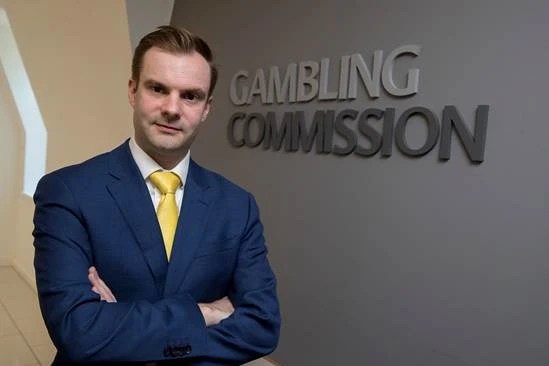
One member of the Gambling Commission’s senior management team – Tim Miller – has been prepared to discuss and acknowledge problems with PHE-OHID; an attitude that contrasts sharply with that of his colleagues.

5. ‘Noble lies’ and consequences?

Underlying the PHE-OHID saga is a sense that some people in positions of authority consider it acceptable to publish inaccurate or misleading statistics if the cause is – in their opinion – just. Some have even suggested that scrutiny of misinformation is unethical, rather than its manufacture. In July this year, the Gambling Commission intends to publish statistics on the prevalence of suicidality amongst gamblers. Given its role in PHE-OHID (in addition to major issues with its new survey), it is questionable why anyone should consider these results credible. It has also – via Gambling Research Exchange Ontario – sponsored a programme of research into wagering and self-harm. Given that these studies have been explicitly grounded in the PHE-OHID deception – and the complicity of many of those involved – suspicions of bias will accompany publication. It is the publication of unreliable research – rather than scrutiny of those statistics – that undermines public trust in authority. Attempts to address health harms in any domain will be ineffective if they are based on inaccurate evidence.

An independent and open review should be carried out into the PHE-OHID deception; but it is difficult to see how this will happen. The Department of Health and Social Care and the Gambling Commission are unlikely to embrace scrutiny; and the DCMS will not wish to embarrass either its regulator or another government department. There are too many people in Parliament and the media who have played a part; and too few prepared to break ranks. The gambling industry meanwhile (with a number of notable exceptions) has shown little inclination to challenge. There is one hope – that the Office for Statistics Regulation will be prepared to take an interest in the integrity of public health estimates. Such an intervention would go somewhere at least towards restoring trust in public bodies.

A Very Public Deception: On the manufacture of mortality statistics in gambling

Part II – Why did public health get things so badly wrong?

n the first in this series of articles, we examined the problems with claims made by state bodies – specifically Public Health England (‘PHE’) and the Office for Health Improvement and Disparities (‘OHID’) that up to 496 deaths by suicide each year in England are associated with ‘problem gambling’. We demonstrated that the basis for these claims is irretrievably flawed. Analysis of the Swedish dataset upon which they rely concluded that “gambling disorder did not appear to be a significant risk factor for the increase in suicide” (Karlsson, 2023). PHE and OHID researchers overlooked critical research findings and clear warnings about the advisability of their approach. While gambling disorder has long been recognised as a risk factor for self-harm, the estimates published by PHE-OHID are categorically unsound.

Read Part One: Lost in Translation?

In this second article in the series, we attempt to understand why PHE and the OHID persisted in following such a clearly problematic approach in the face of strong evidence of its unsuitability; we examine a number of issues of governance; and consider whether officials may have deliberately misled policy-makers and the public.

The Tobacco Road: why did PHE make such unsound claims?

In May 2018, at the conclusion of its review into gaming machines and social responsibility, the British Government’s Department for Culture, Media and Sport asked PHE to “conduct an evidence review of health aspects of gambling-related harm to inform action on prevention and treatment”.  More than three years later, in September 2021, PHE responded with the publication of five reports on the subject. One of these reports (‘The economic and social cost of harms’) claimed annual costs of £1.27bn a year associated with ‘problem gambling’ – with roughly 50% attributable to deaths by suicide.

It was this rather speculative document, rather than PHE’s more robust quantitative review of evidence from NHS Health Surveys, that officials chose to emphasise – prompting Britain’s Gambling Commission to surmise that PHE’s goal was, “to ensure gambling is considered as a public health issue.”

The Gambling Commission had already been given a glimpse of what “a public health issue” would entail. In a draft press release (seen by the Commission), PHE officials called for:

“a public health approach to gambling…similar to how we tackle tobacco consumption or unhealthy food consumption…”.

In the summer of 2022, the PHE researchers (now transferred to OHID) spelt out what this tobacco-style offensive would involve. Their paper, published in the Lancet Public Health, contained 81 measures for state intervention in the gambling market. The list included prohibitions on: all gambling advertising and marketing (including at racecourses); all in-play betting; and the sale of wine, beer and spirits in bingo clubs and casinos. It also included limits on the number of people permitted on a website at any one time, annual tax increases above the rate of inflation and even ‘plain packaging’ for all gambling products (no colours, logos or images permitted on playing cards, gaming machines, National Lottery tickets and so on).

There were other indications that PHE’s endeavours were not entirely objective – or morally neutral. In 2020, for example, its project leader stated that “more research is required to support advocacy and action” against gambling – hardly a statement of impartiality or scientific rigour. Meanwhile, documents made available under the Freedom of Information Act (‘FOIA’) reveal that PHE had agreed to be part of a research group set up by the activist charity, Gambling With Lives (‘GwL’) during the review period – an engagement it failed to disclose within its report.

Thank you for reading CIEO. This post is public so feel free to share it.

Share

Why did OHID publish its report…and did officials mislead?

In January 2023, the Department of Health and Social Care (‘DHSC’) withdrew the PHE report and published an updated set of cost estimates – this time in the range of £1.05bn to £1.77bn a year (underpinned by a choice of 117 or 496 deaths). OHID described the decision to review PHE’s work as “a standard approach for previously published reports ”; but this seems to be untrue. The decision to re-examine the PHE cost estimates alone (none of the other four reports was reviewed – despite the presence of errors) was taken in July 2022 and announced to Parliament shortly afterwards. We have found no evidence that reviewing state agency reports within ten months of publication is a “standard approach” or that any such policy exists.

Disclosures made under FOIA reveal the true reason for review. On 26th July 2022, an unnamed DHSC official circulated a memorandum, stating:

“We are going to need to make changes to two of the evidence review reports as an error has been spotted, and as it’s a change to results, its [sic.] probably what you would classify as a major change.”

Given that the PHE report contained quite a few errors, it is difficult to know which particular mistake prompted re-examination; but the decision was certainly not part of a “standard approach”. This raises the possibility that OHID may have deliberately misrepresented the grounds for review.

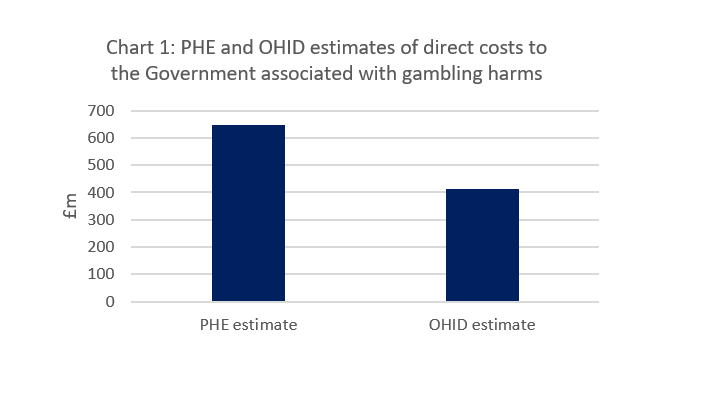
The Gambling Commission and the Advisory Board for Safer Gambling were both told by OHID researchers that “nothing in the report has changed substantially”; but this is incorrect. In fact, every single line item in the OHID cost estimate differed from the PHE version – in some cases substantially. Its estimate of direct costs to the Government was £234.1m lower than PHE’s – a reduction of more than one-third. This was masked by the introduction of a new area of intangible costs, relating to depression and several revisions to the suicide calculation. OHID’s estimates were also based on a ‘harmed population’ 59% smaller than in PHE. As chart 1 (below) shows, the claim that ‘nothing changed substantially’ appears misleading.

In August 2022, the then Health Minister, Maggie Throup MP advised Parliament that the PHE report would be reviewed and that the calculations underpinning its estimates would be published. The review however, has never been made public and – according to disclosures made under FOIA – no such document is held by the DHSC. Contrary to the minister’s pledge, the PHE calculations have still not been released. To do so would reveal a number of errors, such as the fact that PHE’s suicide figure was based on a 21% over-statement of the population prevalence of ‘problem gambling’.

The mystery of the OHID expert panel

OHID was at least prepared to admit – with a heavy dose of understatement – that its estimates were “uncertain”. It relied on a study of hospital patients in Sweden with a clinical diagnosis of gambling disorder (among many other health issues) to estimate the health risks for people in England with no diagnosed mental or physical health conditions whatsoever. In consequence, OHID leaned heavily on the opinion of its expert panel of health economists and academics who, it is claimed, approved the approach.

There are, however two problems where this opinion is concerned. The first is that one member of the expert panel, Dr Henrietta Bowden-Jones of the NHS had publicly criticised the PHE-OHID methodology. At a fringe meeting of the Conservative Party Conference in September 2022, Dr Bowden-Jones stated: “we cannot extrapolate from Swedish studies, from Norwegian studies – it doesn’t work”.

CIEO is a reader-supported publication. To receive new posts and support my work, consider becoming a free or paid subscriber.

Subscribed

The second issue is that the meeting of the expert panel – to discuss the most significant matter in the OHID report – is entirely undocumented. In February 2023, the DHSC admitted that:

“there was no agenda or papers shared before the meeting or minutes circulated afterwards”.

It is difficult to understand how this panel of experts might have been expected to review OHID’s work without access to any documents; and why officials did not consider it necessary to record the panel’s deliberations on this critical point.

Why did public health get things so badly wrong?

Inappropriate behaviour?

The task attempted by PHE-OHID was always going to be challenging, given the dearth of actual data available. This does not explain or excuse the large number of errors and omissions made by researchers and officials:

  • PHE and OHID ignored warnings by Karlsson & Håkansson about the representativeness of the sample in the 2018 Swedish study (upon which they relied);
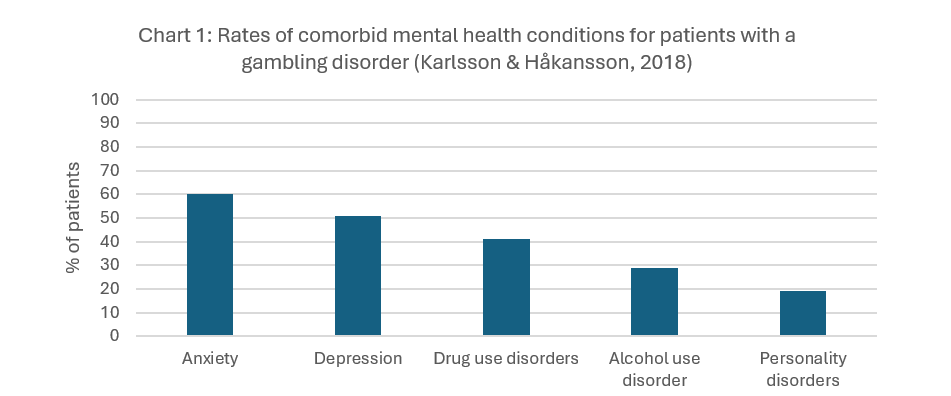
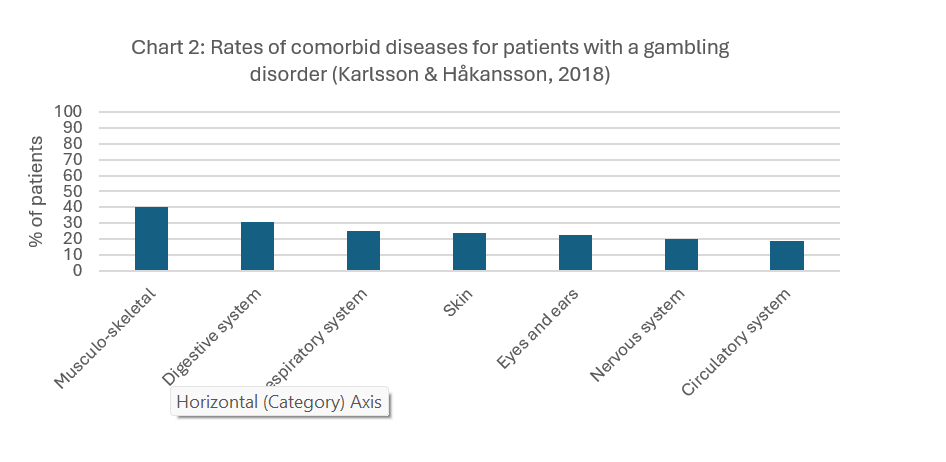
  • PHE and OHID ignored findings in the 2018 study of high rates of mental and physical health comorbidities.
  • PHE and OHID ignored the follow-up study by the Swedish researchers (Håkansson & Karlsson, 2020), which found that risk of suicide attempt was significantly mediated by the presence of other disorders.
  • PHE and OHID ignored the opinion of Dr Anna van der Gaag, chair of the Gambling Commission’s Advisory Board for Safer Gambling, that the PHE calculation was likely to be inaccurate.

A large number of issues with the PHE-OHID reports were brought to the attention of its Director-General, Jonathan Marron in July 2022 and again in September 2023. On both occasions, Mr Marron promised to investigate. Last year, he wrote that he would provide “a proper explanation” for the errors and methodological flaws; but more than seven months later, none has been forthcoming. In what may well be a breach of the Civil Service Code, OHID officials resorted to ad hominem disparagement of their critics – including one national news media outlet – rather than engage constructively.

What is particularly disturbing about the PHE-OHID scandal is not the fact that researchers (presented with an unenviable task) made so many mistakes; but that state officials proved so unwilling to confront them – responding with hostility to legitimate scrutiny.

Next week, in our third article, we will consider the behaviour of others in positions of political or moral authority who variously connived in the deception or turned a blind eye to it. We will reflect on what this means for their future involvement in research and policy-making.

Dan Waugh

May 17th 2024

Regulus Partners

A Very Public Deception: On the manufacture of mortality statistics in gamblingA study of suicides in gambling, are we being told the truth? Part 1

Public Health England was closed down because it was incompetent and was too easily distracted by lifestyle issues when it should have been focusing on public health. It was more of an in-house lobby group than a serious scientific agency. It seems that closing it down and re-opening it under a new name (OHID) with the same staff was not enough to make the leopard change its spots.

Dan Waugh- Regulus Partners

In recent years, the claim that up to 496 deaths a year in England are associated with problem gambling has become a staple of the debate on gambling market reform. The estimates originate from a 2023 report by the British Government’s Office for Health Improvement and Disparities (‘OHID’) and have been used to support demands for a wide range of additional controls on consumers and the market. There is just one problem – they are based on junk science.

While it has long been recognised that people with gambling disorder are at elevated risk of self-harm, the specific estimates produced by OHID – accepted uncritically by many in Parliament and the news media – rely on a number of ‘flat-Earth’ assumptions.

In this series of articles, we examine the methods used (and errors made) in calculating these figures and consider the conduct of those who have propagated them. In this, the first article, we demonstrate why the OHID estimates are unsound. In subsequent weeks we will describe the behaviour of the public health officials responsible for their manufacture; consider the actions of other notionally responsible bodies; and ask what public benefit is served by the generation of spurious statistics.

The first state-sponsored estimate of gambling-related suicides in Britain appeared in September 2021 with the release of Public Health England’s (‘PHE’) report, ‘Gambling-related harms evidence review: the economic and social cost of harms’. It contended that, in England, 409 suicides a year were “associated with problem gambling only”. In January 2023, the PHE report was replaced (due to identification of errors) by an update from OHID. It offered a choice of either 117 or 496 suicides “associated with problem gambling”.

Both the PHE and OHID estimates were based on a 2018 study of the medical records of patients treated in Swedish hospitals between 2006 and 2016. Dr Anna Karlsson and Professor Anders Håkansson from Lund University found that patients in the dataset with a clinical diagnosis of ICD-10 ‘pathological gambling’ (renamed gambling disorder in the ICD-11) were on average, 15.1 times more likely to die by suicide compared with the general population. PHE applied suicide mortality ratios from this study to NHS Health Survey estimates of the prevalence of PGSI ‘problem gambling’ in England to produce a figure of 409 deaths a year.

In 2023, OHID repeated the exercise, using precisely the same information, and produced figures of either 117 or 496 deaths (the lower figure based on the application of the Swedish mortality ratios to the population prevalence of DSM-IV ‘pathological gambling’). In doing so they ignored critical information and clear warnings that their methods were unsound. The hospital patients whose records were analysed in the ‘Swedish study’ suffered from a wide range of diagnosed mental and physical health conditions (see charts 1 and 2, below). As a group, they were at elevated risk of self-harm, regardless of the presence or absence of gambling disorder. PHE-OHID thought otherwise – assuming that  health risks for hospital patients in Sweden with a wide range of illnesses were the same as for people in England with no diagnosed health disorders whatsoever. In other words, they made the ‘flat-Earth’ assumption that there is no association between mental and physical ill-health and risk of suicide.

In making this assumption, PHE and OHID ignored a clear warning from Karlsson & Håkansson. Their paper advised that the hospital patients whose records they had studied were likely to suffer from particularly severe and complex disorders:

“It is therefore likely that results may be skewed toward a population of individuals with more severe forms of GD [gambling disorder]. It is likely that this once again implies that this study sample might contain patients with higher mental health comorbidity, as well as individuals with more severe forms of GD, since these individuals are more likely to receive specialized psychiatry care”.

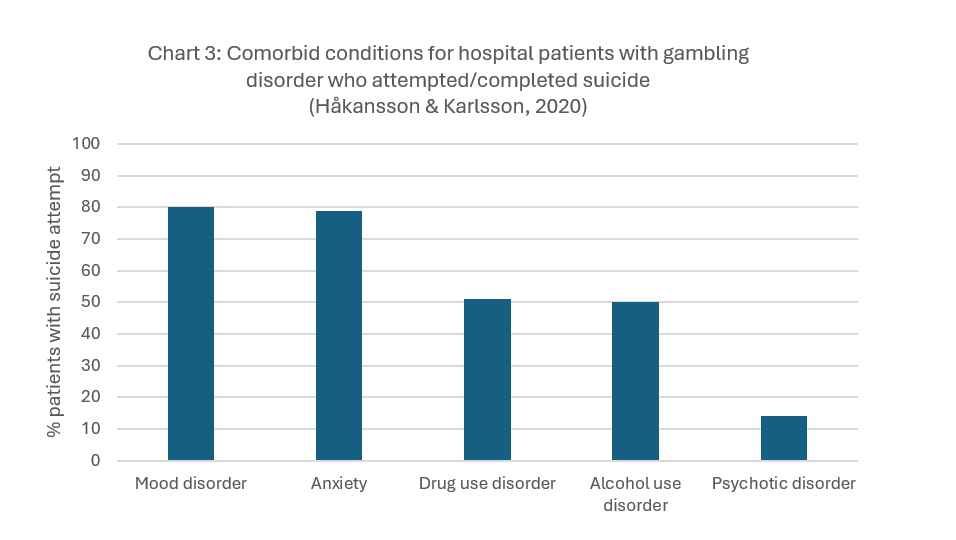
The PHE-OHID researchers also ignored findings from the follow-up to this study (the second in a series of five undertaken by the researchers from Lund University). Håkansson & Karlsson (2020) showed that comorbid health conditions were even higher within the group of patients who had attempted or completed suicide (see chart 3).

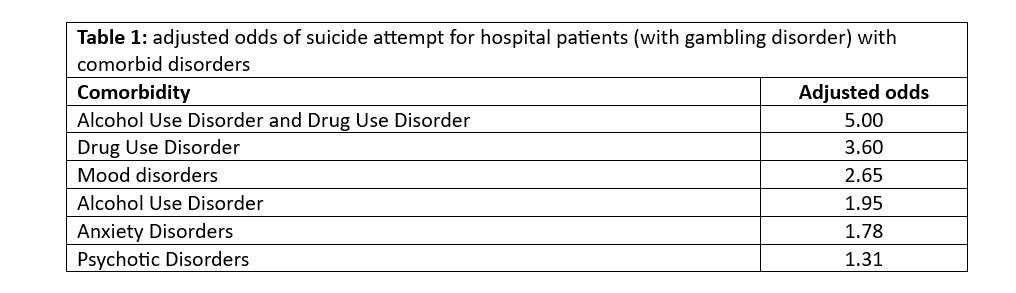
Professor Håkansson and Dr Karlsson showed that risk of suicide attempt was five times higher for patients with gambling disorder if they also had diagnoses of alcohol use disorder and drug use disorder. Of those patients who had made a suicide attempt, 70% had a diagnosis of alcohol use disorder or drug use disorder or both. The researchers at Lund University provided a range of adjusted odds ratios based on the presence of other diagnosed mental health conditions (see table 1). This study – which was published ten months prior to the PHE report – indicated that suicide risk for patients with gambling disorder was halved where no alcohol use or drug use disorders were diagnosed. Even before adjusting for other risk factors, these findings clearly demonstrated the inappropriateness of PHE’s approach.

A third study assessed the effect of socioeconomic factors on risk of suicide attempt. In the fourth study, a control group was used to identify discrete risks associated with gambling disorder. It concluded that:

“gambling disorder did not appear to be a significant risk factor for the increase in suicide and general mortality when controlling for previously known risk factors”.

This finding creates a dilemma for OHID and those who have propagated its claims. If one believes that analysis of the Swedish National Patient register by Karlsson & Håkansson provides a reliable basis for assessing suicide risk in England, then one must conclude that – contrary to PHE-OHID assertions – gambling disorder is not “a significant risk factor”. If on the other hand, one does not believe this is a suitable approach, then the PHE-OHID claims also cannot stand because they rely entirely on the mortality ratios from the first of the Swedish studies.

The fact that PHE and OHID got things wrong does not mean that underlying concerns about gambling disorder and self-harm are misplaced – or that gambling operators, treatment providers and policy-makers should ignore the issue. It has long been recognised that people with the disorder are at elevated risk of suicide, even if the precise nature of the relationship is complex. A number of recent inquests in England have determined that excessive gambling contributed to loss of life. Operators should do more to promote positive mental health and to address risk of self-harm among their customers and employees – whether gambling is involved or not. The PHE-OHID claims are, however, irretrievably flawed and should be disregarded by policy-makers. There is simply no coherent logic that allows them to stand.

In next week’s article, we will consider why PHE-OHID produced such obviously flawed findings and examine potentially serious issues of governance attending their publication.

List of abbreviations

DSM-III: The third edition of the American Psychiatric Association’s Diagnostic and Statistical Manual of Mental Health Disorders.

DSM-IV: A screening questionnaire published by the American Psychiatric Association within the fourth edition of its Diagnostic and Statistical Manual of Mental Health Disorders

OHID: the Office for Health Improvement and Disparities. Part of the Department of Health and Social Care.

PGSI: The Problem Gambling Severity Index. A screening instrument developed by Ferris & Wynne (2001).

PHE: Public Health England. A state agency, reporting to the Department of Health and Social Care. It was disbanded in 2021.

Dan Waugh is a partner at the global strategic sports and leisure advisory firm, Regulus Partners.

Sample Bias – the new normal

 
Great Britain: Regulation – Is the Great British Gambling Debate heading for a Terminal solution?


Last week’s House of Lords debate on gambling advertising was in many respects the same tired old combination of mistruths and moral indignation; but it was notable for providing a glimpse into the next phase of gambling policy discourse in Britain. Lord Foster of Bath, who instigated the short debate told the House that:
 
“I suspect public concern is about to rise because, in July, the Gambling Commission will release new figures about gambling harm. The Gambling Minister in the other place has already indicated that they are likely to show that 1.3 million people will classify as ‘problem gamblers’ and that a further 6 million are at risk. If confirmed, these figures are far higher than those used to inform the Government’s work on their White Paper. This is a real cause for concern, further strengthening the call for action.”


The intent could not be clearer. If the publication of the Gambling Survey for Great Britain (‘GSGB’) in July reveals a markedly higher rate of ‘problem gambling’ than the estimates relied upon by the Government in its White Paper, then the wisdom of the policies contained therein will be open to question. Lord Foster’s point is a fair one. In its White Paper, the Government relied on the 2018 Health Survey for England, which reported a ‘problem gambling’ prevalence rate of 0.38%; and the current Official Statistic (from the HSE 2021) is 0.25%. The Final Experimental Stage of the GSGB reported a figure of 2.5% – between six and ten times higher than the HSE. If the Government and regulator are confident that results obtained from the GSGB are reliable, concern groups will justifiably ask for a re-run of certain policy decisions (and possibly even Judicial Review, given the litigious bent of some activists).
 
The problem is, of course, that the Gambling Commission does not appear to be at all confident that results obtained from the GSGB will be reliable. Each of the new survey’s iterations – from the Pilot Survey in 2022 to the Experimental Stages in 2023 to Wave 1 of the official survey in 2024 – has revealed signs of sample bias. In an independent review (‘independently’ funded by the Gambling Commission), Professor Patick Sturgis of the London School of Economics, commented on the “non-negligible risk” that the GSGB would “substantially over-state the true level of gambling and gambling harm in the population”. He also urged caution, warning that “until there is a better understanding of the errors affecting the new survey’s estimates of the prevalence of gambling and gambling harm, policy-makers must treat them with due caution.” Such advice appears lost on the Commission (which prefers to gloss over inconvenient opinions). In addition to rates of ‘problem’ and ‘at risk’ gambling’, it plans to release survey findings in respect of suicidality, violence and abuse, mental ill-health and use of food banks – in the knowledge that the figures may very well be incorrect and misleading. Just when the Department for Culture, Media and Sport might have thought it was nearing the end of a long and tortuous journey on gambling reform, the Commission is throwing down new track.


The threat to the licensed betting and gaming market in Great Britain is severe. The public health establishment (including senior figures within the Department for Health and Social Care) has signalled its intention to “tackle gambling” (all gambling and not just harmful gambling) in the same way that it has dealt with tobacco smoking. Demands for total bans on advertising (including at racecourses), the sale of beer and wine in bingo clubs and casinos and the imposition of ‘plain packaging’ for all gambling products (no colours, logos or images – farewell Queen of Hearts), will intensify. In Scotland, it is reported that the SNP plans to raise the legal age of gambling if it achieves independence (presumably with a carve out for anti-gambling vitriol in its Hate Speech legislation) but this is only a stop along the route rather than a final destination. It is far from obvious however, that the industry realises the perilous nature of its current position. Tone-deaf advertising on bus stops and at railway stations only strengthens the ground for those seeking a terminal solution.

Racing and the whip

mark souster

Mark Souster

 
The debate about the whip, especially in jumps racing, is one of the  most important issues the sport has to confront. For some it is an existential threat. It has pitched traditionalists against reformers, heretics against the believers.
The focus on equine welfare and all that that entails – with fatalities high up the list too – will be on the Cheltenham Festival next week like never before. The scrutiny will be intense.

whip3
Remember it was two years ago that six horses died at the Festival, three in the Grand Annual. The images of tired horses being whacked in the four mile amateur’s race run on soft ground and when only four finished triggered an outcry.
Paul and Clare Rooney who are among the sport’s biggest British owners, then announced they would boycott Cheltenham – albeit only temporarily as it turned out – on welfare grounds.
It led to a review and a marked shift change in public perception which racing is only now starting to come to terms with.
At the prompting of government responsibility for its ultimate resolution has been taken out of the hands of the BHA, and falls to a new independent Horse Welfare Board compromising experts as well as laymen and women.

bha
Its first report landed last month.  It is clear as day that stronger penalties for misuse of the whip appear to be a certainty by the autumn. “The overall number of offences (over 500 in 2018) remains unnecessarily high and the current penalties do not provide an adequate deterrent effect,” the board concluded.
In its wake, the BHA has announced a three-month consultation with racing insiders and the public on changes to the whip rules, with a view to deciding on and implementing changes by the end of October.
The number of whip offences fell to an all-time low of 410 last year, less than half the number from 2011. However, the board pointed to concern on the subject from the public and politicians.
It said racing had to demonstrate “a proactive, positive direction of travel in relation to the whip, taking steps to eliminate misuse and leading any discussions around the future removal of the whip for encouragement”.
Far deeper questions are also being raised. Should that consultation include questions about whether a horse should be disqualified when its rider breaks the whip rules and also whether the whip should be banned as a means of encouraging horses in races?
Could punishments for whip misuse even be extended to the trainer and owner who had employed a jockey found to be in breach?

whip1
Barry Johnson, a former president of the Royal College of Veterinary Surgeons is the chair of the HWB. “This is a matter of public trust.”
The prevailing thought seems to be that racing needs to address these issues and be accountable if society is to continue to give them a ‘social license to operate.’ Well that is taking it too far.
Racing maybe facing a King Canute moment where the end result is the sport being swamped in a tide of public indignation.
But it needs to draw breath and compose itself and come out with persuasive and reasoned responses. Emotion must not be allowed to replace hard fact and cold analysis. For instance when presented with the evidence from the BHA the Rooneys changed their minds and good on them.

rooneys
We need to get to the core of fundamental questions: Why do we use the whip – for safety encouragement, or an element of both? Where and when did it start being used? Does it instigate a fight or flight reflex? Does it inflict pain?
If it doesn’t, as most contend, then it’s not cruel then why shouldn’t we continue to use it?  And why call it the whip which has such negative violent connotations?
Perhaps a controlled experiment and research would help. If a horse responds to the whip, is it because it focuses them? Does it make them try harder? Or simply stop?
Would we be better off without the whip, so we have lots of hands and heels riding, and maybe carry the whip only for safety?

whip2
Do horses go faster with the whip? If not then why do we use them?  Especially as it’s always at the end of a race when they are all going slower because they are tired.
As one expert put it to me: “I’m sure if you had hit Seb Coe towards the end of a race he probably wouldn’t have been able to go any faster.”
So many questions and as yet too few answers.

Mark Souster


Mark Souster has been the racing writer at The Times since 2016. Before that he was rugby correspondent. In that role he was named sports journalist of the year by the Society of Editors and won sports scoop of the year for his revelations about England’s 2011 World Cup campaign. He has twice been nominated for sports news correspondent of the year.

A bet to win £100 Sir?

‘When I was younger, I worked in my family’s betting shop in Yorkshire, and we never turned a bet down. ‘ Philip Davies MP.

‘Skybet undertake to lay to lose its customers, on Racing, £100. Richard Flint CEO of Skybet

skybet

In the intervening period since Davies ran his family’s little LBO, things have changed dramatically in the world of bookmaking. Little bookmakers, the likes that Davies describes, are dying out, in favour of supermarket style betting companies like Skybet.

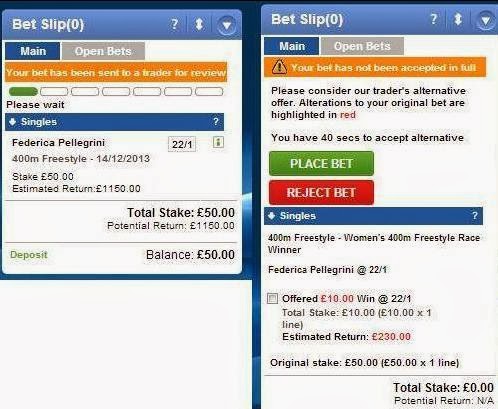
And they’ve stopped taking bets. They provide no reasons for these failures. They answer no questions on the matter.

As things have stood for a few years now, regulators, advertising standards, trading standards and MP’s have stood by and watched large betting corporations advertise products without mandating them to offer the same to all of their customers. I’m no consumer lawyer here, but it seems these companies are breaching several codes, not to mention basic consumer rights.

The Gaming Committee in Parliament has taken an important first step here. What I’ve always found hard to understand is the lack of activity amongst regulators to bring firms fully to account. Consumers have rights.

Richard Flint’s speech revolved, of course, on the rights of the company, in his view, to deliver profits for its shareholders. The rights of consumers, no, wait a minute his own customers were not considered. He is perfectly aware of the PR ills afflicting modern day business, but such matters are usually brushed over by Richard Keys adverts.

Of course, the views of Richard Flint were taken by Racing Post editor Bruce Millington who spoke with some passion to describe all nefarious means punters utilise to get a bet on, and even run business off of bookmakers, without beginning to understand why that was taking place. Nor that such behaviour can be readily controlled by online operators should they wish to. He discussed line trackers, arbers, bonus hunters, value burglars. All the bad things some punters are supposed to be up to these days. His sympathies very obviously lie with big betting as at no stage did he criticise Flint for their modus operandi, nor did he offer any workable solution as Rowlands did for the HBF.

The Racing Post is an active partner in such companies, the very future of his paper and jobs sold to companies that include Skybet. Bruce is, by extension, an employee. I found his participation odd, I mean what did the gaming committee expect to hear from the Racing Post editor? Certainly not a robust defense of consumer rights but I suppose most representatives of big betting declined to appear and explain themselves. The Racing Post has never to my knowledge ran any article openly criticizing its partners. It might ‘report’ on fines or the like, but comment? Certainly not as it has proffered headlines like the image shared below, sensationalising (errantly) the activities of on course bookmakers who do not sponsor the paper.

post

Bruce did clearly say a ‘lay to lose’ minimum was something he felt would not work, but he’s totally wrong. It works extremely well in Australia. The eradication of nefarious activity in that state and a fairer betting platform either escapes his intellect or offends his commercial sense. A lay to lose minimum certainly can benefit operators, forcing them to bet to a margin where everyone is granted a wager, as they are entitled to.

press

What Bruce should be screaming is why on earth everyone (but him) isn’t being afforded a bet. It is right that newspapers are seen to champion the rights of consumers. This is why I’d suggest he is so universally unpopular. A role he seems to embrace.

On the very day he was speaking ‘on behalf’ of punters, he sanctioned the first three pages in his paper in support of FOBT’s. It’s simply indefensible, little wonder the circulation is so low. Where is his respect for the many complaints directed at the trade paper, from his readers, for its defence of betting when they behave so poorly? The hypocrisy of this editor stinks.

Ok, so why ‘restrict’ anyone. If you’ve decided someone is no good – why risk the embarrassment of being a multi million pound company and laying a bet of £1? Surely you just close the account and move on?

No NO NO!

Let’s examine Skybet. Bought for circa 800 million a few years back by CVC. Business ‘grows’ in customers. It ‘Claims’ a half a million more this year to 2 million. It doesn’t release profit figures. In ‘growing’ the business CVC now plan to float the same at a proposed value of 2.4bn. Some rate of ‘growth’ that, – a fanciful figure! But you do the maths. If they even get close to that valuation for its owners, it dwarves doing a few million in because you laid ten places in the Grand National, or offer Best odds against everyone on a Saturday. So even if you do lose a few million ‘gaining weight’ the city loves you.

Conclusion? All you mugs are double mugs for opening up accounts with them, only to be treated like dirt because you’re good at punting and then permit them to keep your account ‘active.’

So you get it? It’s not about the win or loose, it’s the total number. Hence Bet365 ‘claim’ 22 million customers. The level of restrictions, given how close to the bone, even overbroke every Saturday on racing, they choose to bet. They ‘add’ value to the company.

This isn’t what Richard Flint covered, he knows you’re too dumb to figure this one out. He knows no matter how he treats you, you’ll sign up like soldiers if he offers ten places in the US Masters. You’re not very bright – are you? In fact I’d conclude so many who complain to me about restrictions are as dopey as sheep. Why should I care if your moral sensibilities end at their next offer?

How many of those treated so badly, sign up to my firm? Even if we’re just as competitive and lay every one of our customers a wager online to win at least £1000, I hear people say ‘I don’t like the colour of your website’ or ‘you don’t do cashout.’ So we treat punters with respect (punters-not traders btw) – we don’t do cashout, the highest value product to a bookmaker, we rebate a little to our customers every week and we don’t do gaming. We’re precisely what the smart individual should be about, being rewarded for their loyalty and growing old together. I’m a traditional bookmaker and very proud of it. I thoroughly disapprove of these gaming giants and everything they stand for. So should you, make a stand today and sign up to us.

10ck

Richard Flint I found engaging, smart and non-confrontational. A decent sort, and at least brave enough to answer his critics. However, his company, and its peers, do bombard our children with adverts, exacerbate a problem gambling culture, allow people to fund their accounts with credit cards, and leads with slogans like ‘it matters more when there’s money on it.’  An odd campaign for a company more famous for what it does not lay, than what it does. Much of what they do offends a traditional layer like myself. I’ve only ever known laying bets, but they force me to compete on prices they choose often not to lay.

I do applaud this first step from Davies and his committee and the work of the punters forum. I note they haven’t had the courtesy of a response from many companies, that doesn’t surprise me.

Lord Lipsey had it right. He warned operators that to ignore the concerns of Parliament into their behaviour, or even to simply fail to engage with customers and regulators is a dangerous move for the companies. He also made the very valid point that for firms to advertise a price for something, yet not to lay that price, is an issue for advertising standards, of which he has considerable expertise. His view the ASA would likely rule against such operators for their failures to lay what they peddle. So why haven’t punters done precisely that?

asa

Apathy. Punters love a moan, but most are simply too damn lazy or feckless to do anything about it. They whine about Bet365 not laying them a bet, but meekly sign up to their next offer. Donald Trump was elected despite offending the sensibilities of women, Mexicans, immigrants.  People howl, then line up to sign on.

The bottom line, what it all comes down to, in betting, is PRICE. That’s the sole determinant of whether you lay a bet or perhaps not. And naturally how much you lay. Since so many offers are so very unsustainable in commercial terms, yet attractive in new customers.

If I look at a sea of punters in front of me at Cheltenham, I don’t think of who is undesirable or not. We simply don’t restrict bets on course since we run a book based purely on the odds. Indeed, the smallest fiddler on the racetrack would comfortably lay a bet to lose £105 to everyone. Something Skybet will not.

When on course bookmakers were mandated to respect each way standard place terms, they adapted. And so can big betting to any ‘lay to lose’ minimum.

Would some punters lose out? No, but traders would. Those currently utilising bookmakers to facilitate a business. Casual punters are not as obsessed by price as you’d imagine. They just want a bet and I have every sympathy with their complaints.

So a business based on PRICE and not MARKET SHARE would accommodate all of its customers. Isn’t that right Richard?

My point to the committee involved the UK Gambling Commission. They collect essential data from online operators for every quarter. Number of self-exclusions, cooling off, age and sex of new customers is all collated. Lots of interesting material on the demographics of the UK gambling sector. But they currently do not require operators to provide data on how many they close, how many they restrict. They seem afraid to tackle the subject. Why? Surely Parliament and the DCMS must be provided with this information, if they are to have an accurate picture of the sheer scale of the problem.

There’s a clear problem. They are responsible for fair play. Make it your business to find out what’s going on. That’s how you justify your wages lads.

Richard Flint claimed they only restrict 2% of their customers. I’m not sure if he was discussing ten pin bowling, but with my online experience, I’d say that figure was fanciful. In the absence of data who can accurately dispute anything he says?

How do restrictions work? You’d be human to imagine such impressive companies have the very latest tools and analysis, not to mention teams of staffers working on the problem. In fact, it’s depressingly low tech. Broadly based on rather simple software tools working at the point of sale. Bookmaker price vs exchange price. Yes, I did say exchange, the two-bit penny arcade that runs the show.

restrict

Traders for such companies aren’t career bookmakers blooded at Ludlow over twenty years in the rain laying bets and understanding margins. They’re young, impressionable and often ill trained student types, trained to follow Betfair. Many of these traders I’ve met in interview, and their lack of depth and understanding into how punters think and behave is startling.

The truth is Denise Coates of 365 doesn’t engage with customers, – other than via Ray Winstone. They don’t answer questions, offer views, defend or trumpet the business. She’s not alone. William Hill, Betway, Betbright and Betfair have nothing to say on restrictions. They simply refuse to comment. They’re too ashamed to engage.

I’m in the online marketplace. I thoroughly support a lay to lose and it should be £1000 a bet for my customers. That’s what it is, with almost no exception. Yes, we close the traders down or stop them taking prices, but that’s only after personal and detailed analysis of their actions, and only when we conclusively feel they’re operating business off of our backs. And then we tell them exactly why we’re doing what we do.

For those of you thinking of challenging me on why I don’t just lay everybody right now every bet? Well quite simply I’m forced to compete with companies like Bet365 and their restriction culture or put the key in the door. So, patience is what I ask, until government mandates they offer a fair bet to all – I’m manacled to their policies. I do better than any of them in laying a bet to all my customers though. I’ve noticed barely a single restriction in my business in any wager to win at least £1000 in my business in the last month. We’re reacting.

What I support is a culture based on price and respect for all customers. I don’t agree with Simon Clare of ‘never a quarrel Coral’ when he says, ‘some need to be controlled.’ I believe it’s up to the operators to operate a fair platform of betting for all, to an acceptable lay to lose. £1000 is not a gigantic sum for companies turning over billions a year. Any argument against that level I’d challenge in any debate, bring on a straight debate. We operate to that level right now, don’t tell me Skybet, Betfair or Coral cannot match my offer.


Good luck getting a bet with them.


https://www.racingpost.com/news/news/are-bookmakers-unfairly-closing-customer-accounts-views-from-tuesday-s-debate/316874?utm_source=Twitter&utm_medium=Social&utm_campaign=Wednesday%20News&utm_content=Speeches

Racing Post link to speeches given to the panel

bog


Unibet’s favourite ambassador

There’s a dangerous saying in Racing. ‘How dare you question me?’ One could introduce  perhaps ‘I am beyond reproach.’

unibet2

But Nicky, you’re not beyond reproach, for a second. In fact it does appear to coin another well turned phrase, ‘he doth protesteth too much’

Whilst I personally find Nicky,  a most amiable sort, and of appreciable talent, there are two things which he has to take fully on board. One, racing fans don’t have reason to appreciate nor like the commercial stance you are adopting in relationships with Bookmakers. And second, you have to accept that the behaviour of those who work in your yard, or how information is utilised, will be the target for speculation, for as long as you maintain horses are in great order, only to withdraw them a couple of days later.

The ‘some journalists are dead meat’ comment, is unprofessional, and unjustified. Frankly it’s a dangerous precedent, from a yard that so dominates the sport. Journalists have an important role to fulfil, and it’s not to kiss people’s backsides. Fine, we all accept Racing press notoriety not for hard headed sports journalism, rather a deserved reputation for the supine. Printing the rubbish peddled by top trainers as gospel has long since reached epidemic proportion.

See this interview with Matt Chapman from ITV’s feed in which he denies there was a problem with Altior on the Saturday before the Tingle, and maintains there was ‘no issue’

https://www.google.co.uk/url?sa=t&rct=j&q=&esrc=s&source=web&cd=2&cad=rja&uact=8&ved=0ahUKEwjn1YjumaXYAhXpCsAKHX7WAJ0QFggwMAE&url=https%3A%2F%2Fwww.itv.com%2Fracing%2Farchive-clips%2Fmatt-chapman-speaks-to-nicky-henderson-about-the-altior-controversy&usg=AOvVaw1OlX8-6oTcPV6qZcU03oJu

And here is Nick’s Unibet version which maintains there WAS an issue with ALtior’s breathing the Saturday before

https://t.co/4dfZFYlzfq


I don’t know about you, but I’m struggling to understand which version I am to believe?


To deal with each point. One, the practice of association with Betting companies is an abhorrent development, something Henderson should be fully aware is deeply unpopular. Let me remind people how companies such as Ladbrokes utilise information to their advantage, gained from accounts they operate,  as in the David Evans- Rule 4 saga. Anyone that imagines these betting behemoths behave with impeccably good manners when it comes to money must be living in some form of fantasy world. None of them behave well. In fact there’s compelling daily evidence to show how low they have stooped as companies in their pursuit of accounts and money. They’re bound to use associations with top trainers to their commercial advantage, and to penalize their customers therefore. And Nicky knows this, hence his exaggerated indignation at Cheltenham.  Unibet have no reason to release your ‘information’ promptly. They are not a news service.

Punters simply think they are being cheated, whether that’s true or not, such association used to be outlawed, for very good reason. The BHA haven’t supplied any rationale for this decision, and don’t expect a docile Gambling Commission to do anything about it either.

To boot Unibet have ensured the very latest flow of information from Seven Barrows, via their association with your stable Jockey, Nico De Boinville. Couldn’t get any more insidious.

unibet1

Henderson simply shouldn’t be releasing information via any medium other than the stable’s own twitter feed, or perhaps via the racing press feed. Good news, or bad news. A Bookmaker is simply not the right vessel.

altior

As a bookmaker, we were aware of very significant monies for Fox Norton, for the Tingle Creek in the day PRIOR to the withdrawal of the mighty Altior. And we were not alone as the news was all over Twitter. Betfair exchange and other bookmakers reported the same pattern of monies. Fine, Hendo may not have personally made a final decision as to the participation, but others quite clearly had leaked their doubts to their associates, as to the participation of Altior. The fact remains, some people generously helped themselves before the information was released, and they were proven correct. Who was leaking this information, or were they all better informed than Henderson himself? You were after saying the horse was in ‘magnificent order.’

One concludes either Henderson doesn’t know the well being of his horses, he’s waiting on the strength of the opposition to show their hands, or someone else in his organisation knows his charges better than he does.

Perhaps it could be the myopic focus on the Cheltenham Festival. A subject which concerns many racing fans, excepting the regulator itself. The Tingle, Fighting Fifth and many more top races decimated. The BHA far too slow to establish minimum conditions of entry for the Festival. Something they’re told by the likes of Henderson ‘isn’t possible.’

It is. Yesterday I heard the NFL, the world’s best sporting body, totally re-jig it’s schedule next week, to put all potential playoff games on at the same time. Doubtless upsetting giant TV networks. That’s how to run sport. Act

The truth is – Altior will be another one of those top stars who turn up in March, having not experienced a real race (of his class) in the six month lead up to Cheltenham.

The pigs ended up in the betting trough, and people are fully entitled to know why, since they are investing in the sport.

Associations with big betting companies by jockeys and stables has to be ended by this BHA. There’s no sensible regulatory reason for such deals, other than to upset the very people who funded the sport to the tune of 52 million last year.

Remember, Mr Rust, the only people to benefit from those deals are the best of trainers and jockeys. The little guys rarely share in such windfalls, and if it in any way has the whiff of impropriety,-  it has to be outlawed.

unibet3

Finally, I would add that Henderson’s ‘how dare you’ approach, as a top trainer needs to be roundly condemned, in all quarters. This arrogant approach, that if you dare question anything I do, in the manner so common in other sports, is damaging to the good governance of racing. nobody should be above fair interview. Tell me why Nicky Henderson thinks he only deserves good press?

It wasn’t so long ago Nicky, that you were handed the softest ban in living memory for doctoring records, to conceal guilt, and administering banned substances to your horse. I don’t doubt the shame of reporting in those days leaves a hurtful stain in your memory, but you have to accept that those journalists, then and now, are simply, and fairly, doing their job. You broke the rules, knowingly, and with appropriate disregard for the rules. It’s more than a bit rich to claim the moral high ground over your associations with betting companies, especially if you don’t bet with Unibet. I expect most people get their racing news from the Racing Post, or the Guardian. Aren’t these more appropriate mediums?

So Nicky, accept the brickbats as they come, because you most definitely benefit from a veritable avalanche of good press when your horses do well.

I suppose I’m dead..


Aidan O Brien. A dose of reality.

Roll up for your Ladbrokes sponsored, 18 page Aidan O Brien pullout, in tomorrow’s Racing Post.

aidan2
Look, I get everyone likes a winner. And I understand the often unpleasant comments some folk make when you dare to criticise certain Irish horse racing personalities. I mean if you followed and backed Aidan’s group one runners you’d be in clover with 26 wins in Group ones this season. And sure we know he’s a nice guy and a hard worker. I’m not crabbing him for that.

But.. check this list out

8

Oops. On the very week everyone is slapping Coolmore on the back, we hear Churchill (3yo) Caravaggio (a baby) and Highland Reel (grand old timer at 5) retired to further the personal worth of those involved.

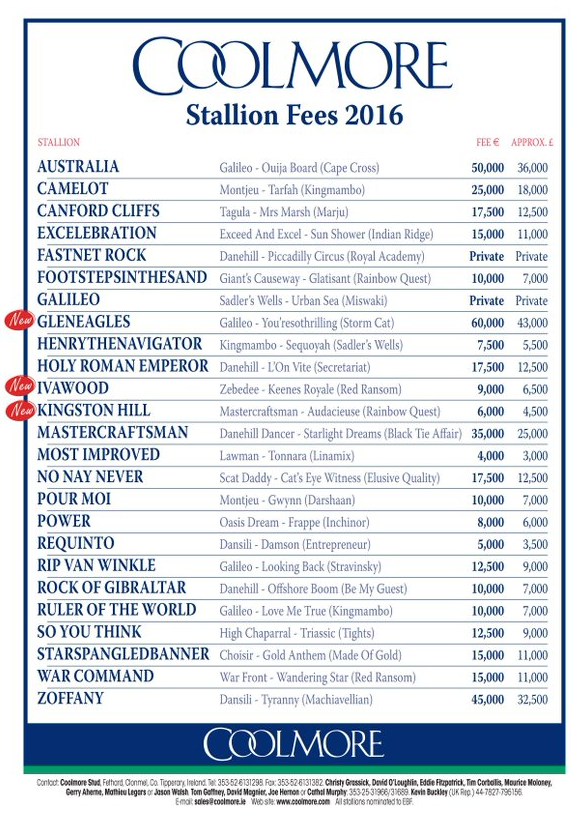
Check out some of last  year’s entrants, rather departures. Australia, Camelot, The Gurkha. All available at attractive stud fees, and oh yes, I know everyone swallows the excuses peddled for their departure. spots on their noses, heat, a really nasty rash.

An effective and successful cash cow, not always the heroic outfit elements of the press feel bounden to peddle. Of course I know they’re about their jobs, who wouldn’t, but let’s the rest of us keep our feet planted firmly in the mud.

What I simply don’t understand is the lack of balance in reporting on an organisation like Coolmore. All that power in one organisation? They can, and frequently do have sufficient top of the line stock to field between 3 and 5 runners in every Group 1. Why is everyone so surprised at their success? Many of the Irish group races may as well be run in Ballydoyle. Rarely more than a token Godolphin participant.
O Brien plunders the Group one market in England because he can, because he has the tools, because there are frankly too many Group 1’s. He threw in 6 participants in the Derby, and his ‘outsider’ won. How many trainers can send six realistic chances into the blue riband event? Five sired by the outstanding Galileo. That’s 5. A success pattern that’s gone on for as long as Galileo’s started outputting the very cream of racing bloodstock. Galileo is Coolmore. And before Galileo was Saddlers Wells and a reputed three hundred and fifty MILLION in stud fees.

Galileo-conformation-resized2

Other than stoic politeness, keeping them quiet, I’m sure those considering investing in a horse with the potential to compete at racing’s top table are far from impressed at the stud fees, or purchase prices they’re being forced to shoulder in Coolmore world. NOT reported so freely, that.

It’s arguable the likes of Clive Cox wiped the floor in training terms this year, buying horses cheaply and producing the goods. AOB simply cannot fail with the stock. Of course that comment is bound to ruffle a few feathers who’ll declare it’s always possible to lose, but please, get a grip of yerselves, he had three in the Chester vase to escort Venice Beach home. Oh and one from his son. There were 8 runners.

Fail? He’d have to be a complete fool

churchill
And yes, he has a stable jockey who is pound for pound ten clear of his peers. The quite outstanding Ryan Moore. We can add Moore to Galileo. How many trainers get that?
Let’s tally it up so far. Galileo, Moore and 350 million head start. Not too bad.

.
It is, quite simply, a massive imbalance in power. It’s a fact. An obvious fact. We surely don’t need to state the obvious do we? Well, I feel we do, because all I’ve read for years is how amazing Coolmore are. To my mind though, they’re Real Madrid, Man Utd, Juventus and PSG rolled into one outfit. Squaring up to them are the biggest underperformers in the sport. Godolphin. And I remain a Sheikh Mohammed fan resolutely. But his staff have not turned up.

.
So yes, Aidan is indeed humble, because he’s no fool and to trumpet such evident success with said material would be obscene. And I like his attitude immensely, he lacks the patronising snobbery of some in racing, but no bother, I’m not about to sit back and listen to one sided reporting.

.

Does Aidan manage these stars to their best performance? I think the writing is on the wall in that regard- he’s supremely good at delivering the right winner, even increasing stud values by a form of rotation of his talent. His placement and tactics are superior. I’m not crabbing his ability.
Turning to that Derby, and the master trainer’s tactics. Check out Wings Of Eagles at Chester in this video. In my opinion Chester stewards shamefully failed to address. Six good cracks in the last 2 furlongs for Venice Beach – none for Wings of Eagles. He wasn’t averse to the whip at Epsom. I can be wrong here- but the question simply has to be asked by officials when they see this.


..
Give thought to the the National Hunt code these days appears far less likely to benefit from flat stayers switching code as in Istabraq’s era, with policy retiring horses at three years of age. Frankly it’s a ridiculous state of affairs. And why isn’t it being declared as such? Sub servience.

.
Unlike the hugely unenterprising Willie Mullins, i do appreciate very much that Coolmore races their stars against each other, not all of whom appear to be off for their life, commonly utilising pace makers, an issue authorities need to correct. However, it’s still great for the sport to see Order Of St George, Winter and Capri squaring off in the ARC. It’s refreshing. Not what Willie would give us. In this regard I want to make clear AOB and Coolmore don’t shy from competition.

.
ryan

Keep also in mind the effect on ownership for those less fortunate than John Magnier. I mean not to demean his achievement in dominating flat racing globally, he’s been eating Godolphin’s lunch for some years. I doubt he’d worry about what I think as Galileo goes about his dailies 🙂 Old bookmaking friends Derek Smith and the mighty Michael Tabor are no slouches when it comes to the business of racing. This is a powerful and enterprising triumverate of business talent.

Guess what? I won’t be getting a stable tour of Ballydoyle next season..but Aidan, personally, you’re a star Sir.

Champions Day – The Bookies view..


champ

A few years ago the Emperor of Jockey Club surveyed his tracks in response to a grand plan from British Racing for a season’s end panto. Cheltenham seemed too bumpy and that of grotesque tweed, ohh no. Newmarket can’t stand kids, hard to find, even with Google maps. Kempton is quite simply a nasty little shack, full of dead flies. He decided he’d make more cash if they went along with the plan to create a season ending bash, at which the finest Port and cheese would, of course, be served. Ascot had been busy building a structure so vast in stature, it created it’s own weather pattern. If you’re going to have a jolly event, it’s important you have a Swinley Bottom. Or Bottoms.

Let’s get the humble pie bit out of the way-I prattled on, along with a few other lesser mortals, that the timing needed revision. The fact remains the whole shebang was saved by the very participation of one horse. Frankel. Had he not bothered turning up in 2012 i believe, the BHA think tank would have been meeting to reconsider upsetting the our froggie friends by moving it back a month. I still believe that’s the best option if we are to secure participation of faster ground animals, but I was outvoted by people wearing waist coats and deerstalkers.

image_update_4e775acb75c2601f_1353588126_9j-4aaqsk

Anyway, they threatened Teddy Grimthorpe with violence, and Frankel duly turned up. The party was saved along with a few jobs at Great British Racing. Ascot was the right venue. It has the infrastructure, class and grandeur to organise an end of season bash and serves drinks in a real glass. It’s been blessed with much better weather over the last few years, and with that the arrival of some of the top equine stars to entertain us. We can all be a toff for the day at Ascot..

Even the French send over the odd runner. Foreign equine stars are my absolute pension. Ridden by Thierry’s and Moet’s. All who think they can turn in to the Ascot straight, 6 lengths back, and possibly win. Mais Non, Espece de Cretin..

I quaffed a few glasses and joined the great unwashed in the betting ring. and the big bets were flying about on Order Of St George and a number of notably lumpy wagers set the tone. It was down and dirty and they didn’t seem to care if I lost.. David Power gave me some fun money for O’Brien’s star. He’s no shrinking violet when it comes to betting. My eyes were stinging, not the kind of bet you get with the Supermarket operators.. St George wasn’t however the only one they came for, Stradivarius was popular and a few saddos backed the French runner.. I should have discovered betting in running..St George touched 33/1 with the Bot traders.

Whilst Harry’s thingy was popular in the sprint, one other horse swamped my book. A fellah I recognised as a warm order, stuffed a chunkin my hand and said ‘put that on horse 5.’  I checked the board. Tasleet – 14/1. ‘Don’t you mean Harry’s?’. No, I’m sure, Tasleet.

I threw the money into the bag as if i stood such bets every day of the week. I gave David Power an interest for being such a nice fellah. He didn’t bat an eyelid. I got on with standing the favourite for a threatening lump. The race looked all over at the two marker with Harry’s sauntering along, – to suddenly be pressed by this Hamdam thing..my big chance lay in the whip, Hamdam doesn’t take to the whip for his stars, two cracks and out, the order of the day. Fortunately. I survived the race this time, back in front.

gosden

I spot Lord Gosden in the walkway, surrounded by 20 or so press folk. ‘Tell us what you had for breakfast John, for the fans you understand..’
‘well I’m rather partial to kippers’ JG replied, in his most aristocratic tone, and they all looked excited. scribbling away. The Gosden accent bothers me. I know John’s public school, and they don’t talk like that. He’s done a study course in phwah phwah and taken the Missus along, so they can converse appropriately.

What he can do, is train. If they stuck a Galileo in his yard covering everything we’d be celebrating 25 English group ones (or you English would) He also strikes me as rather a decent sort, batting for a bit of fair play.

Chapman was also in the ring. Wearing some kind of welly boots, and blanking me for dissing the Opening Show. Even though he was caught on camera dozing off by all 32 viewers. ITV is a paradox, their Opening Show is quite dismal, their afternoon show is, I have to say it, great. I think what they do so much better than Channel 4 is deliver it with style, if not with the Channel 4 quality of production, but that’s quibbling. Everyone looks smart, and everything is great. If you bought the ‘it’s great’ on Sporting Index, you’d be worth one Oppenheinmer…

itv

But Champions Day is great. And so equally have so many of this season’s flat events. In said regard, ITV is totally appropriate. There are those that say I’m hopelessly in love with Francesca Cumani, but that’s a total exageration..

Nice mix on ITV with the intelligent Weaver and Brough Scott brought back from the dead (literally) Cumani’s accuracy with horse action and Chamberlin’s style. Nice, it works for me. Chapman eternally entertaining, he makes me laugh and offers balance, but don’t tell him that, his ego is insufferable. Somewhere in the mix I hope they find jobs for Luck and Cunningham. If you’re committed to the best, then have the best in some capacity.

Viewing figures suggested a half a million, far short of the BBC ideal we were supposed to be treated to. Here you have to blame racing for its failures. Simply far too many opportunities for horses like Enable, Ulyssees and Cracksman to square off. You think it doesn’t matter? Of course it does. Far too often television companies showcasing this sport are presented with half the available participants for a top race. Too many group ones, too many countries failing to co-operate and not enough stars. Cracksman hasn’t raced since York, swerved the Arc and the Breeders and its a miracle if he trains on as a 4 year old it’s a miracle as right now he’s worth as much as his Dad. The National Hunt is in terminal decline because we ignore this cancer. A sport that denies the paying public the best squaring off can’t hope for top viewing audiences when the other channel is showing Manchester United vs Liverpool.

Cracksman strolls onto the field for the main event, balls gently swaying in the wind. Let’s deal with any blithering idiots reading this. If you think Enable would have downed this machine with her far more workmanlike Arc performance, you’ve taken total leave of your senses. He destroyed a top class field, as indeed he did in the Dante. This is the best I’ve seen since his Papa. He would have danced all over the filly. FACT.

I’m sure we can look forward to Enable and Cracksman squaring off as four year olds. Not.

I stood Cracksman for an appropriate amount, – and lost an appropriate amount. Ryan Moore, who’d been brilliant all day, when not under a microphone, drove Highland Reel up Sunninghill High Street. In truth his chances on rain softened ground were limited. The French nags were, predictably, hopeless, and Barney Roy, popular in the ring was held up at the back, and stayed at the back. Two Enables wouldn’t have beaten Cracksman.

cracksman

I deposited some more money with the punters in the last as the favourite came from another planet to upset the day. I enjoyed some of the Ascot atmosphere with friends before leaving, observing thousands having a great time watching a couple of nice bands. No trouble, well stewarded, a lot of very smart folk enjoying a well rounded event. And yes, Newmarket, children actually do go free. Were I to offer one suggestion to Ascot, it’s to install some kind of sub air system to Swinley Bottom, the one area that jeopardizes meetings and diverts runners.

It’s a success. I don’t say that about the National Hunt, expect a few broadsides, but its been an excellent flat season and I believe we are heading in the right direction there. Ascot knows its job and British Racing got this one right.

Pass the sherry someone? Will they make me a steward now??

gb33