
GamScore Wants to Save You From Yourself. By Reading Your Bank Statement. Three Times a Day. 🏦👀

🎰 Gambling Reform  |  Consumer Rights

A new app promises there is “no negative for anyone” in handing over real-time access to your entire financial life. British punters will forgive a degree of scepticism.

geoffbanks.bet  ·  May 2026

There is a sentence in the GamScore press release that deserves to be read slowly, preferably while sitting down with a strong cup of tea. ☕

“There’s no negative for the regulator, the operator and the consumer. It’s a massive tick for all of them.”

No negative for anyone. Not one. A massive tick all round. I have not encountered language this comprehensively reassuring since the last time a bookmaker wrote to inform me that my account remained technically open but my maximum stake on British horse racing had been adjusted downward for operational reasons. No negative whatsoever. Massive tick. 👍

GamScore is a new consumer ‘wellbeing’ app launching in October 2026. It will use open banking to read your bank account three times a day. It will feed everything it finds into an algorithm that generates a personal risk score. (out of ten??) Your bookmaker will have access to that score. It will flag activity consistent with offshore or unlicensed betting and report aggregated intelligence about that activity to regulators. And it will do all of this, the company cheerfully announces, for free. 🆓

For free! Splendid. That settles it then.

“When someone in the gambling industry tells you there is no negative for the consumer, check your pockets. There is always a negative for punters. And I am a Bookie.”

🔍 What Open Banking Actually Means

Here is the thing about open banking that GamScore’s marketing materials glide past with considerable elegance. When you grant open banking access to a third party, they do not see only your gambling transactions. 🎯 They see your entire current account. Every debit. Every credit. The mortgage. The salary. The Tesco shop. The school fees. The Pornhub subscriptions. The VPN subscriptions (ties into Pornhub ecosystem) The private medical invoice. All of it. Labelled, dated, and now sitting on someone else’s servers. Somewhere.

GamScore says it is looking at your gambling behaviour. What it is actually receiving is a continuously updated picture of your entire financial life, refreshed three times a day. The gambling transactions are perhaps five lines out of five hundred on a typical monthly statement. GamScore gets all five hundred. 📊

That data, incidentally, is commercially extraordinary. Income verification. Spending patterns at merchant level. Debt signals. Payday correlations. The kind of information financial services firms spend serious money trying to infer. GamScore receives it directly, at no cost to itself, because you blithely handed it over in exchange for a dashboard, a score, and, let’s face it, a sporting Yankee. Lovely dashboard though, presumably. 💻

🕵️ The Privacy Policy That Forgot the Product

At this point you may be wondering what GamScore’s published privacy policy says about all of this data? Or maybe you just don’t care? 🤔

The privacy policy, published 1st May 2026 and generated using a free online tool called CookieYes, lists the personal information it collects. There are three items. Your name. Your email. Your mobile number.

That is it. 🫠

The open banking data does not appear. The transaction history is absent. The AI risk score is absent. The black market activity flags are absent. It is, as one commentator elegantly put it (and I am stealing it), the data protection equivalent of a surgeon’s consent form that mentions car parking but omits the surgery.

The policy does note that it may be revised “at any time without any prior notice,” with new terms taking effect 180 days after posting, and that your continued use of the app constitutes acceptance. So the rules governing what GamScore does with your bank account can change, unilaterally, without telling you, and your silence counts as agreement. British punters are, of course, broadly familiar with arrangements in which the rules change without warning and silence is treated as consent. We encounter it every time we try to place a bet at a reasonable stake. 🙃

🏴‍☠️ The Black Market Monitoring Twist

Here is the detail that deserves more attention than it has received. GamScore will not merely monitor your activity at licensed operators. It will identify “behavioural patterns consistent with unregulated betting” and provide “regulators with aggregated insights into market trends.”

Consider the population of British bettors currently using offshore operators. Many of them are there because they were driven there by document demands, account restrictions, and stake limits from licensed bookmakers. Having escaped one surveillance regime, they are now being offered a consumer ‘ ‘wellbeing’ app (bless them) that will identify their offshore activity and report it upstream to the same regulatory infrastructure that created the problem in the first place. 🔄

The app that promises to fix affordability checks will, as a design feature, flag the people who left because of affordability checks. There is a circularity here that should give everyone nightmares. 🤯

😍 A Regulator’s Wet Dream

Let us pause and consider who benefits most elegantly from this arrangement, because it is not the punter. 🎯

The Gambling Commission has spent years trying to build a comprehensive surveillance architecture around British bettors. It has faced parliamentary opposition, judicial review threats, accusations of acting ultra vires, a public petition signed by tens of thousands, and sustained pressure from the racing industry. Every step toward a mandated financial monitoring regime has come with a political and legal cost. GamScore solves all of that in one move. 🪄

Think about what the Commission gets here. It gets a single customer view of British bettors’ financial lives, updated continuously, without having to amend the LCCP. It gets black market intelligence it has never been able to gather systematically, fed to it as aggregated regulatory insight, without having to build the infrastructure itself. It gets a compliance lever over operator customer management without having to fight another consultation. And crucially, it gets all of this while maintaining perfect plausible deniability. The Commission did not mandate GamScore. Consumers chose it freely. The regulator merely expressed enthusiasm (exploded all over themselves) for innovative solutions and the market responded. 🙄

This is the dream of every regulator that has ever been frustrated by democratic accountability. Outsource the surveillance to a private company. Let consumers opt in voluntarily. Call it empowerment. Receive the data. The Gambling Commission has been trying to get a real-time view (peer up your crevice with a davy lamp) of bettor financial behaviour since at least 2020. GamScore proposes to hand it over, funded by consumers themselves, wrapped in a wellness dashboard and a personalised score. If the Commission endorses this, and the press release strongly implies it will, it will have achieved through a Swindon startup what six years of formal consultation could not deliver. The punter pays for his own monitoring. Everybody wins. Except, err, the punter. 🏇

💰 The “Free” Question Nobody Is Answering

GamScore Phase 1: consumer wellbeing app. Free. October 2026.

GamScore Phase 2: operator compliance tool. Sold to bookmakers. Early 2027. 💼

Within roughly three months of consumers downloading the free ‘wellbeing’ app and granting access to their bank accounts, GamScore monetises that infrastructure as a compliance product sold to the bookmakers those same consumers bet with. The consumer is not the customer. The consumer is the dataset. 📦

This is not a conspiracy theory. It is the stated business model, laid out in the press release in plain English. Phase 1 acquires the data. Phase 2 sells it. The only question is why nobody has asked about it more directly. Well, at least until contrarians like me came along

“The friction, it turns out, was the form-filling. The surveillance was always fine.”

🤝 The BHA’s Interesting Position

The BHA, which has spent several years vocally opposing affordability checks on the grounds that they are intrusive and treat ordinary bettors as suspected criminals, has described GamScore as “an interesting intervention.” Ok, thanks for playing. 🧐

🎮 How Operators Will Actually Use This

GamScore describes its Phase 2 product as a “single customer view.” That phrase deserves unpacking because it sounds fluffy and warm, and is neither. 🔬

British punters already know what operators do with information about their betting behaviour. They restrict your stakes. They close your account. They limit your markets. They do all of this unilaterally, without explanation, without appeal, and without any obligation to tell you what triggered the decision. The legal framework gives operators near total discretion over who they serve and on what terms. That has not changed. What GamScore changes is the quality and granularity of the information feeding those decisions. 📉

Currently an operator sees what you do on their platform. With GamScore’s single customer view, they see what you do everywhere. Your profit and loss across multiple accounts. Your betting frequency patterns across competitors. Your financial trajectory from your bank statement. Your chasing behaviour identified by an AI that updates three times daily. All of it processed, scored, and served up to the operator in a conveniently actionable format before you have even placed your morning bet. ☀️

And then what? The press release is silent on consequences, which is the most important silence. Because the BGC Code Handbook already requires operators to take action when indicators of harm are identified. GamScore, feeding into that framework as a Phase 2 compliance product, becomes the trigger mechanism for those actions. Your score drops because you had three consecutive losing days, or perhaps you just paid your wife’s Amex. The algorithm flags it. The operator’s compliance system receives the signal. Your account is restricted before you have spoken to anyone, appealed anything, or been given any opportunity to explain that you are a professional punter having a bad week. ❌

The operator does not have to justify this to you. They never have. They will not start now. What changes is that the decision will no longer even feel like a human one. It will arrive as an automated consequence of a number generated by an algorithm you did not design, running on data you provided under a wellness framing, governed by terms that can change without notice. The bookmaker who previously closed your account because you were winning will now close it because a score said so. Accountability has not improved. It has simply been outsourced to mathematics, which is considerably harder to argue with. 🤖

GamScore calls this empowerment. You own your score. It is on your dashboard. Your name is on the front. Which is rather like being told you own the rope they tied you with. 🪢

⚖️ The Verdict

geoffbanks.bet — Bottom Line

Let us be completely clear about what GamScore is, because the press release has worked hard to ensure you are not. 🎯

It is not a consumer protection product. A consumer protection product protects consumers from external threats. GamScore protects the industry from consumers, by building a continuously updated intelligence file on every bettor who signs up and distributing that file, in scored and processed form, to the operators those bettors use. The consumer is not the beneficiary. The consumer is the subject. 📋

It is not a privacy-respecting alternative to affordability checks. Its privacy policy was generated by a free online cookie tool, covers three data fields, omits the entire commercial foundation of the product, and reserves the right to change its terms without telling you. A product proposing to hold real-time access to millions of British bank accounts has less published data governance than a local dentist’s appointment booking system. 🦷

It is not free. Nothing that costs this much to build and operate is free. What is free is the consumer acquisition. The monetisation is the Phase 2 operator compliance product, sold to bookmakers using the data consumers handed over for nothing in Phase 1. 📦

It is not independent. It has positioned itself explicitly as the answer to a Gambling Commission call for innovative solutions, which means it is angling for regulatory endorsement from day one. An entity that needs the regulator’s blessing to succeed is not going to challenge the regulator’s priorities. It is going to serve them. 🫡

And it will not reduce the black market. Bettors driven offshore by intrusive checks and unilateral account restrictions will not return to a licensed market that now monitors their bank accounts three times a day, scores their behaviour algorithmically, flags their offshore activity to regulators, and feeds all of it to the operators who already restricted their stakes. They will stay offshore. They will tell their friends. The black market does not shrink when the licensed market is put under a commercial microscope. It grows. 📈

The Gambling Commission spent six years and considerable political capital trying to build a financial monitoring regime for British bettors. GamScore proposes to hand them something far more powerful, funded by the bettors themselves, with a wellness logo on the front. If the Commission endorses it, they will have confirmed what critics have argued for years. That this was never about harm reduction. It was always about control. 🔒

There is no negative for anyone, Josh Apiafi tells us. The punter begs to differ. The punter, as usual, wasn’t really part of the conversation. 🏇

the growth illusion

UK: industry stats – the growth illusion
 
In September 2019 we wrote a blog titled ‘the myth of growth’, using UK data to show that gambling had not grown materially in real terms for twenty years. A lot has changed in five years: online gambling has grown by another 30% and lockdowns have transformed the way people consume entertainment in a lasting way. However, fundamentally nothing has changed: people are spending less on licensed gambling in Great Britain now than they were in FY19. There are a number of important reasons for this which should shape domestic policy and international comparison as well as UK-facing operations management.


The Gambling Commission’s annual industry stats for FY24 (to March) look optically robust. The top five online group operators, for which the Commission publishes monthly revenue each quarter, have continued to lose share as expected, meaning underlying growth was higher. In the more consolidated betting market, top-five (really 4) share loss was 0.7ppts to 86.7%, which meant betting licensees outside the top operators grew by 10% YoY while the top operators grew by just 3%. The difference in gaming was even more pronounced, with 3.0ppts of share lost to 67.5%, meaning gaming operators outside the top five grew by 20% YoY, vs. 4%. While there are some operational reasons for this difference in performance (biggest isn’t always most innovative and at least two of the top five have suffered from self-inflicted problems caused by weak leadership), we continue to believe that the biggest reason for the shift is an uneven regulatory landscape. In our view, the £5 slots limit which is now been brought in will help to level the regulatory landscape down (something many of the top five advocated for on the basis their performance against the black market wasn’t being judged), thereby pushing a material volume of future underlying demand growth into the black market. Stronger-than-visible growth concentrated principally into the gaming long-tail is a double-edged message for future growth and channelling therefore.
 
UK online growth has accelerated into calendar 2024 (see Financial Update on Q3), in part because of comps but also because of a dangerously misunderstood phenomenon: the lag effect of money printing and inflation. It has been a while since a gambling operator tried to blame a ‘cost of living crisis’ on poor operational performance. The real reason for the 2022 economic shock (which had a negligible impact on gambling) was a hangover from frantic state money printing during lockdowns; these have now washed through, but average salaries in 2023 were 15% higher than in 2019 (note the gambling sector is not 15% bigger), broadly based salary increases are still coming through (c. +5%), while the government continues to use deficit spending to fund the public sector, adding to inflation risk going forward. When the economy was sclerotic, but inflation was consistently c. 2%, then 4% growth meant something; with inflation likely to remain volatile regardless of central bank predictions, absolute growth is far less relevant than relative growth. Largely due to wage increases and inflation, we expect high single digit growth for online gambling in the UK subject to black market leakage, but we expect a relative decline in gambling revenue – with landbased gambling bearing the brunt.
 
FY23-4 marked a period of optical landbased recovery, with all landbased sectors except the struggling National Lottery in growth. However, while landbased sectors in total added a net £63m to Britain’s gambling industry (excluding pub gaming machines, likely down), online added £471m, or 88% of all growth. This is a clear case of channel shift at work in ‘frog boiling’ form: landbased sectors are relieved to see some absolute growth but are losing relative market share. Again, inflation is an enemy in disguse – revenue goes up as businesses become less relevant and more fragile.
However, three long-term consumer demand trends are much more sticky than channel shift.
 
The first is that the National Lottery has failed to maintain early levels of consumer interests (note, now under new ownership). This has been compensated for in part by the strong rise of the Charity Lottery sector, but this is a complementary rather than competitive product: nothing can replace a well-run lottery in terms of mass market customer engagement.
 
Second, is the slow rise of slots content as the digital experience proved more flexible and increasingly more appealing than Britain’s stunted landbased offer. The new online stake restrictions are likely stymie and probably reverse this trend, in our view.
 
Third, is the consistency of betting: football has overtaken horseracing in absolute revenue (by only 15% in FY24 after a generation of predicted doom for racing from betting commentators who preferred opinion to evidence), but betting maintains remarkably consistent in terms of revenue mix over twenty-five years despite all the hype over growth. The relative growth in slots has therefore partially mitigated the relative decline of National Lottery revenue to keep gambling expenditure as a proportion of Household Disposable Income relatively stable at c. 1% over 25 years (note, FY9 was low because of the implementation of the Smoking Ban, the loss of S16/21 machines, and the onset of a global recession). However, an underlying decline can be detected and if the National Lottery is not turned around then it is likely to become more visible, in our view.For all the hype about a changing landscape, very little is changing in terms of underlying consumer behaviour other than channel shift. British consumers are, if anything, gambling less, albeit with revenue concentrated in a smaller number of participants.
 
The growth visible in the FY24 industry stats offers more to be concerned about than relief for a recently battered industry. For the British gambling industry to have a future that is not a story of increasingly pronounced relative decline temporarily disguised by inflation, it needs to achieve ‘just’ two things, in our view:
 ensure the legislative and regulatory framework keeps high value players in the licensed ecosystem; the opposite is currently being achieved (note, London has already largely lost a c. £150-300m annual high roller casino segment taxed at a marginal rate of 50% – sufficiently specialist to disappear largely un-noticed) create products that have genuine mass-market appeal (the Charity Lottery sector is the unsung standout success story here) 
These two drivers of industry sustainability sound simple, but they are proving dangerously elusive to deliver.
 
UK: RET policy – money, money, money: why the levy is far from funny
“What operators rightly hate being told is that they ought to be contributing more than they are to RG programs without being told what they are actually paying for. They then readily form the suspicion that most of their money is spent on the cost of employing an army of hostile public and quasi-public officials. These officials are then perceived as having as their primary concern not the alleviation of suffering but the retention or expansion of their own jobs. This in turn, can be suspected of leading to the proliferation of regulations that have little or no empirical basis.”
Professor Peter Collins, 2003
 
The decision to impoae a safer gambling levy on licensed gambling operators in Britian is by far the most ill-considered of the policies contained within the previous British Government’s white paper on regulatory reform. It is also likely to be the most significant in the longer term, with far-reaching consequences for the functioning of the gambling market, harm prevention and policy coherence.  In this article, we set out why we believe the levy is bad policy, what its outcomes are likely to be and how some of its worst consequences might be mitigated.
Why the levy is bad policy
The imposition of the ‘safer gambling’ levy has been dressed up by proponents as self-evident. After all, what could be more reasonable than requiring gambling businesses to fund the treatment of people suffering gambling disorder as well as work to better understand harm and to prevent its occurrence? The polluter, as the trope goes, should pay. 
 
The problem is that is not how our society works. In the normal world, businesses pay taxes at rates set by HM Treasury, which are used to fund public services, including healthcare, research and education. Charities, community groups, and private businesses address gaps in what the state is prepared to fund. The safer gambling levy breaks this model by requiring treatment and other costs to be funded directly from the expenditures of gambling consumers. In so doing, it sets a precedent for levies to be funded against general retail businesses (to recover costs from compulsive buying behaviour), internet providers (internet use disorder), coffee shops and teahouses (caffeine use disorder), pubs and bars (alcohol use disorder), and restaurants (obesity) among others. Followed to its logical conclusion, it proposes a healthcare system paid for by citizens according to their lifestyle choices. There is a dark and unsettling logic to this if applied consistently – but no obvious justification for its imposition on gambling consumers alone.
 
Combined with the draft guidelines of the National Institute for Health and Care Excellence, the levy will make treatment providers dependent upon the NHS through the stipulation that they may not seek funding or engage with gambling businesses – effectively penalising those organisations that support the current regulations. One consequence of this model is that – contrary to the spin – the levy increases the dependence of treatment and harm prevention providers on the industry (as a number of public health figures have already observed). In replacing a voluntary system of funding with a tax, the government will tie financing to industry revenues. If consumer spending with licensed operators reduces, so will funding. Organizations lobbying for tighter restrictions on gambling consumers (or higher taxes on operators) will do so in the knowledge that new measures may negatively impact their own finances. The Department for Culture, Media and Sport has forecast a net market contraction of 8.2% as a result of its white paper reforms but this is speculative, and the impact could well be greater (particularly if modernising reforms for landbased operators are delayed). There is a very good chance that the levy brings in less than expected, which would be a major problem if the levy was underpinned by an actual budget or assessment of need. 
 
The levy has been justified by reference to two factors: concerns over the perception of research independence under current arrangements (regardless of whether those perceptions are grounded in fact)the fact that some operators have contributed derisory amounts under the voluntary system 
The first suggests that government policy is now dictated by perception (which is in turn influenced by lobbying) rather than actual evidence. The second is a red herring – no gambling business of any scale has been guilty of under-funding; and the parsimony of the few is poor justification for the creation of a new tax, although it does justify targeted intervention.
 
The levy is also likely to be wasteful. HM Revenue and Customs already collects c. £3.5bn in specific gambling duties (in addition to general taxes less Output VAT) from the gambling industry, under direction from HM Treasury. The levy, however, envisages the establishment of an entirely new tax system, designed to collect roughly £100m under a non-fiscal authority, overseen by a levy board. While a Levy Board works well in racing, it is independently supervised with formal betting input (a board seat) and levy collected pays for clearly defined common interest objectives, neither of which apply to the safer gambling levy (although they could). Without these governance guard rails, the potential for waste, error and fraud is enormous, in our view.
 
The suggestion that the levy Is ‘smart’ appears to be Ir of those Orwellian conceits that has come into vogue in recent years (such as the idea recently expressed in the Lancet that state control is freedom). The logic for determining who pays what – including the exemption of the National Lottery – appears non-existent beyond the results of a sector and product popularity contest among the levy’s engineers. The application of a 1.1% rate to online gambling is justified by the idea that: i) it is associated with higher rates of ‘problem gambling’; and ii) remote operators have lower operating costs. The first is solely true of online gaming and is not true for betting – the ‘problem gambling’ rate for online sports bettors in the most recent Health Survey for England was just 1.2% (albeit it is dangerous to leap to causality given that PG rates are principally set by a product’s popularity). The second is true for some remote operators some of the time – but not for the many others: plenty of landbased businesses have higher margins than plenty of online businesses and the channel has little to do with the outcome. More generally, the suggestion that efficiency should be penalised hardly fits with the Government’s growth agenda. There is a reason why tax policy is generally set by finance ministries and not by regulators. Ironically, based on the premise that online gambling operators are able to pay more because of higher margins, they should be able to offset any margin-reducing tax increases with a reduced Levy rate, though we doubt the logic will be applied so robustly.
 
The levy is not so much smart as unfair. To provide one example, operators of gaming machines in bingo clubs and arcades are required to pay; but pubs and social clubs providing precisely the same machines are not. Further, the way that the Government has presented the tax is misleading because it is levied on suppliers (at 1.1%) as well as B2C operators (at between 0.1% and 1.1%). The effective rate of the new tax will therefore be applied inconsistently and at rates higher than claimed since we do not believe a recoverability mechanism (ie, the way VAT works outside the gambling sector) has been proposed – and it would make no sense if it did since gambling suppliers exist to serve gambling customers, who are being taxed through gambling operators. There is an additional irony that this highly complex levy, with multiple and arbitrary rates across different gambling products and channels, comes as the government simultaneously seeks to copy another of the previous government’s soundbite-driven schemes, since it will: consult next year on proposals to bring remote gambling (meaning gambling offered over the internet, telephone, TV and radio) into a single tax, rather than taxing it through a three-tax structure. This will aim to simplify, future-proof and close loopholes in the system. Perhaps someone needs to tune the governments’ wireless.
 
What can we expect next?
It has been claimed that the ‘safer gambling’ levy will result in greater resources and more certainty for harm prevention services, which would be a good thing. It will probably (depending on events) bring in more money than under the voluntary system; but that is not the same thing. For one thing, it will involve the creation of new administrative bureaucracy for which no published budget exists (a major lacuna) and, given the way that the state spends money, is unlikely to be either modest or well governed.
 
Half of the funds left over after as yet unknown administrative costs will be allocated to the perennially over-stretched National Health Service, which will almost certainly prioritise its own services over the requirements of the Third Sector. The charities, who have in some cases been effectively and diligently providing treatment to people with gambling disorder for more than half-a-century, will now be required to bid for the funds that were previously theirs. Several harm prevention organizations have already started to shut down programmes (including training for licensees) and making members of staff redundant (up to 150, if reports are correct). Made dependent on the state, treatment providers may find that they are required to fall in line with radical public health ideologies, such as the belief that adults bear no responsibility for their actions and harm is solely the result of exposure to ‘addictive products’. This denial of human agency breaches a core tenet of psychotherapy and has the potential to cause enormous damage to vulnerable people by institutionalising victimhood.
 
A further 30% of net funds will be allocated to the conveniently vague domain of ‘harm prevention’. Rumour suggests that the commissioner will be either GambleAware or OHID. The former has already called for mandatory health messages on all gambling advertisements (including for the National Lottery and horseracing); while the latter has manufactured suicide statistics and proposed ‘plain packaging’ (no colours, logos or images) for all gambling products. GambleAware may be slightly less illiberal than OHID, but both have trouble distinguishing between harmful gambling and gambling – a blind spot that ultimately leads to long-term prohibition via a medium-term funding bonanza. We can only imagine what they might get up to with up to c. £30m a year.
 
The final 20% is allocated to research under UK Research and Innovation (‘UKRI’). It is to be hoped that UKRI demonstrates greater scientific rigour and moral neutrality in commissioning research than the Gambling Commission, GambleAware, or OHID. The risk, however, is that it becomes a slush fund for anti-gambling activism that will be used not just in Britain but internationally to campaign for the prohibition of gambling once all the funding that can be extracted has been. In recent years, a profusion of clearly agenda-driven journal papers and reports of low academic quality have been published – often as a consequence of Gambling Commission or government funding – alongside a very small number of high-quality studies. There is a risk that the levy will be used to fuel a propaganda engine for an international anti-gambling movement. The reason why activists have prioritised the levy above all other matters is because they know just how large the prize is – up to £20m per annum.
 
For all the high-minded rhetoric, the levy seems destined to result in disruption to treatment services, increased stigmatisation of gambling as a legitimate adult pastime, and the production of misinformation on an industrial scale which politicians and bureaucrats seek to lack the discipline or inclination to critically assess. 
 
What should be done now?
The safer gambling levy may be bad policy, but it is now policy, and it will come into force next year. The question is therefore what ought to be done by licensees and others. We make three suggestions:
 Governance – there is a good chance that money raised by the levy will be used inefficiently, unscientifically and inappropriately. The process for how funds are allocated and assessed therefore requires close public attention. Scrutiny should be applied to the levy’s governance arrangements and the process of evaluation in 2030. Given what has gone before, it would be naive to trust those responsible to mark their own homework Continued support – a large number of harm prevention organisations now face uncertain futures. It would be a mistake, in our view, for operators to cease their support for charities and other harm prevention organizations once the levy kicks in even at the cost of ‘paying twice’. Several important programmes now face defunding (in addition to those that have already fallen by the wayside); and operators need insights from these groups in order to inform their own ‘safer gambling’ initiatives – for the sake of disordered gamblers and the sustainability of effective treatment, a distinction must be made between the sunk cost of a pollicised levy and productive expenditure on mitigating the harms that the licensed gambling sector does cause or exacerbate Critical analysis – the levy is likely to result in an expansion of anti-gambling activism, particularly in the domain of ‘research’, which will reach into other jurisdictions. To date, the licensed gambling industry in Britain and other jurisdictions has done an extremely poor job of assessing and (where appropriate) rebutting bad science. It is critical that it develops both the technical capability to scrutinise research and the willingness to call out misinformation (including misinformation which seems to support the industry). There is a good case to be made for building this capability on an internation basis.Ironically, the new levy is at least in part the unwitting handiwork of some of the largest licensees in Britain’s gambling industry whose lobbying made the policy almost inevitable. The Betting and Gaming Council’s endorsement of the policy was unfathomable to us at the time and continues to be so; it makes a lobbyist’s job much easier in the short-term but the industry’s job far harder in the long-term. There is a lesson here which the industry should now be able to perceive – policymaking is difficult in this space; and the pursuit of easy fixes is liable to end in disaster. Unfortunately, the government may have to wait a little longer before it arrives at this epiphany.  

Regulus partners
Disclaimer; The analysis provided in this report represents the opinions of the authors. Any assessment of trends and change is necessarily subjective. The information and opinions provided herein are not intended to provide legal, accounting, investment or policy advice, nor should they be used as a forecast. Regulus Partners may act, or have acted, for any of the companies and other stakeholders mentioned in this report.

The Chancellor would be wise not to kill one of Britain’s few remaining golden goose industries

“I know we cannot tax and spend our way to prosperity.”

These were the words of Chancellor Rachel Reeves to the business community ahead of this week’s International Investment Summit. This was an event she championed as a way to try and promote growth.

I cannot agree more with those sentiments. But taxing business to the point of oblivion will hobble growth, not deliver it.

The Betting and Gaming Council (BGC) members I represent annually generate £6.8bn into the economy in gross value added, according to figures compiled by EY. They raise a further £4bn in tax for the Treasury, while supporting 109,000 jobs.

This is a huge business, with around 22.5m adults in the UK enjoying a bet each month. The overwhelming majority of them do so safely and responsibly. It is part of our British heritage and culture as well as a bastion of the leisure and entertainment sector. It has made our members – companies such as Flutter, Entain, evoke, Bally’s and bet365 – global leaders, generating billions for the UK.

Crucially, these are not just London-centric operations. Our members have headquarters in Stoke-on-Trent, Newcastle-under-Lyme and, as the Chancellor rightly recognised, in her very own city of Leeds.

We have always been clear that proportionate regulations and a stable tax regime are the only foundations which can deliver on the Chancellor’s ambitions. In order to continue to invest and grow, our members need confidence and stability. Both have been in short supply in recent years.

When the previous government finally published the Gambling Act Review white paper, the BGC welcomed the balanced and proportionate measures it contained.

However, there is no sugar-coating the reality: it will cost our sector well over £1bn a year in lost revenues once all the measures are implemented. It includes a new tax in the form of a statutory levy of £100m a year to fund research, prevention and treatment services to tackle problem gambling – an issue the NHS’s Health Survey for England has confirmed affects just 0.4pc of the adult population.

As we wrestle with those seismic changes, the last thing we need is a further tax rise being demanded by anti-gambling campaigners. They gleefully claim that increasing taxes as high as 50pc will raise billions for the Treasury, while having zero impact on businesses, jobs or key sports we fund such as horse racing. It’s fantasy economics and they know it. Any tax rises now, of any scale, will land a hammer blow to one of the Chancellor’s few growth sectors.

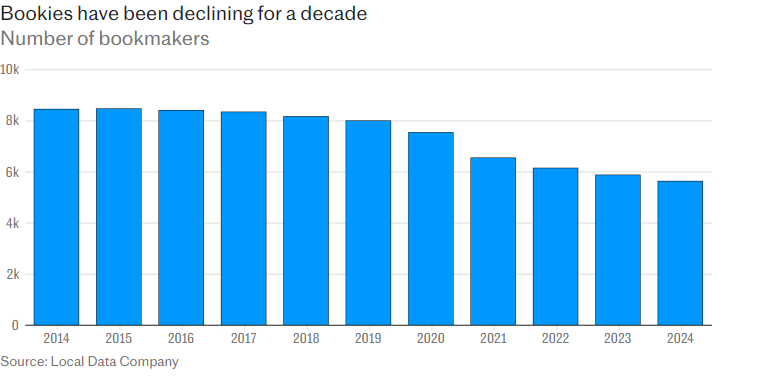
Contrary to the cries of campaigners, betting and gaming is not a soft target. Putting up taxes or imposing draconian regulations does huge damage to businesses. For example, recent regulatory changes directly contributed to 2,485 bookmakers closing since 2019 – a 28pc reduction with the loss of over 10,000 jobs and the business rates they generated. 

You cannot put “rocket boosters” under sectors such as ours, as Liz Kendall, the Secretary for Work and Pensions, said at the Investment Summit, while also slamming the brakes on our industry with tax hikes and changes which drive customers away.

The pain is also not restricted to our members, it directly hurts sport.

Horse racing is the most obvious. The affordability checks – a construct totally unique to betting – has hastened double-digit percentage declines in betting turnover, effectively making it close to a loss-making product for some of our biggest members.

Football, especially in the lower leagues as well as in rugby league – a sport much lauded by Lisa Nandy, the Culture and Sport Secretary – along with other working-class sports, such as snooker, darts and boxing, rely on the income betting delivers. Hit betting and you will hit sport, from the grassroots to the elite level.

There is another issue blithely ignored by armchair economists, the growing threat of the unsafe, unregulated black market. A recent study found 1.5m Britons stake up to £4.3bn on this gambling black market. These operators offer deals too good to be true, circumventing the crucial player protection tools standard across BGC members. They also don’t pay tax, don’t create UK jobs and don’t support sport.

Rachel Reeves is right to go for growth. So it would make no sense whatsoever in the Budget to over-tax a gambling industry which has been hit hard by the Government in recent years. We want to play our part in investing and helping to grow the economy. The Chancellor would be wise not to kill the goose that is already laying the golden eggs. 

Grainne Hurst- Betting and Gaming Council CEO

From the Telegraph