it’s ok to lie- in a good cause!

Last year, the Gambling Commission wrote to the Betting and Gaming Council (‘BGC’) to ask it to stop referring to Health Survey statistics. It now transpires that it did so on behalf of the activist organisation, Gambling with Lives (‘GwL’)

Great Britain: Politics – is something rotten in the state of the West Midlands?
A novel solution to addressing ‘problem gambling’ was briefly glimpsed in parliamentary debate last week – the imposition of strict gambling controls on people in the West Midlands; leaving those living elsewhere in England to flutter as they see fit. 

During Wednesday’s Westminster Hall Debate on Gambling Harms, Sarah Coombes MP (Lab, West Bromwich) claimed that there were “168,000 people in the west midlands who say that problem gambling is devastatingly affecting their lives” and the lives of family members. Seconds earlier, Ms Coombes’s colleague, Jim Dickson MP (Lab, Dartmouth) had told the chamber, with the authority of the now defunct Public Health England (‘PHE’), that an identical number of people in the whole of England were experiencing ‘problem gambling’. Taken together, these statements appear to indicate that gambling may only be a problem for people living in the environs of Wolverhampton, West Bromwich, Walsall, Coventry and Birmingham (home of Britain’s Gambling Commission).

No sooner did this regional lockdown ‘public health approach to problem gambling’ hove into view, than it started to dissolve under the weight of wider MP interventions. Dawn Butler MP (Lab, Brent) argued that there are around 20,000 ‘problem gamblers’ in her constituency alone; and Cameron Thomas MP (LibDem, Tewkesbury) claimed (incorrectly) that PHE had put the national figure at 246,000. Other MPs insisted that there were in fact 1.3 million or more ‘problem gamblers’ in Great Britain – claims that rely on the misuse of official statistics, as defined by the Gambling Commission. 
In general, the debate was a poor advertisement for parliamentary discourse. One Liberal Democrat MP suggested that supporters of Liverpool FC would find themselves “unable to talk to their friends and family about the losses and their addiction” as a direct result of Ladbrokes becoming the club’s official betting partner; while Butler of Brent claimed, without providing a shred of evidence, that gambling was “more addictive than heroin”. According to National Health Survey (‘NHS’) estimates, the rate of DSM-IV gambling disorder lies between 0.1% and 0.2% of the adult population, compared with 3.1% of people showing signs of drug dependency and a similar proportion with mild or severe alcohol dependency). As flies to wanton boys are statistics to MPs; they use them for their sport.

Only one participant – Labour’s Jake Richards, Member for Rother Valley – appeared to notice what was going on, observing that, “we have heard a lot of statistics in this debate, but they vary because we just do not know what we are dealing with”. Mr Richards was half-correct in his diagnosis. The real reason for the confusion is that prevalence rates are based on responses to self-report surveys – and estimates vary significantly depending on how these are conducted. NHS Health Surveys have historically been conducted in-person, an approach considered to be the “gold standard” in terms of yielding accurate results (Sturgis & Kuha, 2022). The Gambling Commission’s Gambling Survey for Great Britain (‘GSGB’) is conducted online and is less likely to be reliable due to low response rates and topic salience bias (ibid.). GambleAware’s Annual Treatment Survey uses self-selected online panels (surveys of people who actively choose to spend their time filling out questionnaires) and, while these panels may have their uses, providing reliable population-level figures is not one of them.

The chief executive of the Gambling Commission, Andrew Rhodes recently lamented that arguments over which survey is more accurate distract from what really matters. He is correct – but this is a situation of the Commission’s own making. Repeated attempts by the regulator to undermine public confidence in Health Surveys in order to shore up the defences of the GSGB reflect poorly on those involved and have prompted activists to describe the use of NHS statistics as “a con”. If it is a con, then it appears that both HM Government and HM Opposition are in on it. In last week’s debate the shadow gambling minister, Louie French (Cons, Old Bexley and Sidcup), and the DCMS minister, Stephanie Peacock (Lab, Barnsley South) chose statistics from NHS Health Surveys rather than the GSGB. 

Last year, the Gambling Commission wrote to the Betting and Gaming Council (‘BGC’) to ask it to stop referring to Health Survey statistics. It now transpires that it did so on behalf of the activist organisation, Gambling with Lives (‘GwL’). On 2 October 2024, GwL wrote to the Commission to ask whether it would take action against the BGC for continuing to use NHS figures (which have the status of Accredited Official Statistics) in preference to those from the GSGB (which don’t). Eight days later, the Commission did precisely that – copying and pasting the GwL objections into an email to the trade body. It did so despite the fact that the BGC’s actions do not constitute misuse; while turning a blind eye to cases of actual misuse. The regulator will presumably now also take the DCMS and shadow minister to task for the ‘non-crime statistics incident’ of believing the NHS.

The publication of the NHS Adult Psychiatric Morbidity Survey and the GSGB 2024 this summer will put another couple of ‘problem gambling’ figures into the mix; and these will be supplemented next year by the Health Survey for England – unless the Commission intervenes (it has told the Department of Health and Social Care that it wishes to ‘manage’ statistics that compete with its own). The chances of clarity or coherence breaking out any time soon seem slim. 

Regulus Partners – February 2025

Abusing NHS statistics

UK: ‘We don’t need no thought control’ – why the Gambling Commission should leave NHS stats alone

In recent years, the Gambling Commission has been on the receiving end of criticism from all sides of the so-called gambling debate. Last year, the MP, Sir Philip Davies declared that the regulator was “out of control”, while the Social Market Foundation has described it as “not fit for purpose”. The Commission has not publicly endorsed either of these views – or advertised them on its website – presumably because it considers them to be untrue as well as unflattering. Last month, however, the Betting and Gaming Council (‘BGC’) was asked by the Commission to make claims about the prevalence of gambling harms which are probably false – and to publish them on its website.


In an email recently released under the Freedom of Information Act, the Commission wrote:
 
“We’ve been keeping an eye on use of GSGB [Gambling Survey for Great Britain] data and use of figures as the official statistic. We’ve noticed that BGC still refers to previous stats, it’s not a misuse of stat issue but we’d be keen for you to start using the official figure moving forwards.”
 

This invitation was politely declined by the BGC on the grounds that it has greater confidence in NHS statistics (which are accredited by the UK Statistics Authority) than in the Commission’s (which are not). The BGC is similarly unlikely to profess that its members are (to borrow from Blackadder) ‘head over heels in love with Satan and all his little wizards’; but the Commission can always try.  

 
The regulator’s entreaties should be considered in the light of the following circumstances:
i) the balance of evidence indicates that the GSGB substantially overstates levels of gambling and gambling harm in Britain
ii) the Gambling Commission knows this
iii) in asking the BGC to go along with the charade, the Commission is acting, at best, inconsistently
iv) the GSGB is already being used (and misused) by activists, seeking to reopen the Government’s Gambling Act Review.


We examine each of these points in turn.  

 
1. The balance of evidence
The GSGB may be the new source of official statistics, but this does not mean it provides a reliable picture of gambling prevalence in Britain. To believe that it does, it is necessary to subscribe to the following:
        i.            Every single official statistic on gambling and harmful gambling produced over the last 17 years – by the National Health Service (‘NHS’), the Department for Culture, Media and Sport and the Gambling Commission itself – has been substantially wrong
      ii.            The NHS has serially misreported the prevalence of health disorders in general – and continues to do so
    iii.            Audited data on actual customer numbers using licensed operators is incorrect (or there is a massive black market that failed to show up in previous studies and of which the Commission was previously unaware)
     iv.            The opinion of the independent review (conducted by Professor Sturgis of the London School of Economics) that the GSGB may substantially overstate true levels of gambling and gambling harm is misguided
 

To believe that all these things are true (and to cajole others into professing the same) requires more than blind faith and a sheriff’s badge. Tellingly, the Gambling Commission does not have very much confidence in the GSGB itself; and has issued guidance that key results should be used “with some caution” or not at all.


2. Withholding evidence (again)
The Gambling Commission’s defence of the GSGB has largely consisted of attacks on NHS statistics, claiming that they have under-reported rates of ‘problem gambling’. While scrutiny is important, undermining accredited official statistics on health is a step not to be taken lightly. Some sort of evidence is required. For this, the Commission has relied upon a 2022 study which claimed social desirability response bias (ie, the fact that people sometimes answer survey questions in what they consider to be an acceptable rather than accurate fashion) caused under-reporting of ‘problem gambling’ in NHS surveys. This ‘evidence’ was thoroughly debunked by Professor Sturgis as part of his independent review – but for reasons known only to the Commission, the analysis was suppressed. It required a Freedom of Information Act request to secure the release of the information. This is not the first time that the Commission has prevented publication of critical evidence – having previously withheld survey data on customer opposition to affordability checks. Disclosures also reveal the Commission was warned by its lead adviser, Professor Heather Wardle, that social desirability response bias was likely to be a “marginal factor” in explaining differences between the GSGB and Health Surveys (and that the dominant factor of topic salience bias resulted in over-reporting in the GSGB). 
 
3. Two-tier thought policing?
In recent years, various parties have taken highly selective approaches to the use of ‘problem gambling’ statistics – often ignoring official estimates in favour of more convenient alternatives. Last year, the National Institute for Economic and Social Research did so in a report funded by a Gambling Commission settlement – using a rate two or three times higher than the official statistic. There is no suggestion that the Commission objected to this. In public consultations, the Commission itself relied on ‘problem gambling’ prevalence rates from the 2018 Health Survey for England rather than lower figures from the 2021 edition (ie, the official statistics at that time). In a speech in Rome last month, the chief executive of the Commission, Andrew Rhodes criticised those who wished to “turn the clock back” to previous official statistics, and in the very same speech cited participation estimates from ‘previous official statistics’.

 
4. The weaponisation of research
The importance of all of this has been amply demonstrated in recent weeks. Both the Institute for Public Policy Research and the Social Market Foundation cited the GSGB’s inflated rates of ‘problem gambling’ in support of demands for ruinous and self-defeating tax rates (as high as 66% of revenue); while GambleAware has used the survey findings to call for tobacco-style health warnings to be slapped on all betting and gaming adverts (including those for the National Lottery). The Commission appears, therefore, to be encouraging the use of inaccurate statistics on gambling harms in the knowledge that they will be used in support of an anti-gambling agenda.

Perhaps Sir Philip had a point after all…

REGULUS PARTNERS NOVEMBER 2024

ABSURDENOMICS

Absurdonomics: Bad money or poor education?


This week, Baroness Twycross participated in her first public discussion on gambling regulation, since being handed the policy brief in the summer. It was a salutary experience for the new minister, who may now be starting to grasp just how murky, partisan and at times downright dishonest the so-called gambling debate has become.
The minister will have been disconcerted to hear from fellow panellist, Professor Adrian Pabst of the National Institute of Economic and Social Research (‘NIESR’), that the costs to the state of ‘problem gambling’ could now be in the region of £5bn a year. It is likely however, that her counterparts at the Department of Education would have been even more alarmed if they understood how the professor had managed to arrive at this figure.


Last year, NIESR published its report on the ‘fiscal costs and benefits of problem gambling’. It asserted that harmful gambling cost the British taxpayer at least £1.4bn a year – a figure that hinged on its estimate that 0.7% of adults in Britain were ‘problem gamblers’. Since then, the Gambling Commission has published a controversial new Gambling Survey for Great Britain (‘GSGB’), which indicates a prevalence rate of 2.5% instead.

Professor Pabst appears therefore to have upweighted his previous estimate in line with this new figure. There are, however, two obvious problems with this. First, the GSGB is an unreliable survey – irretrievably damaged by selection bias – and the Gambling Commission itself has said that it cannot be used to provide population level estimates of harmful gambling (which is precisely what the NIESR revision relies upon). Second, the original NIESR cost estimate of £1.4bn is largely made-up!!

Roughly 60% of NIESR’s 2023 cost estimate refers to excess use of Universal Credit by ‘problem gamblers’; and was calculated using data from the ONS ‘Wealth and Assets Survey’. The ONS survey however, contains no information whatsoever that might be used to identify ‘problem gambling’; and so NIESR invented its own. It decided for example, that anyone who had won £500 or more in the previous two years and was not working due to ill health must be an ‘at risk gambler’.


Its criteria for identifying ‘problem gamblers’ meanwhile, was so speculative that it encompassed people who did not gamble at all. In this way, NIESR conjured a ‘problem gambling’ cost estimate of £800m a year out of thin air (and this presumably rises to £2.9bn using the Pabst rate of inflation).The next biggest area of alleged cost involves excess use of hospital inpatient services and was based on results from the 2007 NHS Adult Psychiatric Morbidity Survey. This dataset does at least contain estimates of ‘problem gambling’; but NIESR’s figure of £447m a year in costs (32% of the total) was based on a ridiculously small sample of just nine survey respondents; and the calculation was neither provided nor explained. The remaining 11% of costs were derived using similarly weak methods. The report is riven with flaws (including basic errors of addition, multiplication and division) and inconsistencies (it provided no fewer than four different cost estimates for excess use of GP surgeries by ‘problem gamblers’).

The project was overseen by an expert advisory group, chaired by Dr James Noyes of the SMF, a long-standing collaborator with Professor Pabst. Dr Noyes also chaired this week’s SMF event in Liverpool. Other members of the expert advisory group included Professor Heather Wardle from the University of Glasgow and Dr Henrietta Bowden-Jones of the NHS. At the time of its publication, Professor Wardle described NIESR’s work as “an important new report”, which showed that “the fiscal burden of gambling harms in the UK…have been underestimated”; somehow overlooking the myriad problems with how it was put together.

NIESR’s report was funded by a £140,050 regulatory settlement approved by the Gambling Commission – but the market regulator has expressed a lack of interest in the quality of output or the fact that some of those involved have used the report for the purposes of anti-gambling activism – not just in Britain but in New Jersey too. Regulatory settlement rules stipulate that funds must not be used for campaigning or lobbying – but as the Commission does not actually check what is done with settlement funds and provides no sanction or recourse for misuse – this rule is of only academic importance.

Professor Pabst’s comments this week may constitute a breach of settlement fund rules as well as the Gambling Commission’s guidance on the use of the GSGB – although the latter is so ambiguous that it would be hard to apportion too much blame.

The NIESR report forms part of a wider canon of studies claiming substantial social and economic costs from gambling. Earlier this month, Nera Consulting published a report alleging that online gambling was economically harmful because it diverted consumer spending away from more labour-intensive industries. Nera’s claim revolves around the idea that people should spend their money, not on things that they enjoy but on goods and services that require large numbers of people to produce them. Similarly, a report from the SMF in 2022 suggested that online gambling was economically harmful because it did not involve extended supply chains – a bizarre claim in an era of environmentalism.

Public Health England, the Office for Health Improvement and Disparities and the Institute for Public Policy Research have also produced a variety of speculative and, in some cases, misleading cost estimates.

Large sums of money have been expended on these projects – both by the state and by one private individual in particular – but it’s unclear what has been learned as a result (aside from the fact that basic numeracy appears not to be a requirement to work for an economic think tank). Even if researchers were able to provide meaningful estimates of costs, it is questionable what policy purpose they might serve without a similarly rigorous estimate of consumer and societal benefits. While Baroness Twycross heard much about the ‘bad money’ of betting, we must hope that her eyes have been opened to the absurd economics of the gambling debate.

Note: In 2023, we shared our critique with NIESR and asked (on several occasions) whether the authors considered any aspects of our analysis to be incorrect. We received no response to our enquiries.
REGULUS PARTNERS

The gambling suicides myth

The rate of deaths caused by gambling has been foolishly exaggerated

The rate of deaths caused by gambling has been foolishly exaggerated

Artillery Row by Christopher Snowdon May 2024

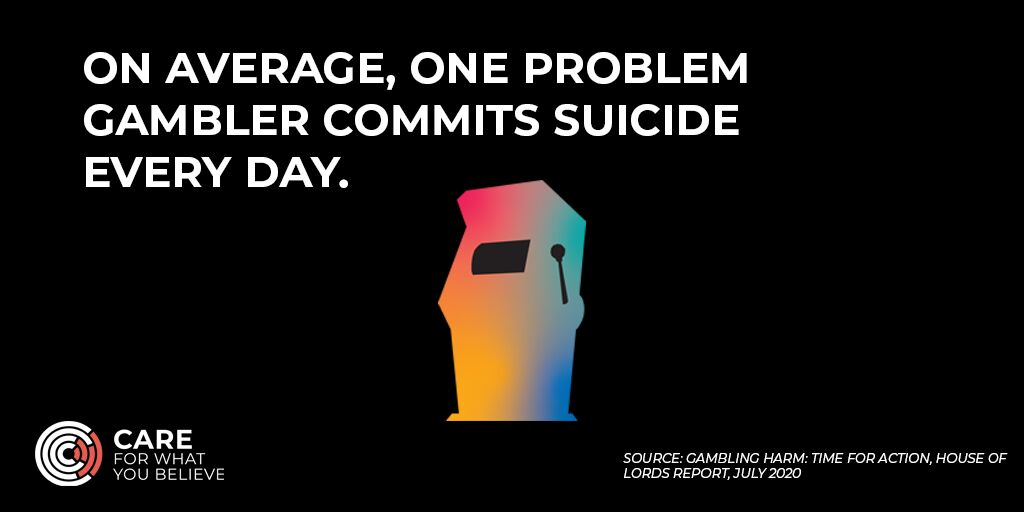
here is one gambling-related suicide in the UK every day. There are up to 496 gambling-related suicides a year. Ten per cent of all the suicides in England are caused by gambling. 

These statistics, and other iterations of them, have become mantras for the anti-gambling lobby since January 2023 when the Office for Health Improvement and Disparities (OHID) published a report claiming that there are “between 117 and 496 suicides associated with problem gambling” in England. Activists naturally focused on the larger of these two numbers and started putting it on billboards. The monetised value of years of life supposedly lost to suicide make up most of the “up to” £1.77 billion that gambling is said to cost “wider society” each year.

It turns out that these figures are based on nothing. They are a will o’ the wisp. A mirage. They exist only on a laptop in Whitehall. They are worthless.

How can we possibly know how many suicides are linked to problem gambling, let alone how many are solely caused by it? Gambling is only mentioned on one coroner’s report a year, on average, which is presumably an under-estimate. In the absence of better evidence, OHID’s predecessor Public Health England turned to a study from Sweden which looked at 2,099 hospital patients who were diagnosed with pathological gambling between 2005 and 2016. Sixty-seven of them died, including 21 who took their own life. The authors noted that the suicide rate among this cohort of pathological gamblers was fifteen times higher than the suicide rate of the general Swedish population. 

Upon this sliver of evidence, everything else rested. In 2021, Public Health England simply estimated how many problem gamblers were in England and then multiplied the number of expected suicides by fifteen. This produced a figure of 409 suicides a year which anti-gambling activists then put on T-shirts

Public Health England was closed down soon afterwards and replaced by OHID. Last January, OHID used the same methodology but produced two different estimates, one based on how many people are thought to have “gambling disorder” (previously known as pathological gambling) and the other based on how many suffer from the less severe condition of “problem gambling”. The figures were 117 and 496 respectively.

You don’t need to be intimately acquainted with basic statistics to see the problem here. People who are being given medical or psychiatric treatment in hospitals are inherently different to people who are not. If you are admitted to hospital, there is already something wrong with you. If you are admitted to hospital and asked to take a survey to diagnose gambling disorder (or any other psychological problem) then you are very likely to be at the higher end of the risk spectrum.

Sure enough, there was a lot wrong with the 2,099 people in the Swedish study. Between 2005 and 2016, 65 per cent of them suffered from “injury, poisoning, and other consequences of external causes”. 60 per cent had an anxiety disorder. 51 per cent suffered from depression. 41 per cent had a substance-use disorder. 29 per cent had an alcohol-use disorder. 19 per cent had a personality disorder. 19 per cent intentionally self-harmed. 12 per cent were bipolar. 9 per cent had schizophrenia. In the context of all this human misery, a suicide rate of one per cent does not seem too surprising and it is absurd to assume that all the suicides were the result of problem gambling. For many of these unfortunate people, gambling may have been the least of their worries.

The authors of the study freely admitted that these hospital patients were unlikely to be representative of the average problem gambler:

It is therefore likely that results may be skewed toward a population of individuals with more severe forms of GD [gambling disorder]. It is likely that this once again implies that this study sample might contain patients with higher mental health comorbidity, as well as individuals with more severe forms of GD, since these individuals are more likely to receive specialized psychiatry care.

Public Health England and OHID ignored all this and extrapolated the suicide rate among pathological gamblers with multiple co-morbidities in Swedish hospitals across the estimated number of problem gamblers in the general population in England. No attempt was made to adjust for the many other risk factors for suicide that these people obviously had. 

Last year, however, one of the two authors of the Swedish study did exactly that. Using the same dataset in a new study for her PhD thesis, Anna Karlsson found that “gambling disorder did not appear to be a significant risk factor for the increase in suicide and general mortality when controlling for previously known risk factors”. She concluded that her research “could not determine whether GD [gambling disorder] is an independent risk factor for suicide”.

This does not mean that there is no link between gambling disorder and suicide. History and common sense tell us that people who get into severe financial difficulties are more likely to take their own lives and it is obvious that problem gambling is one way to suffer financial distress, albeit the only one that is now treated as a “public health” issue. What it does mean is that gambling disorder, on its own, was not a big enough risk factor for suicide to show up among the people studied by the Swedish authors using standard statistical practice. If you extrapolated the properly adjusted figures from the Swedish study across the English population, the number of gambling-related suicides would be zero.

It is hard to believe that OHID was not aware that it had made an error that a literal schoolboy could have spotted. Public Health England was closed down because it was incompetent and was too easily distracted by lifestyle issues when it should have been focusing on public health. It was more of an in-house lobby group than a serious scientific agency. It seems that closing it down and re-opening it under a new name with the same staff was not enough to make the leopard change its spots.

The Great Suicide Deception – Part IV – What purpose is served by spurious statistics?

Dan Waugh-Regulus Partners May 2024

This is the fourth and final article in our series on attempts by state bodies to claim widespread suicide mortality associated with problem gambling. In the first three articles we demonstrated why estimates prepared by Public Health England and the Office for Health Improvement and Disparities were irretrievably flawed; we examined the conduct of PHE and OHID, including evidence of bias and inappropriate behaviour; and we considered the role played by the Gambling Commission, the Advisory Board for Safer Gambling and others in either propagating the PHE-OHID claims or withholding concerns about their reliability. We conclude by addressing the wisdom of attempts to boil down a matter as complex as suicide to any single factor.

It has long been understood that people with gambling disorder are at elevated risk of death by suicide. The DSM-5 (the American Psychiatric Association’s ‘bible’) comments on elevated rates of suicide ideation and attempts among people in treatment for gambling disorder (and makes similar observations in relation to a large number of other mental health conditions, including alcohol use disorder). Concerns in relation to gambling disorder and self-harm – and what might be done to prevent suicide by people with the disorder – are entirely valid.

It is also widely accepted that suicidality is a complex matter. In their 2016 meta-analysis of 50 years of suicide research, Franklin et al. made the following observation: 

“…any individual with nearly any type of mental illness (i.e. internalizing, externalizing, psychotic, or personality disorder symptoms), serious or chronic physical illness, life stress (e.g. social, occupational, or legal problem), special population status (e.g. migrant, prisoner, nonheterosexual), or access to lethal means (e.g. firearms, drugs, high places) may be at risk for [suicidal behaviours and thoughts]. A large proportion of the population possess at least one of these risk factors at any given time, with many people possessing multiple factors.”   

Understanding that people with a gambling disorder are at elevated risk of suicide is helpful when it comes to devising self-harm prevention strategies. For example, Hakansson & Karlsson (the Swedish researchers relied upon by PHE-OHID) conclude their 2020 study with the following recommendation:

“The findings call for improved screening and treatment interventions for patients with gambling disorder and other mental health comorbidity.”

It is questionable however whether studies of discrete associations between any single activity or human characteristic and death by suicide should – by themselves – be used to justify state controls on that activity.  By way of illustration, a 2021 study on the prevalence of suicidal behaviour in a group of patients with behavioural addictions (Valenciano-Mendoza et al.) found: 

“the highest prevalence of suicide attempts was registered for sex addiction (9.1%), followed by buying–shopping disorder (7.6%), gambling disorder (6.7%), and gaming disorder (3.0%).”

These findings may be useful for addressing risk of self-harm within population groups suffering from these mental health conditions. They do not – by themselves – justify bans on sex, shopping or playing video games. A 2017 study of young adults in England (aged 20-24 years, n=106) by Appleby et al., found that four deaths by suicide were linked to ‘gambling problems’; and this has been used to suggest that 250 deaths by suicide each year are ‘gambling-related’. The study also found that 44 of those who had died “had a reported history of excessive alcohol use. Illicit drug use was reported in 54 (51%)”; sevenwere reported as experiencing problems related to being a student” (including five experiencing “academic pressures”. One might therefore estimate (using the same methodology as for gambling problems) that around 3,200 suicides are related to illicit drug use; 2,625 to excessive alcohol use; and 440 to academia. Such findings should prompt concern and policy responses; but it is questionable whether these should extend – for example – to complete bans on advertisements for beer or universities.

Some activists have called for coroners to assess, as a matter of routine, the possible involvement of gambling in deaths under investigation – the Bishop of St Albans has doggedly pursued a Private Members Bill to mandate this. At first blush it seems to be a reasonable suggestion. The problem is that it places an additional requirement on already over-burdened coroners; and risks distortion if other known factors are not also investigated with the same degree of rigour. The presence of Adverse Childhood Experiences (‘ACEs’) is a well-documented antecedent of suicide with one study (Dube et al., 2001) finding that as many as 80% of suicide cases analysed had a history of ACEs. There are also well-documented associations between relationship breakdown and self-harm. The practicality and wisdom of asking coroners to probe into every corner of the deceased’s life should be carefully considered.

Those determined to produce figures on the prevalence of gambling-related suicide should first set out a clear operationalised definition of what this term means. How is the relationship to be characterised (e.g. does the individual need to have gambled in the prior 12 months? Does he or she need to have a diagnosis of gambling disorder?) and to what extent is there evidence of causal contribution to death (e.g. was gambling disorder a significant factor or a minor factor?). Finally, they should be required to contextualise their findings by reference to other risk factors.

Running through some of the institutional responses to PHE-OHID is the idea that unreliable estimates of mortality serve a valid purpose pending the production of more robust statistics – something along the lines of ‘fake it until you can make it’. The chair of the Gambling Commission’s Advisory Board for Safer Gambling (‘ABSG’), Dr Anna van der Gaag, for example has written that: 

“Good research, especially if it is on an under-researched area like this one, tends to begin and end in a different place, prompting challenge, replication, debate, and the research in this important area is no different.”

It is a view that overlooks four important points. First, the PHE-OHID work on the cost of gambling harms is riven with errors (including mathematical mistakes) and should not be considered “good research”. Second, the ABSG specifically called for “action” as a result of the PHE estimates – with no suggestion of the need for caution or refinement. Third, rather than welcoming challenge, the ABSG has engaged in ad hominem disparagement of those attempting to apply scrutiny to the PHE-OHID claims (likening this, without substantiation, to the activities of Big Oil). Fourth, it is questionable how far we should trust ‘better research’ if those responsible for it have propagated or tolerated misinformation in the past. As we saw during the Covid pandemic, the production of misleading statistics may in fact set back the cause of harm prevention by undermining trust in authority. 

Suicide risk among people with a gambling disorder is a legitimate issue and warrants an intelligent response; but this is unlikely to be achieved through the publication of spurious estimates of prevalence. As the US economist, Professor Douglas Walker has observed; 

“If researchers continue to offer social cost estimates, they should estimate costs that are measurable. But for other costs such as psychic costs that cannot be measured…let us identify them without providing spurious empirical estimates. Offering methodologically flawed cost estimates does not improve our understanding nor does it promote sound policy…In areas where research is still quite primitive, perhaps no data would be better than flawed data.”

Coda

We are aware that some individuals and organisations will resent this series of articles on PHE-OHID (not least the OHID researchers themselves). Our intention in writing them has not been to hurt or insult – but to shine a light on the way that some statistics are created and the distortive effect that ‘bad statistics’ can have on government policies. The application of scrutiny to research is an important part of the scientific process; and where state bodies are concerned, an important part of the democratic process too. It is entirely consistent to be concerned about a particular issue (e.g. risk of self-harm in a gambling context) and at the same time to believe that research into that issue should be conducted with honesty, openness and in accordance with scientific principles. In this way, we may hope to reduce the stigma associated with self-harm (such that gambling firms and other businesses gain the confidence to openly confront it); and that, over time, we may apply greater intelligence to the prevention of suicide in a gambling context and more generally. 

Unreliable Suicide Claims in Gambling: ABSG’s Questionable Stance

The Great Suicide Deception. Part III – Conspiracy of Silence

Dan Waugh, Regulus Partners. May 2024

The Great Suicide Deception. Part III – Conspiracy of Silence

This is the third in a series of articles examining claims made by state bodies in England about rates of suicide associated with ‘problem gambling’. In the first we demonstrated that estimates of suicide mortality produced, first by Public Health England (‘PHE’, 2021) and then by the Office for Health Improvement and Disparities (‘OHID’, 2023) were irretrievably flawed. In the second, we looked at the behaviour of PHE and OHID, finding indications of a priori bias or inexplicable negligence and unsound governance. In this third article, we examine the conduct of others in positions of authority and ask why so many people who knew that PHE and OHID’s claims were unreliable decided to look the other way. We also recognise those who were prepared to apply critical analysis. Once again, we observe that, while gambling disorder has been recognised as a risk factor for self-harm for more than 40 years, efforts to tackle this are unlikely to be advanced by the use of junk science.

1. Why did the Gambling Commission not ‘do the right thing’?

By April 2022, Britain’s Gambling Commission knew that estimates of suicide mortality published by PHE were “unreliable” and based on “inaccurate” assumptions. This may have been a somewhat uncomfortable finding, given that the regulator had previously described the review as “important and independent”. It had arrived at this opinion despite not having received anything more than an executive summary (which it had not read when it agreed to provide “a supportive quote”). It also knew that PHE was far from “independent”, having been made aware of its intention to apply tobacco-style controls to participation in betting and gaming.

At a meeting in March 2022, Gambling Commission officials admitted that they did not understand how PHE had arrived at some of its estimates (no-one could have been expected to – given the fact that the calculations were mathematically incorrect). In April, these officials circulated a highly critical review of the PHE report, in which they noted that the suicide claims were not based on “reliable data”. The Commission however, elected not to take the matter up with the OHID (which had subsumed PHE upon the latter’s disbandment) or to inform the Secretary of State. The market regulator – which counts “doing the right thing” among its corporate values – elected to suppress its critique. In one rather sinister coda to the Commission’s critique, one official speculated that PHE’s claim of more than 400 suicides might be rescued, if only future prevalence surveys showed a higher rate of ‘problem gambling’ in the population. At this point, the Commission had started work on a new Gambling Survey for Great Britain in the expectation that – as a result of methodological issues – would produce a higher rate of ‘problem gambling’ than reported by tNHS Health Surveys.


When asked by journalists whether it considered the PHE claims to be reliable, the Gambling Commission responded that it was not its role to review the work of other state agencies; but failed to mention that this is precisely what it had done. As late as 2023, its chief executive, Andrew Rhodes continued to defend the PHE-OHID estimates, despite being aware of the problems with them; and it seems likely that the market regulator has been involved in disseminating the misinformation via approval of regulatory settlement funds.

2. the ABSG and the irrelevance of accuracy

In the summer of 2022, the OHID wrote to the Gambling Commission’s Advisory Board for Safer Gambling (‘ABSG’) to ask for its opinion on criticism of PHE’s suicide analysis. In her response, the ABSG’s chair, Dr Anna van der Gaag appeared to agree that there were indeed a number of issues. She wrote: “I see their point about basing calculations on the Swedish hospital study leading to an over estimation of the numbers”. She then proceeded to suggest that accuracy in such matters was unimportant and that attempts to apply scrutiny was “a distraction from what matters to people and families harmed by gambling”. This represented a change in attitude from three months earlier when the ABSG had described PHE’s highly exact estimate of 409 suicides associated with problem gambling as a “catalyst towards action”. The Gambling Commission allowed the ABSG to publish this opinion in the full knowledge that it was based on unreliable data. 

The following year, Dr van der Gaag was one of two co-adjudicators responsible for allocating around £1m in Gambling Commission (regulatory settlement) funding for the purposes of research into suicide and gambling. Applicants were specifically directed towards the OHID analysis (i.e. estimates that the ABSG knew were flawed) as well as claims by the activist group, Gambling With Lives (despite the fact that even the OHID had indirectly criticised one of GwL’s claims). One of the successful bids (a £582,599 award to a consortium led by the University of Lincoln) included Gambling With Lives as an active member of the research team. 

3. the Silence of the ‘Independents’

Among those who have supported the claims of PHE-OHID are a number of self-styled ‘independent’ researchers. These include academics from the universities of Cambridge, Hong Kong, Lincoln, Manchester, Nottingham and Southampton, as well as King’s College, London, who have cited the estimates uncritically in their work. Perhaps they considered (naively, if so) that research produced by the Government is unimpeachable; yet the errors made by PHE-OHID are so glaring that no researcher of any calibre could have failed to notice them. The failure to subject such serious claims to critical analysis before repeating them indicates – at the very least – an absence of intellectual curiosity. Much is made of the need for research independence (typically defined solely by an absence of industry funding, regardless of ideology or other affiliations); but independence has little value if it is not accompanied by intelligence and integrity. 

4. Breaking ground

A small number of groups and individuals have been prepared to apply scrutiny and challenge, despite the circumstances. The Racing Post and the think tank Cieo have published a number of our own articles on the problems with PHE-OHID (as well as other issues with research-activism); and a handful of journalists, including Chris Snowdon, Steve Hoare and Scott Longley have been prepared to challenge the PHE-OHID claims. Figures from trade groups, bacta and the Gambling Business Group have spoken out publicly on issues with PHE-OHID.

Officials at the Department for Culture, Media and Sport have displayed a capacity for critical analysis, notable by its absence elsewhere in Whitehall. Their White Paper on reform of the betting and gaming market acknowledged valid concerns about self-harm but conspicuously omitted the OHID figures. Lord Foster of Bath, a stern critic of the gambling industry, has acknowledged that the PHE-OHID claims are not reliable and – in a show of honesty and humility rare in the gambling debate – apologised for using the figures himself. He continues to make the case for self-harm to be treated seriously in a gambling context; but without recourse to spurious statistics. Philip Davies, the Conservative Member of Parliament for Shipley, has challenged unsound statistics in parliamentary debates; and Dame Caroline Dinenage’s select committee for Culture, Media and Sport noted concerns of reliability in its report on gambling regulation. 

One member of the Gambling Commission’s senior management team – Tim Miller – has been prepared to discuss and acknowledge problems with PHE-OHID; an attitude that contrasts sharply with that of his colleagues.

5. ‘Noble lies’ and consequences?

Underlying the PHE-OHID saga is a sense that some people in positions of authority consider it acceptable to publish inaccurate or misleading statistics if the cause is – in their opinion – just. Some have even suggested that scrutiny of misinformation is unethical, rather than its manufacture. In July this year, the Gambling Commission intends to publish statistics on the prevalence of suicidality amongst gamblers. Given its role in PHE-OHID (in addition to major issues with its new survey), it is questionable why anyone should consider these results credible. It has also – via Gambling Research Exchange Ontario – sponsored a programme of research into wagering and self-harm. Given that these studies have been explicitly grounded in the PHE-OHID deception – and the complicity of many of those involved – suspicions of bias will accompany publication. It is the publication of unreliable research – rather than scrutiny of those statistics – that undermines public trust in authority. Attempts to address health harms in any domain will be ineffective if they are based on inaccurate evidence.

An independent and open review should be carried out into the PHE-OHID deception; but it is difficult to see how this will happen. The Department of Health and Social Care and the Gambling Commission are unlikely to embrace scrutiny; and the DCMS will not wish to embarrass either its regulator or another government department. There are too many people in Parliament and the media who have played a part; and too few prepared to break ranks. The gambling industry meanwhile (with a number of notable exceptions) has shown little inclination to challenge. There is one hope – that the Office for Statistics Regulation will be prepared to take an interest in the integrity of public health estimates. Such an intervention would go somewhere at least towards restoring trust in public bodies.

Sample Bias – the new normal

 
Great Britain: Regulation – Is the Great British Gambling Debate heading for a Terminal solution?


Last week’s House of Lords debate on gambling advertising was in many respects the same tired old combination of mistruths and moral indignation; but it was notable for providing a glimpse into the next phase of gambling policy discourse in Britain. Lord Foster of Bath, who instigated the short debate told the House that:
 
“I suspect public concern is about to rise because, in July, the Gambling Commission will release new figures about gambling harm. The Gambling Minister in the other place has already indicated that they are likely to show that 1.3 million people will classify as ‘problem gamblers’ and that a further 6 million are at risk. If confirmed, these figures are far higher than those used to inform the Government’s work on their White Paper. This is a real cause for concern, further strengthening the call for action.”


The intent could not be clearer. If the publication of the Gambling Survey for Great Britain (‘GSGB’) in July reveals a markedly higher rate of ‘problem gambling’ than the estimates relied upon by the Government in its White Paper, then the wisdom of the policies contained therein will be open to question. Lord Foster’s point is a fair one. In its White Paper, the Government relied on the 2018 Health Survey for England, which reported a ‘problem gambling’ prevalence rate of 0.38%; and the current Official Statistic (from the HSE 2021) is 0.25%. The Final Experimental Stage of the GSGB reported a figure of 2.5% – between six and ten times higher than the HSE. If the Government and regulator are confident that results obtained from the GSGB are reliable, concern groups will justifiably ask for a re-run of certain policy decisions (and possibly even Judicial Review, given the litigious bent of some activists).
 
The problem is, of course, that the Gambling Commission does not appear to be at all confident that results obtained from the GSGB will be reliable. Each of the new survey’s iterations – from the Pilot Survey in 2022 to the Experimental Stages in 2023 to Wave 1 of the official survey in 2024 – has revealed signs of sample bias. In an independent review (‘independently’ funded by the Gambling Commission), Professor Patick Sturgis of the London School of Economics, commented on the “non-negligible risk” that the GSGB would “substantially over-state the true level of gambling and gambling harm in the population”. He also urged caution, warning that “until there is a better understanding of the errors affecting the new survey’s estimates of the prevalence of gambling and gambling harm, policy-makers must treat them with due caution.” Such advice appears lost on the Commission (which prefers to gloss over inconvenient opinions). In addition to rates of ‘problem’ and ‘at risk’ gambling’, it plans to release survey findings in respect of suicidality, violence and abuse, mental ill-health and use of food banks – in the knowledge that the figures may very well be incorrect and misleading. Just when the Department for Culture, Media and Sport might have thought it was nearing the end of a long and tortuous journey on gambling reform, the Commission is throwing down new track.


The threat to the licensed betting and gaming market in Great Britain is severe. The public health establishment (including senior figures within the Department for Health and Social Care) has signalled its intention to “tackle gambling” (all gambling and not just harmful gambling) in the same way that it has dealt with tobacco smoking. Demands for total bans on advertising (including at racecourses), the sale of beer and wine in bingo clubs and casinos and the imposition of ‘plain packaging’ for all gambling products (no colours, logos or images – farewell Queen of Hearts), will intensify. In Scotland, it is reported that the SNP plans to raise the legal age of gambling if it achieves independence (presumably with a carve out for anti-gambling vitriol in its Hate Speech legislation) but this is only a stop along the route rather than a final destination. It is far from obvious however, that the industry realises the perilous nature of its current position. Tone-deaf advertising on bus stops and at railway stations only strengthens the ground for those seeking a terminal solution.