
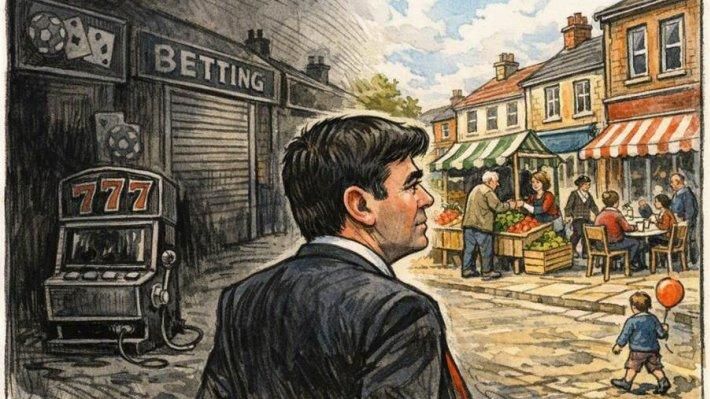

Gambling Is Not a Public Health Issue
When campaigners call gambling a public health issue, they are not making a loose rhetorical point. They are invoking a specific piece of theory, and it matters that people understand what it is and what it commits them to.
The theory is the Total Consumption Model, imported from alcohol research. It holds that harm in a population rises and falls with total consumption. Under this model, you do not need to identify who is being harmed or show that a policy helps them. You only need to reduce the overall amount of the activity. Less gambling in aggregate is treated as less harm by definition.
Read Gambling with Lives’ own evidence to Parliament this year. They state openly that the policy question is not whether advertising causes addiction. The question is whether it increases participation. Participation itself has become the target. That is the model working exactly as designed. Once it is accepted, every measure that shrinks the market counts as a success, whether or not a single person suffering from gambling disorder is helped.

This is why important racing figures like Martin Cruddace need to revise his view that for political reasons we need to accept the gambling as a public health issue. Because it is false. Were we to accept this premise we could argue driving as a public heath issue similarly.
Road safety policy however differs from the ‘gambling public health argument’ in that it targets the harmful behaviour and leaves the rest of the population alone. Drink driving laws restrict drunk drivers. Speed enforcement restricts speeders. Nobody proposes cutting road deaths by reducing the total volume of driving, rationing mileage, or requiring ordinary motorists to prove they can afford their petrol. That is precisely what advocates seek from gambling reform. It attacks everyone, not just the vulnerable. Changing my old mucker’s mind on anything is like trying to shift the Titanic. He is, however of enormous influence, so we must try. I am not suggesting the boss of Arena Leisure as an anti gambler. Far from it

The participation in argument matters because the model makes a testable prediction, and in gambling the prediction fails. Total consumption rose enormously over two decades. This is a key point. Online betting grew from nothing into the largest part of the market. Advertising spend ran into billions. Smartphones put a betting account in every pocket. If harm tracked total consumption, problem gambling prevalence should have climbed with it. It did not. On the health survey series it stayed at around half of one percent of adults throughout. Exposure went up. The rate of disorder did not. The foundation of the entire framework does not hold for this activity.
Now look at what the model has delivered in practice. Affordability checks applied the total consumption logic directly: restrict the whole betting public in order to reach the few. Customers refused intrusive document demands and left the regulated market. Racing’s funding contracted. The Gambling Commission has produced no evidence that problem gambling fell as a result. Under any normal test that is failure. Under the total consumption test it is success, because the market got smaller. That is the sleight the public health framing performs. It changes the definition of success from harm reduced to gambling reduced, and nobody voted for that change. Gamblers neither want to reduce, nor does it shift the bar on problem gambling one iota (that is if you don’t move the bar, as the gambling commission has with its absurd gambling survey of Great Britain!)
The same logic now underpins demands for tax rises designed to shrink the sector and for the denormalisation of betting called for by the chair of the Lancet Commission, and fanatical anti gamblers like Heather Wardle on gambling. The stated aim in each case is less gambling, not less harm.
Gambling disorder is real and can be devastating. It affects a small minority who need identification, treatment and support. Those are targeted clinical tasks. A framework that measures success by the contraction of a lawful market, while producing no evidence of reduced harm, is not protecting anyone. It is pursuing a different goal under a borrowed name.

Absurdonomics: Bad money or poor education? This week, Baroness Twycross participated in her first public discussion on gambling regulation, since being handed the policy brief in the summer. It was a salutary experience for the new minister, who may now be starting to grasp just how murky, partisan and at times downright dishonest the so-called gambling debate has become. The minister will have been disconcerted to hear from fellow panellist, Professor Adrian Pabst of the National Institute of Economic and Social Research (‘NIESR’), that the costs to the state of ‘problem gambling’ could now be in the region of £5bn a year. It is likely however, that her counterparts at the Department of Education would have been even more alarmed if they understood how the professor had managed to arrive at this figure.  Last year, NIESR published its report on the ‘fiscal costs and benefits of problem gambling’. It asserted that harmful gambling cost the British taxpayer at least £1.4bn a year – a figure that hinged on its estimate that 0.7% of adults in Britain were ‘problem gamblers’. Since then, the Gambling Commission has published a controversial new Gambling Survey for Great Britain (‘GSGB’), which indicates a prevalence rate of 2.5% instead. Professor Pabst appears therefore to have upweighted his previous estimate in line with this new figure. There are, however, two obvious problems with this. First, the GSGB is an unreliable survey – irretrievably damaged by selection bias – and the Gambling Commission itself has said that it cannot be used to provide population level estimates of harmful gambling (which is precisely what the NIESR revision relies upon). Second, the original NIESR cost estimate of £1.4bn is largely made-up!! Roughly 60% of NIESR’s 2023 cost estimate refers to excess use of Universal Credit by ‘problem gamblers’; and was calculated using data from the ONS ‘Wealth and Assets Survey’. The ONS survey however, contains no information whatsoever that might be used to identify ‘problem gambling’; and so NIESR invented its own. It decided for example, that anyone who had won £500 or more in the previous two years and was not working due to ill health must be an ‘at risk gambler’.  Its criteria for identifying ‘problem gamblers’ meanwhile, was so speculative that it encompassed people who did not gamble at all. In this way, NIESR conjured a ‘problem gambling’ cost estimate of £800m a year out of thin air (and this presumably rises to £2.9bn using the Pabst rate of inflation).The next biggest area of alleged cost involves excess use of hospital inpatient services and was based on results from the 2007 NHS Adult Psychiatric Morbidity Survey. This dataset does at least contain estimates of ‘problem gambling’; but NIESR’s figure of £447m a year in costs (32% of the total) was based on a ridiculously small sample of just nine survey respondents; and the calculation was neither provided nor explained. The remaining 11% of costs were derived using similarly weak methods. The report is riven with flaws (including basic errors of addition, multiplication and division) and inconsistencies (it provided no fewer than four different cost estimates for excess use of GP surgeries by ‘problem gamblers’).  The project was overseen by an expert advisory group, chaired by Dr James Noyes of the SMF, a long-standing collaborator with Professor Pabst. Dr Noyes also chaired this week’s SMF event in Liverpool. Other members of the expert advisory group included Professor Heather Wardle from the University of Glasgow and Dr Henrietta Bowden-Jones of the NHS. At the time of its publication, Professor Wardle described NIESR’s work as “an important new report”, which showed that “the fiscal burden of gambling harms in the UK…have been underestimated”; somehow overlooking the myriad problems with how it was put together.  NIESR’s report was funded by a £140,050 regulatory settlement approved by the Gambling Commission – but the market regulator has expressed a lack of interest in the quality of output or the fact that some of those involved have used the report for the purposes of anti-gambling activism – not just in Britain but in New Jersey too. Regulatory settlement rules stipulate that funds must not be used for campaigning or lobbying – but as the Commission does not actually check what is done with settlement funds and provides no sanction or recourse for misuse – this rule is of only academic importance. Professor Pabst’s comments this week may constitute a breach of settlement fund rules as well as the Gambling Commission’s guidance on the use of the GSGB – although the latter is so ambiguous that it would be hard to apportion too much blame. The NIESR report forms part of a wider canon of studies claiming substantial social and economic costs from gambling. Earlier this month, Nera Consulting published a report alleging that online gambling was economically harmful because it diverted consumer spending away from more labour-intensive industries. Nera’s claim revolves around the idea that people should spend their money, not on things that they enjoy but on goods and services that require large numbers of people to produce them. Similarly, a report from the SMF in 2022 suggested that online gambling was economically harmful because it did not involve extended supply chains – a bizarre claim in an era of environmentalism. Public Health England, the Office for Health Improvement and Disparities and the Institute for Public Policy Research have also produced a variety of speculative and, in some cases, misleading cost estimates.  Large sums of money have been expended on these projects – both by the state and by one private individual in particular – but it’s unclear what has been learned as a result (aside from the fact that basic numeracy appears not to be a requirement to work for an economic think tank). Even if researchers were able to provide meaningful estimates of costs, it is questionable what policy purpose they might serve without a similarly rigorous estimate of consumer and societal benefits. While Baroness Twycross heard much about the ‘bad money’ of betting, we must hope that her eyes have been opened to the absurd economics of the gambling debate. Note: In 2023, we shared our critique with NIESR and asked (on several occasions) whether the authors considered any aspects of our analysis to be incorrect. We received no response to our enquiries. REGULUS PARTNERS |

