Next Monday at Labour conference in Liverpool there is a fringe event titled What Next for Gambling Reform: Time for a New Act?
It runs at the Live Lounge in the M&S Bank Arena which presumably the person funding the whole bash has acquired at considerable cost.
The new Gambling Minister, Vicky Foxcroft, is on the panel. It will be her first substantial public outing on the brief, a few weeks into the job.
Look at the nodding dogs invited. The chair is Dr James Noyes, Senior Fellow at the Social Market Foundation. The SMF’s gambling research programme is funded by Derek Webb. One of the two hosts is the Coalition to End Gambling Ads, whose director Will Prochaska also sits on the panel. Funded by Derek Webb. The other host is More in Common, the polling company whose surveys the Coalition cites when it claims the public supports an advertising ban. Alex Ballinger MP and Dawn Butler MP complete the lineup. A more dedicated group of prohibitionists it would be hard to find. It is dignified by this latest sham version of gambling ministers to make the pilgrimage
Noyes asked publicly for any questions to what are described as ‘experts.’ a loose term one suspects for people who wouldn’t know a betting shop from a cinema. All those questions asking about the warped nature of the panel, ignored. One chump asked why his bets get trestricted by bookies? Will be put to the panel.. You get the drift
So who exactly is Derek Webb? Not a British public health expert. He is a casino entrepreneur who invented Three Card Poker, a high margin table game built for fast, repeated play. It remains one of the most profitable products on any casino floor. Webb sold out for a fortune and now pumps that casino money into Britain through a Beverly Hills company, funding think tanks, campaign groups and political parties to restrict how British punters spend their own money. He doesn’t believe you’re capable of managing how you spend your money. You’re all dribbling fools needing his help. Or he thinks it’s the fast track to a peerage. My money is on B
Prohibitionist central
Webb gave over one million pounds to Labour before the last election. A man enriched by one of the fastest, highest margin gambling games ever devised is paying to lecture this country about the dangers of a bet on the 3.30 at Haydock. There is a word for that.
Now count the other side of Monday’s panel. No licensed operator. Nobody from racing, a sport that stands to lose hundreds of millions from the policies this panel will promote. Nobody who speaks for the millions of smelly unwashed people who bet legally every week without harm. Excluded. This is not a breach of any code. Ministers speak at fringe events all the time and there is no rule requiring balance on a conference panel. Ms Foxcroft is entitled to attend and let her derive discomfort from the atmosphere. One hopes her virtue signalling ends with the next election. Quite what she’s doing administering gambling is unclear
Let’s not pretend it is a debate. Every organisation on that platform sits inside a single parochial funding network, glorifying in their own effluence, nodding enthusiastically along as you do when you’ve found new money, and a new minister will receive her introduction to gambling policy entirely from one side of the argument. The record of that side deserves scrutiny. In 2020 Dr Noyes wrote the SMF paper proposing affordability checks at one hundred pounds a month. A pitiful £3 a day. Lose more than that and Noyes expected your bookmaker to demand payslips. He later retreated from the absurdity, but only after several years of damage
That thinking fed the checks which have driven high staking customers out of the regulated market, damaged racing’s finances and reduced problem gambling by not one measurable person. The Coalition’s statistics on gambling revenue have been publicly corrected by the outgoing chief executive of the Gambling Commission. These are the voices that will have the Minister’s undivided attention on Monday.
So here is the question I would put from the floor. Minister, who briefs you on the other side? What meetings are in your diary with the licensed industry, racecourses and the customers your policies will affect? And as a representative of a government claiming to desire growth – aren’t you in the wrong place? Or just simply in the wrong job
If the answer is none, your induction is not an education. It is a recruitment. My invitation stands. I run a licensed independent bookmaker. I will meet the Minister any day she chooses, and I will bring punters, not lobbyists. She should hear both sides before the first decision is taken, not after.
When campaigners call gambling a public health issue, they are not making a loose rhetorical point. They are invoking a specific piece of theory, and it matters that people understand what it is and what it commits them to.
The theory is the Total Consumption Model, imported from alcohol research. It holds that harm in a population rises and falls with total consumption. Under this model, you do not need to identify who is being harmed or show that a policy helps them. You only need to reduce the overall amount of the activity. Less gambling in aggregate is treated as less harm by definition.
Read Gambling with Lives’ own evidence to Parliament this year. They state openly that the policy question is not whether advertising causes addiction. The question is whether it increases participation. Participation itself has become the target. That is the model working exactly as designed. Once it is accepted, every measure that shrinks the market counts as a success, whether or not a single person suffering from gambling disorder is helped.
This is why important racing figures like Martin Cruddace need to revise his view that for political reasons we need to accept the gambling as a public health issue. Because it is false. Were we to accept this premise we could argue driving as a public heath issue similarly.
Road safety policy however differs from the ‘gambling public health argument’ in that it targets the harmful behaviour and leaves the rest of the population alone. Drink driving laws restrict drunk drivers. Speed enforcement restricts speeders. Nobody proposes cutting road deaths by reducing the total volume of driving, rationing mileage, or requiring ordinary motorists to prove they can afford their petrol. That is precisely what advocates seek from gambling reform. It attacks everyone, not just the vulnerable. Changing my old mucker’s mind on anything is like trying to shift the Titanic. He is, however of enormous influence, so we must try. I am not suggesting the boss of Arena Leisure as an anti gambler. Far from it
The participation in argument matters because the model makes a testable prediction, and in gambling the prediction fails. Total consumption rose enormously over two decades. This is a key point. Online betting grew from nothing into the largest part of the market. Advertising spend ran into billions. Smartphones put a betting account in every pocket. If harm tracked total consumption, problem gambling prevalence should have climbed with it. It did not. On the health survey series it stayed at around half of one percent of adults throughout. Exposure went up. The rate of disorder did not. The foundation of the entire framework does not hold for this activity.
Now look at what the model has delivered in practice. Affordability checks applied the total consumption logic directly: restrict the whole betting public in order to reach the few. Customers refused intrusive document demands and left the regulated market. Racing’s funding contracted. The Gambling Commission has produced no evidence that problem gambling fell as a result. Under any normal test that is failure. Under the total consumption test it is success, because the market got smaller. That is the sleight the public health framing performs. It changes the definition of success from harm reduced to gambling reduced, and nobody voted for that change. Gamblers neither want to reduce, nor does it shift the bar on problem gambling one iota (that is if you don’t move the bar, as the gambling commission has with its absurd gambling survey of Great Britain!)
The same logic now underpins demands for tax rises designed to shrink the sector and for the denormalisation of betting called for by the chair of the Lancet Commission, and fanatical anti gamblers like Heather Wardle on gambling. The stated aim in each case is less gambling, not less harm.
Gambling disorder is real and can be devastating. It affects a small minority who need identification, treatment and support. Those are targeted clinical tasks. A framework that measures success by the contraction of a lawful market, while producing no evidence of reduced harm, is not protecting anyone. It is pursuing a different goal under a borrowed name.
Somewhere in a Birmingham office, a group of unelected bureaucrats are preparing to vote on whether to impose Financial Risk Assessments on British punters. No parliamentary mandate. No independent scrutiny. No published final pilot report. Just a Board nodding through what they spent six years lobbying for. 🙄
I know. Shocking.
Let’s set the scene. The Gambling Commission’s previous CEO, Andrew Rhodes, departed on 30 April 2026. His replacement as Acting CEO? Step forward Sarah Gardner. The same Sarah Gardner who once told a Danish regulator that she simply cannot accept the argument that driving customers off the regulated market and into illegal alternatives should slow down the Commission’s regulatory ambitions. Cannot accept it. Just won’t have it. 🚫
So the person who has declared black market growth an irrelevance is now running the organisation about to greenlight the policy most likely to cause it. Wonderful. Truly wonderful.
The Math That Isn’t Adding Up 🔢
The Commission’s Director of Major Policy Projects, Helen Rhodes, published a blog in April 2026 reassuring us that only “less than 3% of active customer accounts” would trigger any steps under the FRA proposals, and that 97% of those assessments would be completely frictionless.
Let us pause here and appreciate the artistry.
Three percent of accounts sounds tiny. A rounding error. A statistical footnote. Except the UK has roughly 22 million active betting accounts. Three percent of that is 660,000 people. 660,000 people who will, in the GC’s own framing, have their credit file silently interrogated by a third party data provider without their knowledge or consent, with no appeal mechanism, and with the operator obliged to act on whatever the algorithm spits out.
“Frictionless” for whom, exactly? 🤔
And remember: these are accounts, not people. Many regular punters hold accounts with multiple operators. The same individual triggers the check five times over. The 3% figure is not a measure of consumer impact. It is a number designed to sound reassuring in a press release.
The People Being Targeted Are Not the Problem 🏇💷
Here is the part the Commission really does not want you to think about too carefully. Because when you do, the entire FRA architecture collapses.
The 3% of accounts facing the heaviest scrutiny under FRAs are, by definition, the highest staking customers in the regulated market. These are not, in the main, problem gamblers. They are the economic engine of British horse racing and of the licensed betting industry as a whole.
Dan Waugh of Regulus Partners put it plainly: the problem gambling rate for people who bet on sport online is, in his words, “microscopic” unless those customers are also engaged in online casino products. Horse racing specifically has a lower problem gambling rate within sports betting than almost any other category. 📉
So who does suffer gambling harm at meaningful rates? The evidence consistently points not to the high rolling racing punter sitting in the Members at Goodwood, but to lower income individuals engaged in high margin, high frequency products. Online slots. Fixed odds terminals. Products with house edges of 4%, 10%, 40%. Products where consistent, predictable losses grind down people with less financial resilience. The GSGB data shows that problem gambling prevalence is modestly higher in lower income groups. The open banking studies the Commission itself commissioned showed that, interestingly, the most financially concerning gamblers had income levels around 21% above the average. Higher stakers tend to be higher earners. That is not a surprise. It is arithmetic. 💡
Yet the FRA architecture is calibrated to trigger on spend volume, not on product type, not on income ratio, not on any actual indicator of distress. And spend volume is exactly where the racing punter lives.
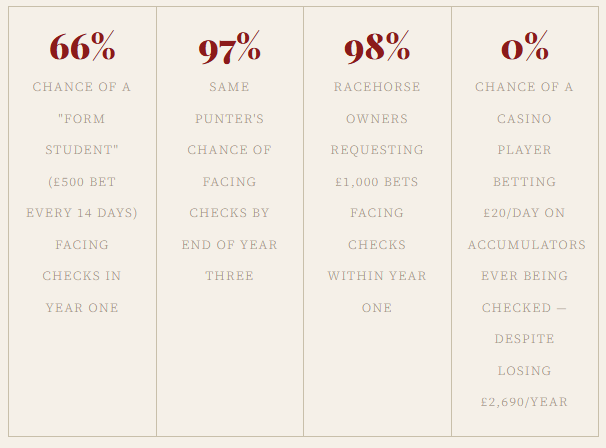
SharpBetting’s modelling of different customer types under the EFRC regime tells the story with brutal precision. A roulette player placing hundreds of small bets per day at a 2.7% house edge loses around £5,000 a year. They are almost never triggered for a check. After five years, only 2% of simulated roulette accounts faced an EFRC. An acca punter betting £20 a day on long shot multiples loses £2,690 a year on average. Never triggered once. Not a single check.
Meanwhile a Racing Enthusiast placing £25 bets on two selections a day at 8/1 loses around £1,800 a year. That is less than either the roulette player or the acca punter. Yet 76% of Racing Enthusiast accounts are triggered for a check by year three. A Form Student placing a single careful £500 bet every fortnight on a studied selection loses around £250 a year. 97% of Form Student accounts face a check by year three. She loses the least. She gets checked the most. 🤦
This is not a consumer protection regime. This is a system that identifies and interrogates the customers who bet intelligently on horse racing while waving through the customers who lose more money on online casino games. It is as if the policy were specifically designed to cause maximum disruption to the sport and product with the lowest harm profile in the entire regulated market. 🎯
And the economic consequences of targeting precisely this cohort are devastating. Horse racing receives the Horserace Betting Levy, which last year generated £108 million. That sounds significant. But it is only a fraction of the total. When media rights, sponsorship, marketing and promotional activity funded by betting operators is included, higher staking customers contribute close to six times the value of the Levy back into the sport. We are talking about an economic relationship worth hundreds of millions of pounds to an industry employing tens of thousands of people, sustaining racecourses from Carlisle to Cheltenham, and underpinning the livelihoods of stable staff, trainers, jockeys, vets, bloodstock agents and everyone else in the ecosystem. 🏟️
The Racing Post’s Big Punting Survey found that among those regularly staking £500 or more, more than 50% had already been subjected to affordability checks. Not 3%. More than half. These are the customers on whom racing’s financial survival depends. One in five of those betting at £100 a time has already used a black market bookmaker in the last twelve months. More than one in three of those betting at £1,000 or more per bet has done so. They are not leaving the market because they cannot afford to bet. They are leaving because they are being treated like suspects while the regulator focuses its ideological firepower on the wrong product, the wrong customer, and the wrong type of harm entirely. 🚨
The Commission wants you to believe FRAs are about protecting the vulnerable. The evidence says they are systematically harassing the financially robust while doing next to nothing for the genuinely at risk. It is the regulatory equivalent of conducting drug searches at the golf club while waving through the inner city. And the sport that pays the price is the one that had the lowest harm rate to begin with.
The Commission vs The Commission 🥊
Here is where it gets genuinely funny. If you enjoy regulatory self-contradiction as entertainment, which you absolutely should.
The GC’s Compliance and Enforcement Report for 2019 to 2020 stated, in black and white, that customers wishing to spend more than the national average should be asked to provide payslips, P60s, tax returns or bank statements. Operators were told this was what compliance looked like. Fines followed for those who failed to implement it.
Fast forward to April 2026. Tim Miller, the Commission’s Executive Director, told the Ethical Gambling Forum that in 2026 it cannot be right that regulatory compliance still leads to some operators asking consumers to share financial documentation.
So operators were fined for not asking for documents. And now the Commission is appalled that operators are asking for documents.
The Commission spent four years training bookmakers to demand your payslips, and is now standing in front of a camera looking baffled that bookmakers are demanding your payslips. It is the regulatory equivalent of arson followed by a vigorous public statement condemning fire. 🔥🔥🔥
The Pilot Nobody Reviewed 🕵️
The entire justification for the Board vote rests on the FRA pilot. A pilot that concluded in summer 2025. A pilot for which no final, published, independent evaluation has been made available to the public, to Parliament, or to the industry.
Helen Rhodes’ April 2026 blog was described as an “update on post pilot analysis.” It was a Commission blog post. Written by a Commission employee. Reviewed by the Commission. Published on the Commission website to inform a Commission Board decision.
Dan Waugh of Regulus Partners put it well: the Commission cannot be allowed to mark its own homework, particularly when the dog has a habit of chewing inconvenient facts out of any assessment it undertakes.
No independent review. No OSR sign off. No parliamentary debate. No published data. Just a blog.
This is the evidence base on which they are voting. Take that in. 🤦
408 People Who Know More Than You Do 📢
Over 400 of the most senior figures in British horse racing, including trainers, owners, racecourse executives, and industry veterans, signed an open letter to Culture Secretary Lisa Nandy warning of the catastrophic consequences of FRA implementation. The BHA chief executive warned publicly that the government was sleepwalking into disaster. The Racing Post ran weeks of frontpage coverage detailing consumer harm, black market growth, and the chill on racecourse betting rings.
The Commission’s response? “Much of it has been ill informed or inaccurate.”
Yes. John Gosden: ill informed. The BHA board: inaccurate. 408 signatories representing billions in economic activity: not quite up to speed.
Meanwhile the Commission, whose leadership has no professional background in racing or betting, and which derives much of its ideological scaffolding from public health academics funded by a California based anti gambling billionaire, is, apparently, the voice of reason in this debate. 🎓💰
The Black Market Elephant 🐘
The Racing Post has reported that black market betting now accounts for an estimated 20% of UK racing turnover. William Hill owner Evoke has cited black market penetration as a factor in its UK revenue decline. Multiple senior racing figures have publicly admitted to betting on unregulated sites because they cannot get a bet on in the licensed market.
Sarah Gardner, the new Acting CEO, cannot accept this argument.
The unlicensed operators she cannot be bothered to worry about do not verify age. They do not contribute to the Horserace Betting Levy. They do not fund GamStop. They have no safer gambling obligations whatsoever. They take from the sport and give nothing back. And they are growing precisely because the regulated market is being made progressively more hostile to anyone who wants to have a proper bet.
But sure. Let’s vote to make the regulated market even less accessible. That will definitely fix the problem. 🤡
What Happens Next 📅
The Board votes. FRAs go through. Operators implement. The 3% that becomes 660,000 accounts gets their credit files silently checked. A meaningful proportion of those have insufficient credit data, or flags from financial difficulties unrelated to gambling, or simply do not match the threshold. Their operators are obliged to interact with them. Some will comply with whatever is asked. Many will not. They will close their accounts and open new ones on unlicensed sites based in Curaçao or Gibraltar or nowhere at all.
The Racing Post will write about it. The Commission will say the coverage is ill informed.
The Levy will fall. Racecourses will struggle. Small yards will close. Rural jobs will go.
The Commission will convene a working group to study the issue. They will publish an update blog. It will be written by a Commission employee, reviewed by the Commission, and published on the Commission website.
And somewhere, a Curacao sportsbook will be counting its new British customers and wondering what all the fuss is about. 💻🌴
The Gambling Commission is not a public health body. It is not a Treasury department. It is a licensing authority with a statutory duty under s.22 of the Gambling Act 2005 to aim to permit gambling. That duty has not been repealed. It is simply being ignored.
Vote against it. Write to your MP. Tell the BHA. Tell the BGC. Make some noise.
Because the Commission is about to make a decision it cannot be held accountable for, using evidence it will not publish, on behalf of consumers it does not represent, with consequences it refuses to acknowledge.
And nobody is stopping them. 🚨
Geoff Banks is a licensed remote betting operator. Views expressed are his own.
HOW THE GAMBLING COMMISSION IS FAILING PUNTERS AND RACING
Betting & Regulation
The Right to Bet: How the Gambling Commission Is Failing Punters, Racing and the Law
Affordability checks are being imposed on millions of ordinary bettors on the basis of flawed evidence, without legal authority, and with consequences the regulator either cannot see or chooses to ignore. It is time to say so plainly.
Gambling is legal in Great Britain. It has been freely permitted, and indeed actively liberalised, since the Gambling Act 2005 created one of the most open betting markets in the world. The legislation that established this framework also created the Gambling Commission, and it imposed on that body a clear statutory duty: not merely to pursue the licensing objectives of protecting the vulnerable and preventing crime, but to permit gambling, in so far as the Commission thinks it reasonably consistent with those objectives.
That duty is not decorative. It is not a footnote. It sits in section 22 of the Act alongside the harm-prevention objectives, carrying equal legal weight. The Commission was never intended to be a body that restricts gambling whenever it can find a rationale — it was intended to be a regulator that allows a lawful activity to flourish while managing genuine risks. By any honest assessment, it has drifted very far from that mandate.
The “Choice” That Is No Choice at All
In a recent smartbetting podcast interview, Gambling Commission chief executive Andrew Rhodes was confronted with a direct and reasonable question. Punters are currently being told by bookmakers — among them bet365, one of the largest operators in the world — that if they wish to continue betting at certain levels, they must enrol in an open banking service called Bet Budget and grant access to their financial records. In some cases, we are told, this means sharing five years of complete bank account history across all accounts held.
The interviewer put this squarely to Rhodes: is this really a choice? Rhodes replied that it is a consumer choice — they decide whether or not to use open banking. The Commission is not doing this. The operator is doing this. And if you don’t like it, you can choose not to.
This answer deserves to be examined carefully, because it is not an honest account of what is happening.
The exchange — verbatim
“Their choice is adhere to this or you can’t bet with us — so it’s not really a choice, is it?”
— Interviewer, Smart Betting Club Podcast
“It’s a choice as in you can bet or you can’t.”
— Andrew Rhodes, Gambling Commission CEO
That response — “you can bet or you can’t” — is, in effect, an endorsement of coercion dressed up as consumer autonomy. The logic, applied consistently, would justify almost any operator imposition. A bookmaker could demand you provide your passport, your payslips, your mortgage documents and a letter from your employer, and the regulator’s position would be: that’s the operator’s commercial decision, and you are free not to use them. This is not consumer protection. It is the abandonment of it.
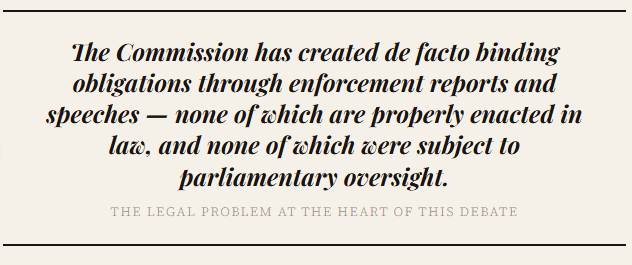
What makes it worse is that the Commission has spent years applying regulatory pressure — through enforcement reports, compliance activity, and implied threat of licence sanction — that has driven operators toward exactly this behaviour. The checks that Rhodes presents as “operator choices” are, in very large part, a direct consequence of Commission pressure applied through channels that were never subjected to formal rule-making or parliamentary scrutiny. Operators did not suddenly decide, of their own commercial volition, that demanding five years of bank records from punters was good for business. They did it because they were afraid of what would happen if they didn’t.
The Legal Duty Being Ignored
Section 22 of the Gambling Act requires the Commission to aim to permit gambling. This is not a vague aspiration. It is a positive obligation, and one that has meaningful content. The “reasonably consistent” qualifier that follows it requires the Commission to balance the duty to permit against the licensing objectives — it does not allow harm prevention to operate as an absolute trump card that extinguishes all other considerations.
Consider what proportionality requires in this context. The enforcement cases that provided the Commission’s original justification for pushing operators toward affordability checks involved genuinely extreme conduct: people losing hundreds of thousands of pounds without any check whatsoever, operators treating clearly distressed customers as VIPs. Nobody defends that. Nobody should.
But the regulatory response has not been calibrated to address those extreme cases. It has been applied at a level so far below them that it now routinely catches ordinary recreational punters — people losing a few hundred pounds a month on horse racing, betting within their means, causing harm to nobody — and subjects them to intrusive interrogation about their personal finances. The Commission’s own proposed thresholds would trigger checks at net losses as low as £150 in a month. At one point in the debate, the figure of £1.37 a day was cited as the effective threshold for frictionless financial vulnerability checks. The Commission did not dispute this arithmetic.
It is very difficult to argue that a policy causing documented, serious collateral harm — to a lawful industry, to hundreds of thousands of ordinary consumers, to the financial ecosystem of British horse racing — while failing to demonstrate any measurable reduction in problem gambling rates, satisfies the proportionality test that section 22 implicitly requires.
The “3%” That Tells a Misleading Story
Throughout this debate, the Commission and government have repeatedly invoked the figure that only 3% of accounts will be affected by enhanced financial risk checks. This has been treated as a reassurance — a signal that the vast majority of punters have nothing to worry about.
It is not an honest reassurance. It is a number that has been selected, presented and sustained in its most politically convenient form.
The 3.2% figure comes from a survey of 5.86 million active accounts covering May 2020 to April 2021. It represents the proportion of accounts losing £2,000 in a rolling 90-day period in a single year, at 2020 price levels. From that baseline, the problems compound quickly.
The thresholds were never inflation-adjusted before implementation. By summer 2024, when the policy was due to begin, £2,000 at 2020 prices had risen to approximately £2,528 in real terms. The figures simply weren’t updated. On inflation-adjusted terms, around 4.1% of accounts would breach the 90-day threshold, and 2.5% would hit the 24-hour £1,000 threshold. Because accounts can qualify for both, the true affected proportion is higher still — the Commission’s own analysis confirmed that between a fifth and a quarter of individuals identified by one threshold did not exceed the other, meaning the number of unique individuals affected is notably higher than either figure alone suggests.
More importantly, 3% in year one is not 3% in year three. The process is not stationary. Accounts that avoid checks in year one can breach a threshold in subsequent years as results accumulate. Independent simulation modelling of typical racing punter profiles makes this vivid:
That last figure deserves emphasis. The threshold design is structurally biased. A punter placing modest daily accumulator bets at a high operator margin — losing nearly £2,700 a year — will never trigger a check, because steady daily losses don’t produce the variance spikes that trip the thresholds. Meanwhile a knowledgeable racing punter placing a single £500 fortnightly wager will almost certainly face checks within three years, even if they are profitable overall.
The policy, in short, disproportionately targets the most engaged, most informed, most economically valuable customers of horse racing — while largely ignoring the steady, high-frequency, low-unit gamblers that arguably represent a greater harm risk. This is not a technicality. It is a fundamental design failure that the Commission has never adequately addressed.
Horse Racing: Not Collateral Damage. A Foreseeable Catastrophe.
When the podcast interviewer asked whether the knock-on effect on sports like horse racing was “just collateral damage”, Rhodes demurred. He acknowledged racing’s unique dependency on gambling — 70% of its gross gambling yield comes from just 1% of accounts, five times the concentration of other sports. He acknowledged a declining consumer base. He then suggested that racing has structural problems independent of affordability checks and that it’s “not really for the Gambling Commission to comment on the economics of horse racing.”
This position is not sustainable. The Commission’s regulatory decisions are a direct, proximate, and now quantified cause of racing’s financial deterioration. The claim that this is somehow outside the Commission’s remit is precisely the kind of institutional detachment from consequences that makes this situation so frustrating.
“The Gambling Commission increasingly appears to be unaccountable and out of control. Moreover, they continue to be unable to demonstrate any evidence as to the impact that the current affordability measures are having on problem gambling rates.”— Martin Cruddace, CEO, Arena Racing Company
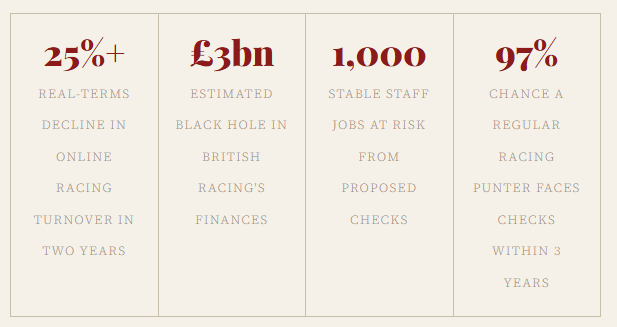
The numbers are not in dispute. Online racing turnover fell to £8.37 billion in the year to March 2024, compared to around £10 billion two years previously. Had it grown in line with inflation, it would be close to £11.5 billion — a real-terms decline of more than 25%, or a gap of some £3 billion. The BHA’s own data shows turnover year-to-date at end of August 2024 was down a further 9.5%, suggesting the decline is accelerating rather than stabilising.
The levy that funds racing’s prize money, its safety infrastructure, its veterinary research — all of it flows from betting turnover. British racing already receives less than 3% of betting revenue, compared to 7.7% in France and 8.4% in Ireland. It cannot absorb a 25% revenue shock. The mathematics are not complex.
Independent economic modelling by Regulus Partners, commissioned by the BHA, estimated that up to 1,000 stable staff jobs — one in seven — could be lost if the current proposals are implemented in full. These are not executive positions. They are the people who care for 14,000 thoroughbreds in training, who work in rural economies across Britain, who are not rich and who have no obvious alternative employment in the areas where racing yards operate.
“Racing cannot take any more financial setbacks. Racing and betting have come together on this issue like never before, because they know that they face the greatest ever threat to their existence.”— MP Philip Davies, Westminster Hall debate, February 2024
British racing contributes £4.1 billion to the British economy. It employs 80,000 people directly and 100,000 indirectly. It supports 8,000 small and medium enterprises. It touches 60 marginal parliamentary constituencies. It is not a fringe activity of the wealthy. It is a rural industry, deeply embedded in British cultural and economic life, and it is being hollowed out by a regulator that cannot demonstrate that what it is doing is working.
The Black Market: The Risk the Commission Keeps Minimising
Perhaps the most concerning aspect of the Commission’s posture throughout this period has been its persistent tendency to underweight the black market risk. At a Culture, Media and Sport select committee hearing, Rhodes said that every time he had heard someone say people were going to the black market, he had asked them where, and had never received an answer he could act on. This was presented as scepticism about the phenomenon’s scale.
Since then, Yield Sec data has shown a substantial increase in black market gambling, with visits to unregulated sites from UK users tripling during the 2022 World Cup, with peaks during Cheltenham and Royal Ascot — precisely the events most associated with the racing audience being disrupted by affordability checks. Rhodes contested the methodology. He may have points. But the direction of travel is not seriously in dispute, and his earlier scepticism now looks like something he has had to quietly retreat from.
What no one in the Commission’s leadership has grappled with honestly is the fundamental policy logic problem. If affordability checks in the regulated market drive even a fraction of consumers to the unregulated black market, the harm-prevention case for those checks collapses. Black market operators have no safer gambling tools, no self-exclusion obligations, no consumer protections whatsoever. They don’t want winning punters, and they are notorious for not paying out. A policy that displaces people from a regulated environment into that landscape has made those consumers worse off by every measure the Commission claims to care about.
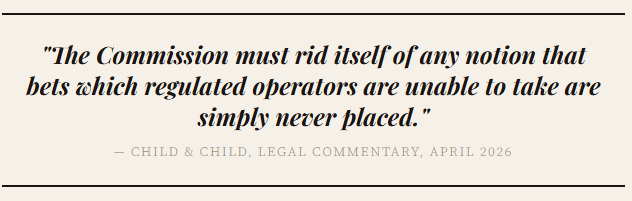
The Commission appears to operate on an implicit assumption that bets which regulated operators are unable to take simply will not be placed. That assumption is not credible. It never was.
What Honest Accountability Looks Like
None of this is to argue that gambling requires no regulation, or that every punter is responsible and every operator trustworthy. The cases that prompted government action — people losing hundreds of thousands without any interaction from the operator — were genuinely indefensible. The regulatory impulse behind affordability checks is not unreasonable in origin.
But reasonable in origin does not mean appropriate in execution. And the Commission has failed, repeatedly and seriously, on execution:
It applied regulatory pressure through enforcement reports and informal guidance without formal rule-making, creating binding practical obligations that were never subjected to legal scrutiny or parliamentary oversight. It allowed years of chaotic, inconsistent, operator-by-operator affordability checking to cause real harm to real consumers before attempting to standardise anything. It cited a “3% of accounts” figure that was stale, not inflation-adjusted, accounts-not-people, and systematically selected to understate real-world exposure. It pushed a pilot scheme to test whether frictionless checks work — after those checks had already been de facto implemented and had already caused the damage the pilot was supposedly designed to prevent. It has been unable, after years of this regime, to point to any evidence that problem gambling rates have fallen as a result. And it has watched a 25% real-terms collapse in horse racing turnover — a lawful industry it is legally obliged to permit — and described it as something it cannot properly comment on.
That is not the record of a regulator carrying out its statutory duty. It is the record of a body that has allowed one interpretation of one part of its mandate to crowd out everything else, without accountability and without evidence that the approach is working.
What Needs to Happen
The government should require the Gambling Commission to publish, before any formal implementation of enhanced financial risk checks, a full impact assessment that quantifies: the reduction in problem gambling rates attributable to current affordability measures; the proportion of consumers displaced to the unregulated market as a result; and the economic damage to horse racing and the wider rural economy. If such an assessment cannot be produced — because the evidence does not exist — then the policy cannot be justified.
The Commission should acknowledge formally, and in its regulatory guidance, that it has a statutory duty to permit gambling, and that this duty imposes a proportionality requirement on everything it does. The harm-prevention licensing objective does not override that duty. It must be balanced against it.
The open banking situation — where consumers are told by regulated operators that they must surrender five years of complete financial data or be refused service — must be directly addressed. Rhodes’ characterisation of this as a “consumer choice” is not acceptable from a regulator that is supposed to ensure gambling is fair and open. It is not open to say to a consumer: hand over your most sensitive personal financial information, or we won’t take your bet. That is not consumer autonomy. It is coercion, and the Commission should say so.
And the racing industry — which operates under a unique statutory funding relationship with the gambling sector through the levy — deserves specific recognition of the disproportionate impact that demand-side restrictions on betting turnover have on its finances. The Gambling Commission’s mandate to permit gambling is especially acute here: if it is permitting the regulated industry to collapse the consumer base for the very betting activity that funds an entire sport, it is not fulfilling its obligations under the Act.
Over 400 leading figures in racing — trainers, owners, jockeys, MPs of all parties — have signed an open letter to the Secretary of State calling for affordability checks to be scrapped. The BHA has warned that the Commission appears to be considering the pilot results without adequate government scrutiny of the consequences. Racing’s turnover is still falling.
The Gambling Commission was created to balance protection with permission. Right now, it is failing at both: it cannot demonstrate the protection is working, and it is presiding over the systematic destruction of a legal, economically vital industry it was legally obliged to protect. That is a regulatory failure of the first order, and it requires a direct political response — not more pilots, not more consultations, not more expressions of good intent.
British punters have a right to bet without being subjected to financial interrogation. British racing has a right to the regulatory environment the law promised it. Neither right is currently being honoured.
This analysis draws on the Gambling Act 2005, the Gambling Commission’s consultation responses and enforcement reports, parliamentary debate records (Hansard, February 2024), independent economic modelling by Regulus Partners, research published by the British Horseracing Authority, the Smart Betting Club podcast interview with Andrew Rhodes, legal commentary by Child & Child, and impact assessments published by gamblingreform.co.uk. All statistics are sourced from publicly available official data or named independent research.