Response to SP regulatory system – consultation
Former NJPC chief exec Clive Reams, recently penned a letter in response to the criticism levelled at the SPRC, after the Grand National, advocating ‘no change’ to the SP system. When the current mechanism was devised in the 1990’s he argued vehemently against the then proposed system whereby 5 bookmakers could govern the SP returns – as ‘a bookies benefit.’
Of course he was at the time in violent disagreement with a system being proposed where the largest five firms produced the SP’s. And of course he would have been right. To permit those same firms to control the returns, when their off course empires were of such high worth in comparison to a veritable ‘cottage industry’ – would clearly disfavour punters. Any notion of those same organisations using their on course positions to actually bet competitively – and disfavour their huge shop and mobile empires, would have been nonsensical.
Yet now, we see that same official arguing in favour of the current mechanism. Despite the fact that same system has been modified several times, to permit now as low as three trading on course bookmakers, not only to provide an SP, but importantly the shows, otherwise known as board prices
Mr Reams hasn’t been seen in the betting rings for many years to the best of my knowledge.
It’s my conviction the SP mechanism – in its current form, was practicably out of date shortly after its inception and requires thorough modernisation. Not abolishment.
The commission, in its call for responses to the system, makes clear it supports little to no change to the system. That we are afforded a workable and simple mechanism, which provides for such as guaranteed odds against SP. Why the commission feels ‘board’ prices would disappear in any revisions is beyond my understanding. Perhaps to scare people into the false belief that show odds would be consigned to the bin.
We already utilise industry odds in some meetings – Meydan and Longchamp for example. There’s no argument to support the commission’s assertion a system based on track bookie’s odds- is the only one which would support guaranteed odds
It’s rather apparent the SPRC depends upon the advice and views as reported by the press association staff, tasked with returning a fair SP from the racetracks. They are neither witness nor party to discussions between bookmakers – and their customers. Their honesty is not in question here- but they clearly cannot have the ground level experience to report accurately what is really transpiring.
The commission will also consult with the FRB, namely Robin Grossmith for his advice. Whilst Robin is a respected colleague of many years’ experience, it should be remembered that an important part of his remit is to secure payments for on course bookmaker’s data. He would naturally argue the system as working in a satisfactory manner – and without any knowledge or understanding of how the mechanism, currently being employed, affects off track companies. Most track firms care little for the impact their activities have on the wider betting community
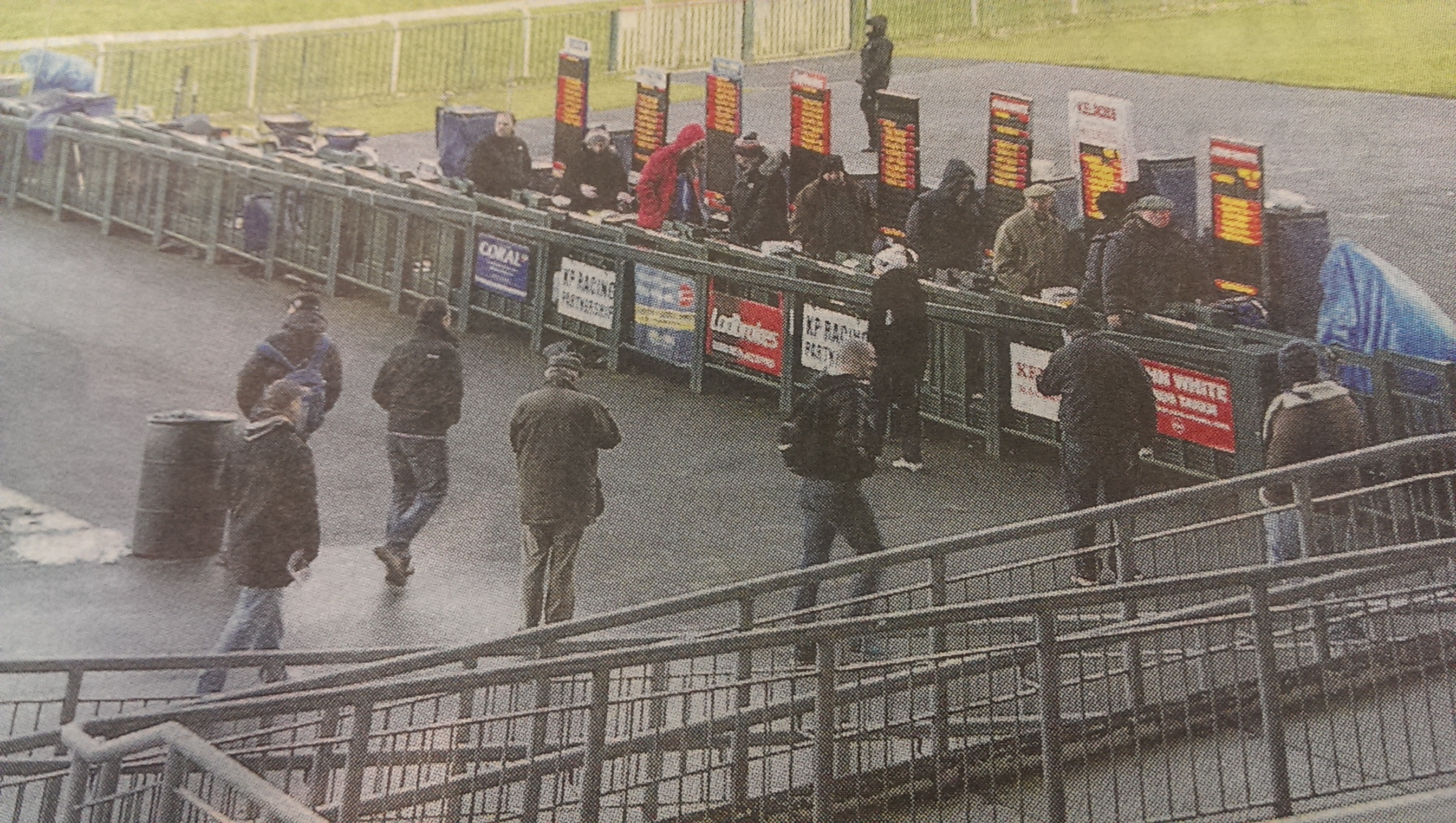
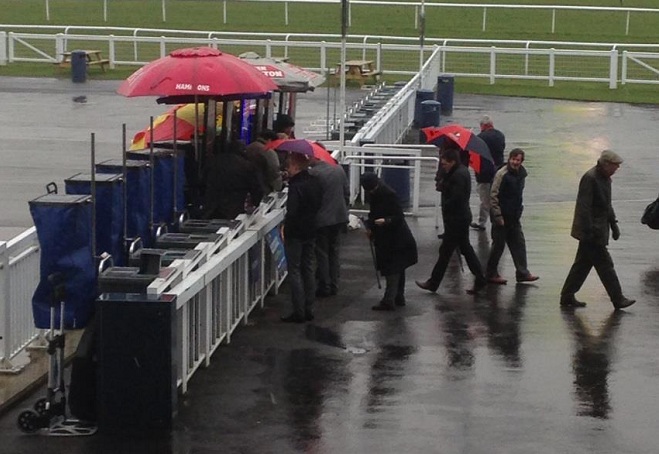
The dynamics of betting have fundamentally changed in the last 20 years, whence the current system was put in place. In that time changes have been few and limited in nature. 20 years ago a pitch at Sandown at the top of the rail would have been worth well in excess of £100,000 – and very hard to come by. These days – those same pitches can be purchased for less than a third of that value- and with minimal interest, most certainly not from someone trying to get into racecourse bookmaking as a career! In the same 20 years- the average turnover per race to on track firms would have declined to not less than 1/6th the value of the late 1990’s. Midweek racing has declined in interest to customers to attend. Rings are often ghost towns. Few punters turn up, and in a cashless society they have less to spend with bookies trading. Mobile betting apps have taken over – being more aggressive in nature, easy to use, from funded accounts and related to offers. Racetracks have taken over betting at some tracks –and this new competition to the business a track bookmaker is afforded will have significant impact on their very existence.
My average midweek turnover, as a leading layer, in strong betting positions, is now routinely less than £500 a race- if I bet in any way sensibly. A risible figure. For this reason I rarely attend midweek fixtures. Nor do many of my colleagues. The only way to buck such turnover figures is to exceed exchange odds, then to risk arbing from other bookmakers. If a bookmaker does not offer a pure exchange price on a ‘fancied’ runner- it’s difficult to field any appreciable money for it
Bookmaker numbers have been shored up by some firms operating multiple positions. One bookmaker (John White) operates three positions at Kempton – a small ring as you are aware. Kempton – for example, routinely operates with a sample of around six firms – they are providing prices for a huge off course industry, from a venue where few punters turn up to bet
At the same time as this decline has been evidenced- the off track firms have increased in size, technology advances, and power. Where once betting rings were vibrant and busy, with standard place terms, minimum lay to lose guarantees – and by extension a useful ‘guide’ to SP’s – now they are ripe only to cheap manipulation of their odds. Huge multi national betting concerns can control a weak market with veritable pennies. This imbalance would simply be outlawed in any other financial sphere. It is important for the SP commission to give this point full consideration.
VOLUME OF RACING
Since 1995, and importantly in the era of Peter Saville at the BHB in 2005, the volume of actual meetings has soared from around 1000 annually – to 1450 currently. Racetracks have also focussed their business more towards Saturdays and providing cheap funded product. This has had a thoroughly negative effect to the turnover on track and split the punters interest between meetings. Further a customer can now sit at home and watch either ATR or RUK on his satellite – even watch live streaming racing on the likes of Bet365. All have had an entirely negative effect to bookmakers on track. In the same period the expenses of running an on course business have soared. Many bookmakers have quietly retired from the ring
RACECOURSE DATA TECHNOLOGY
In the last 20 years or so most firms now utilise software provided for them by RDT. The build of their system and its layout is specifically designed to facilitate easy wagers to and from exchanges. A wager can be practicably negotiated faster than on a web browser, a whole set of prices backed, or an entire position closed out. RDT receive a commission from Betdaq for such activities. Such software did not exist in said advanced form when the SPRC devised the mechanism in the 1990’s. All bookmaker software on track is designed to facilitate wagers with exchanges. It has caused a sea change in how bookmakers engage in business on track. They differ from their off track colleagues in that instead of being viewed as traditional ‘layers’ – balancing books with real money, they have metamorphosed to ‘traders’
TRADING
What should also be considered is the wholesale change in the approach by on course bookmakers to betting. When the mechanism was put in play, the majority of firms were traditional in nature. That is to say they were in the business of framing a book and accepting risk. This has fundamentally changed. The vast majority now ‘trade’ many wagers away with exchanges to create margin and keep risk levels low. In order to engage sufficient liquidity to make this practice work – prices must virtually mirror those available on exchanges. For example – a firm will typically offer 4/1 a horse for any variance on an exchange from 4.9 to 5.4. If the operator is lucky, he will be able to trade at 4/1 and hedge at 5.4 – bookmakers have become the new ‘arbers’
There’s little discernible difference between ‘show’ odds and exchange odds for the more fancied runners
Off track firms are, by extension, accepting wagers – and risk, on shows therefore based almost purely on exchange odds. This is a far from healthy system – and a central plank for lower levy returns – down over 50% in recent times. Most bets are accepted at board odds- rather than the more ‘protected’ SP returns. Off track firms do not ‘trade’ wagers in the manner in which on course firms do. To boot, since the shows being returned are up to one minute behind changes in exchange odds, off track firms find themselves subject to arbing from punters. This business is unprofitable and most bookmakers close accounts from those engaged in this practice. Such moves are unpopular and leave firms open to unjustified criticism.
THE STARTING PRICE
Let us consider the actual SP – in practice most track firms have stopped trading aggressively, or at all – it’s often too risky to bet to exchange odds and risk a sizeable wager which a bookmaker cannot trade, with the exchange, in the limited time before the off. Prices are revised downwards throughout the ring – or unavailable. Most books are structured and the operator is loathe to change it. Large operators, such as William Hill on course, are naturally particularly mindful to ‘bet well’ with one eye understandably on their important off course entity. In my experience their returns are given considerable weight in any return. SP’s are, in practice, more favourable to the industry for these simple reasons.
There’s habitually a considerable difference between exchange SP’s and Bookmaker Sp’s
PRICE REVISIONS
It is common in circumstances to hear criticism of course bookmakers for failing to balance books by pricing up horses which they have not significantly laid, at times when they take substantial monies from legitimate hedging activity happening fast and late throughout the ring. Through the year we will hear many examples- the Grand National being a notable one, of an overround which disfavours punters betting at SP.
This is fairly easy to explain- since most track bookmakers are less ‘layers’ than ‘traders’ . When they do catch late funds for a selection, they are far more about dealing with trading the wager profitably on exchanges. In the 1990’s – most firms would have been trying to balance their books by raising the prices of other runners to compensate, if you will. This is no longer necessary with the advent of betting exchanges and software dedicated to trading
Further, the notion that bookmakers should counter raise odds when there are often no punters to offer those odds to, is fanciful.
Finally, large entities sending money back to the tracks place their wagers as late as practicable, certainly never 20 minutes before the race for example. Again such practices, as in the likes of FOREX, would be viewed as questionable. Is racing somehow different? I am not suggesting they are not fully entitled to boss the SP’s, but there are issues of scale and timing.
SAMPLE SYSTEM
The current mechanism employs a bank of up to 25 firms at the largest meetings. At the lesser meetings it is exceptionally difficult to find 25 firms, betting within the commission’s guidelines, to return an SP. The SPRC has revised the number of bookmakers required to return an SP to below the level which caused such upset between the NJPC and the commission in the 1990’s, when 66 questions were tabled on the subject The commission has also modified what it permits to return a show to below the accepted industry standard terms and without requirement for a minimum ‘lay to lose’ figure.
At York’s Dante meet recently, I was one of only six firms in the whole ring, to offer an industry standard ¼ the odds a place in two 16-21 runner handicaps on one day, whilst the rest of the ring were legitimately offering a 1/5th. A bookmaker betting to a fifth in said instance could offer 25/1 a horse – whereas I would only be able to offer as low as 16/1. How does the commission handle such anomalies? Or where the favourite is odds on and all but a couple of firms are betting win only? Once again the sample is nowhere near that required for a fair SP, nor takes into account it is supposed to mirror standard terms off track to be seen as accurate – that is if there were appreciable monies to bet to. There are many examples of such cracks in the system throughout the year, which would not be evidenced if we had a system properly balanced by the true weight of money wagered on a race
We are of course well aware that the Grand National return in no way accurately reflected a fair return. Whilst I would argue that 1.66% per runner is by no means excessive- the truth remains the show embarrassed bookmakers on course, and will lead to customers choosing not to wager at the racetrack at all. Many firms were offering 9/1 the favourite – which was returned at 6/1- at the same time the exchange was offering 14.5 on Shutthefrontdoor.
The simple fact is the use of ‘SP Samples’ as a methodology for returning prices (especially where 5 of the 25 firms in the show represent major off track business) is clearly far too easy, and inexpensive, to control. In practice it’s fairly evident who the firms are that are part of the sample
Bookmakers not included in the sample are routinely ignored. Bookmakers within the sample are often asked to accept wagers at less than the odds they are currently displaying. Particularly at small meetings. Is there clear and incontrovertible evidence that this goes on? No. It is however, quite routine to be asked to ‘co-operate’ on shows in return for the crumbs off of a large concern’s table. If you co-operate – you benefit.
IS this system of hedging fair? Not if a wager is proffered ‘with hooks’. Any discussions with other firms will confirm this is precisely what goes on. It is totally acceptable for a large concern to wager to control a price which reflects the full weight of money. But not where said concerns can control a the market for such a tiny outlay and by openly requesting the bookmaker to cut his odds in return for a nominal wager.
WEIGHT OF MONEY
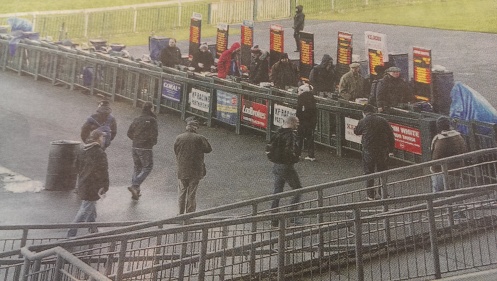
What should concern the SPRC, is the effect on a fair mechanism of such large concerns wagering with such a tiny entity as three to eight bookmakers trading an all weather track for example. What also should engage thinking, is the possibility of manipulation of weaker exchanges on small markets. Especially when one considers RDT controls well in excess of 90% of on course firms and produces software designed specifically to encourage the practice of trading. In reality, it is Betdaq- the weaker exchange of two, who govern on course returns. In my view this could be viewed as a cartel. It takes a tiny movement of exchange money – typically less than £10, to be followed by several on course layers.
INDUSTRY PRICES
Why have off track concerns not called for control of their own SP’s to date? Two factors explain this anomaly
First, and rather obviously, where the SP itself is required to be revised downwards, it can be easily controlled in a market devoid of regular punters with a very small ‘hedging’ fund. Large concerns represented on course can constitute up to 50% of those available to govern an SP. Especially as the SPRC mandates that in the strongest rings at our festivals, only up to 25 firms are required to return the show. Hedging can therefore be restricted to just those firms. This is precisely what occurred at Aintree. Indeed one pivotal operator, running multiple pitches, informed me ‘where he was in the sample, he was 6/1, – where he was outside the sample – 9/1 about the favourite’.
If all operators are betting to the same commercial terms – there’s really no need to limit the number who return an SP, and it’s clearly a system which fails the means test in such areas.
Second – what concerns major operators off track, when one considers the issue of industry odds, is how their competitors would behave were the mechanism revised. Would, for example, an aggressive operator such as Paddy Power- buck the general acceptance of a new industry return by producing its own ‘enhanced’ SP. As things stand currently – everyone accepts the status quo, warts and all. Of course most firms would prefer an accurate industry SP, not based on exchange odds on course, but the elephant in the room remains their competitors
With the disappearance of John McCririck from television schemes – a major obstacle to industry odds has been removed
OVERVIEW
Centrally the landscape of betting is unrecognisable – were we to compare it with 1995.
The SP regulatory commission is recommending we keep a system where the ‘show’ odds for fancied horses directly mirror exchanges and where the SP is ‘protected’ by circumstances. Where small time traders – desperate for any bettors can be easily bullied by larger operators and where punters feel they are being cheated (unfairly) by track firms.
We are long overdue constructive change. I welcome this consultation
Proposals.
- On Course bookmakers to compile one fifth part of a new mechanism, only where there are an absolute minimum of 25 separate entities available to return an SP
- Those 25 firms must be betting to recognised tattersalls standards in every race they are engaged to return the SP. Modified terms can not be accepted
- At least 25 firms must be available offering a full each way service to return an SP
- Sample system to be totally abolished on course. All firms betting to standard tattersalls terms to be included in the returns
- Track bookmakers who wish to include their data in any new return, must undertake to lay any advertised price to a minimum of £100 – to include to other operators.
- Four fifths of the new mechanism to involve the 19 largest operators. These operators to include Betfair and racetrack bet
- Betfair’s SP can only be taken from their each way market
- Industry odds governed by weight of money and by provision of prices to SIS
- SPRC to consult with operators to produce a formula which most accurately reflects an operators liquidity – and therefore influence on the SP
Geoff Banks
10 June 2015