My customers are not the Gambling Commission’s property
By Geoffrey Banks | 22 October 2026
I’ve been a bookmaker for decades despite not being that old. I’ve taken bets from people I’ve known for most of my working life. Some are wealthy, some aren’t. Some bet hundreds, others thousands. Most understand perfectly well what they’re doing. Gambling involves risk.
They’re my customers. Not the Gambling Commission’s.
They are adults spending their own money on a lawful pastime. They expect me to offer competitive odds, honour their bets, pay their winnings and treat them with honour.
They don’t expect to explain their salaries, savings, pensions or personal wealth to a stranger simply because they enjoy gambling. Or share it with my staff, quite understandably
And they certainly don’t expect a regulator to decide, years afterwards, whether I should have allowed them to bet.
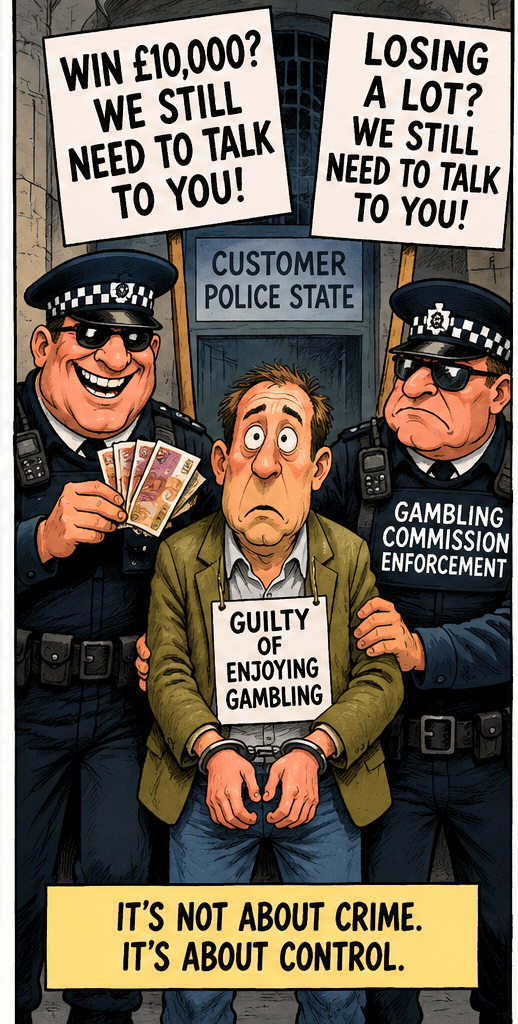
Yet that is increasingly what the Gambling Commission’s enforcement department is doing.
There were genuine failings. Delayed withdrawals, inadequate responses to repeated failed deposits and breaches of agreed customer limits are matters a regulator should address.
But among the findings was criticism that L&L had not adequately established whether customer expenditure was proportionate to income or wealth.
There it is – affordability checks!
And although Andrew Rhodes has left the Gambling Commission to balls it up at Harris Hagen, the policies developed under his leadership have not simply disappeared with him. They’re doubling down on insane
Sarah Gardner is now Acting Chief Executive. The Commission remains responsible for explaining why its enforcement decisions demand financial assessments that its published policy says it doesn’t require.
Customers don’t want financial interrogation to have a bet.
The Commission talks endlessly about protecting customers. It might consider listening to them before they all end up at Stake. Com
Many customers have made their objections to intrusive financial checks perfectly clear. They don’t want to hand over bank statements, payslips or access to their financial transactions to justify having a bet.
The Commission itself acknowledges that document checks are unpopular. Its financial risk assessment proposals are specifically intended to reduce reliance on them.
So why does its enforcement activity continue to encourage operators to investigate customers’ income and wealth?
I know customers who would sooner close an account than disclose their personal finances. I don’t blame them.
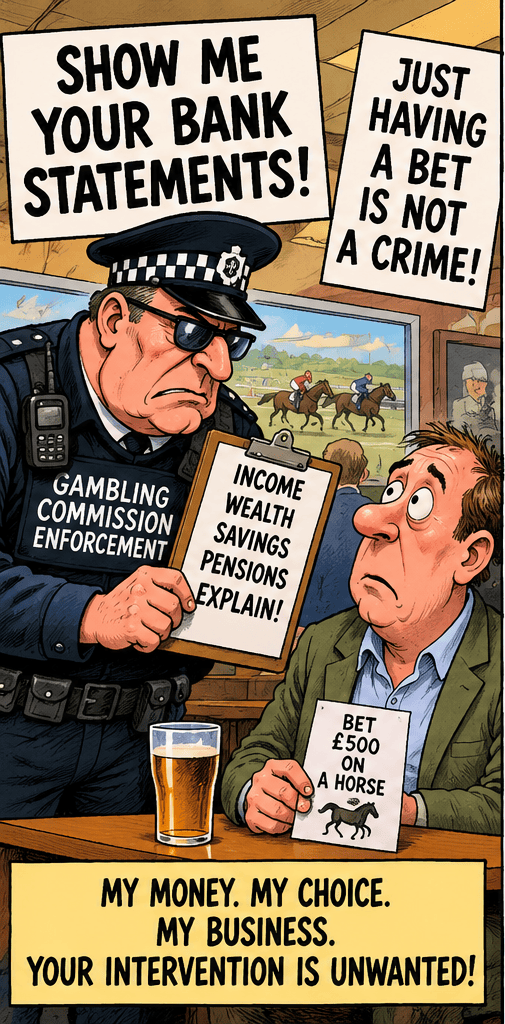
When did a bookmaker become entitled to examine someone’s bank statements simply because they want £500 on a horse?
And why should a successful businessman, who has spent decades accumulating his own wealth, have to prove to a gambling company that he’s allowed to enjoy it?
We don’t demand financial assessments before someone buys an expensive holiday, a luxury car or a painting.
Gambling carries risks, and those risks justify appropriate regulation. They do not justify treating every customer who spends substantial sums as financially incompetent.
The Commission increasingly forgets the difference.
Where is the evidence that these interventions work?
Here is the question Parliament should be asking.
Where is the convincing evidence that the financial interventions being imposed on customers actually reduce problem gambling?
Not evidence that some gamblers experience financial difficulties. We know that.
Not evidence that a credit-reference agency can identify missed payments or defaults. That is what credit-reference agencies do.
I mean evidence that requiring operators to interrupt betting, demand documents, investigate wealth and restrict customers produces a measurable reduction in gambling harm.
The Commission’s financial risk assessment pilot examined whether financial vulnerability could be identified and whether assessments could be conducted with minimal disruption.
That is not proof that the resulting interventions prevent problem gambling.
The Commission has decided to introduce financial risk assessments in stages and says it will continue evaluating their impact.
Yet operators are already being criticised through enforcement for failing to undertake financial enquiries that resemble the affordability assessments the Commission says it doesn’t require.
The burden should be on the regulator to demonstrate that its interventions are necessary, effective and proportionate. To prove these overbearing imposition on people are worthwhile
Instead, bookmakers face the financial consequences of failing to intervene, while the benefits of those interventions remain insufficiently demonstrated.
That is a remarkably one-sided arrangement.
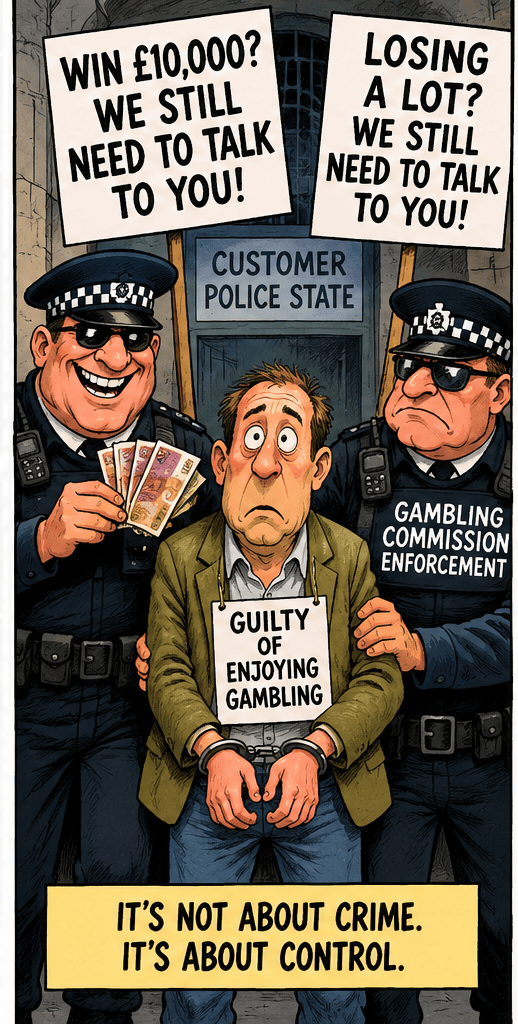
Apparently, winning is now suspicious
Consider the recent Rank settlement involving Grosvenor Casinos.
The Commission criticised the absence of safer gambling interactions with a long-standing, wealthy customer who lost a substantial amount.
In another example, an established customer won around £260,000, subsequently lost £250,000 over 12 days and remained £10,000 ahead.
The Commission nevertheless criticised the absence of recorded safer gambling interactions.
A customer wins £10,000 and the regulator finds fault with the operator.
A pattern of substantial gambling is not, by itself, proof that the customer has a gambling problem. Nor does a wealthy customer become financially vulnerable merely because the regulator considers the sums involved large.
What troubles me is the disappearance of proportion and context.
I know customers for whom a £5,000 bet is entirely ordinary. I know others for whom £100 is significant.
That is why personal knowledge and commercial judgment matter.
But the Commission’s approach encourages operators to disregard that knowledge and intervene defensively, because an ex copper in the enforcement department may take a different view two years later.
If a bookmaker intervenes unnecessarily, the customer suffers the inconvenience. If the bookmaker doesn’t intervene, the Commission may impose a substantial settlement.
The regulator faces neither consequence.
A policy the enforcement department appears to ignore
In May 2025 the Commission explicitly stated that it had no regulatory requirements for affordability checks and wasn’t proposing any.
Andrew Rhodes had previously explained to Parliament that affordability policy was being addressed through the Government’s Gambling Act Review White Paper process.
He has since departed. But his departure doesn’t repeal the Commission’s published policy.
Indeed, senior Commission officials subsequently made clear that the organisation intended to continue the regulatory approach established during his tenure.
Sarah Gardner therefore inherits a question that Rhodes never satisfactorily resolved.
The Commission distinguishes financial risk assessments from traditional affordability checks, saying they identify serious financial difficulties rather than calculate what a customer can afford.
Yet in the L&L case, enforcement criticised failures to assess whether expenditure was proportionate to wealth or income.
One customer deposited £4,400 within eight hours. The Commission questioned the provenance of the money, including the absence of evidence that it originated from employment, business income or savings.
Other warning signs justified AML enquiries. But money won from another bookmaker isn’t inherently suspicious, and customers aren’t obliged to finance their gambling from wages.
Checking whether funds are legitimate is one thing. Assessing whether a customer is sufficiently wealthy to gamble is another.
If the Commission’s policy says affordability checks aren’t required, why does its enforcement department appear to be demanding financial judgments that serve much the same purpose?
Sarah Gardner should explain whether enforcement is applying the Commission’s policy or developing its own.
When did an operator’s own policy become law?
L&L’s internal procedures said customer funds should ideally be evidenced as coming from employment or business income.
The Commission criticised the company for not following those procedures.
The LCCP requires effective AML controls, including proper implementation of relevant policies. But an operator’s voluntary precaution doesn’t automatically become an additional licence condition.
If a bookmaker introduces safeguards beyond the regulatory minimum, should it face greater punishment merely because it hasn’t followed every detail of them?
That creates a perverse incentive.
Write an ambitious compliance manual and hand the Commission more ammunition. Write the bare minimum and give it fewer opportunities to find fault.
The regulator should be encouraging operators to improve their procedures, not using voluntary commitments as an excuse to enlarge their regulatory obligations.If so, what should John Pierce and his merry band of stormtroopers in the enforcement unit fine themselves for departure from aim to permit, for example? Or application of affordability based enforcement? That’s a material breach. How many millions Mr Pierce should you pay?
If failures against those voluntary standards are increasing financial settlements, the Commission should explain how those penalties are calculated.
An operator shouldn’t be punished twice for the same underlying deficiency because it also happens to appear in its own manual.
The operators have helped create this mess
The industry cannot escape criticism either.
Major bookmakers began conducting their own affordability checks, often introducing restrictions and demands for financial information that went beyond what the Commission had expressly required. Unquestionably this was, in part l, driven by a desire to profile all clients and filter out traders
Instead of challenging the regulatory direction, parts of the industry effectively implemented it themselves.
Customers paid the price in intrusive questions, delayed transactions and closed accounts. They’ve departed gambling or opened up in Curaçao
Then came the settlements.
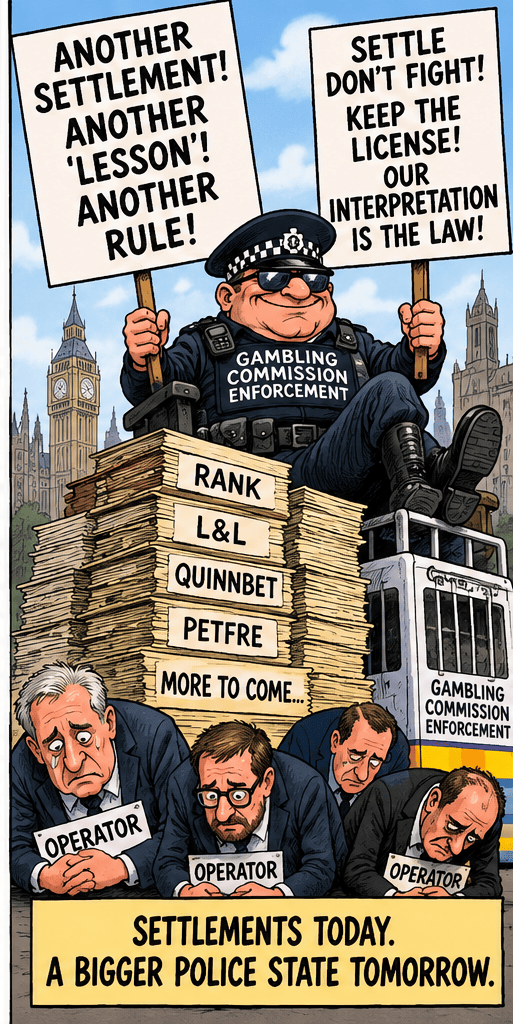
Rank, QuinnBet, Petfre, L&L and others have agreed substantial payments rather than fight the Commission’s interpretation through potentially lengthy and expensive proceedings.
I understand why, but it won’t be my direction of travel, these enforcement types deserve their day in front of a judge. In fact appeasement, driven by their lawyers, has been disastrous.
When a regulator controls the licence on which your business depends, today’s supine breed of industry lawyers advise you to settle rather than risk a contested enforcement action, a much larger penalty or even revocation.
For an individual company, that may be commercially sensible.
Each settlement, however, allows the Commission to publish another interpretation of the rules. The next operator is expected to have learned the lesson. Another settlement follows, and the interpretation gains further unmerited authority a judge would clearly reject.
Nobody has to prove that the Commission’s interpretation would survive a serious legal challenge.
The operators pay, their lawyers close the file, and enforcement moves on to its next target. Oh, and they love a good public razzing of the operators.
A habit has developed. The Commission investigates, the operator negotiates, the lawyers recommend settlement, and another public statement enlarges the expectations imposed on everyone else.
The operators have helped build the machinery now being used against them.
And their customers have had remarkably little say in any of it.
Is enforcement acting beyond its powers?
Licence condition 12.1.1 addresses anti-money-laundering controls. Social responsibility code 3.4.3 requires monitoring for indicators of harm and appropriate customer interaction.
Neither expressly imposes a general requirement to assess every customer’s gambling expenditure against income or wealth.
Yet enforcement statements increasingly appear to demand financial investigations beyond the Commission’s own description of its regulatory requirements.
That raises two separate issues.
First, whether enforcement is operating outside the Commission’s stated policy. On the evidence of these cases, there is a serious question for Sarah Gardner to answer. Before she departs to work for Harris Hagen of course
Second, whether particular enforcement expectations are ultra vires — beyond the Commission’s lawful authority.
That is ultimately a question of law, not simply opinion. Existing AML and customer interaction conditions confer significant powers, but they cannot be stretched indefinitely to impose obligations that have never been properly adopted.
A settlement doesn’t resolve that question. It is not a court judgment.
Nor does a succession of settlements turn an enforcement preference into legislation.
If the Commission wishes to require general assessments of customers’ financial capacity, it should identify the statutory authority, publish the requirement and subject it to the appropriate regulatory process.
It should not create a second rulebook through enforcement notices.
The danger is that enforcement has become accustomed to obtaining settlements and has started treating its own accumulated interpretations as though they carry the force of law.
It has become drunk on its own power. The perceived ‘success’of enforcement
That question deserves examination by Parliament, particularly if enforcement is operating beyond the boundaries of the Commission’s published policy.
Who protects my customers from the regulator?
The Gambling Act requires the Commission to aim to permit gambling insofar as reasonably consistent with the licensing objectives.
Parliament intended gambling to be lawful.
The Commission’s role is to protect vulnerable people, prevent crime and ensure gambling is fair. It is not to eliminate every possibility that an adult might lose money.
Those objectives do not give it an unlimited mandate to intrude into the private financial affairs of millions of customers.
Every unnecessary intervention makes licensed gambling less attractive.
Every intrusive request for bank statements encourages another customer to close an account.
Some will stop gambling. Others will find somewhere else to bet, including operators outside British regulation. Clearly I object to that..
The Commission acknowledges the danger of the illegal market. It should accept publicly its enforcement culture is contributing to that danger.
My customers deserve protection from fraud, dishonesty and genuinely irresponsible operators.
They also deserve protection from unnecessary regulatory intrusion. The right to say no to someone ringing them up, or worse, as with Big Corp, the suspension of their account if they refuse these measures
They have rights, privacy and the freedom to make their own decisions.So if a customer says he doesn’t want these interventions? He should, as he is with other forms of cold calling, be permitted to say no. To rely on his own recognisance
Those interests should carry considerably more weight than they appear to in the Commission’s enforcement statements.
Gardner has some explaining to do
The Commission should be held to the same standards of evidence, proportionality and legal accountability that it demands of bookmakers.
Sarah Gardner should explain whether the Commission’s published position on affordability checks remains unchanged.
She should establish whether her enforcement department is applying that policy or imposing additional requirements through settlements.
She should explain whether voluntary operator procedures are being used to aggravate financial penalties.
And she should produce convincing evidence that the financial interventions being encouraged actually reduce gambling harm. Au minimas
The industry also needs to stop treating settlement as the automatic answer to every disagreement with the regulator. If nobody challenges questionable interpretations, they become the standards everyone is expected to follow.
I’ve spent decades building relationships with customers. I know that protecting them matters.
But protecting customers doesn’t mean taking away their judgment, disregarding their objections or treating their money as though it belongs to the state.
My customers are adults. They’re entitled to gamble. They’re entitled to privacy. And they’re entitled to expect the regulator to obey the limits of its own authority.
It’s time Parliament reminded the Gambling Commission of all three.
Regulus partners disassemble an incompetent report, funded by Derek Webb, by Nera Consulting
The 2021 report was written by George Anstey, Soren Christian and Sofia Bittari – three economic illiterates from Nera Consulting (a think tank). It was commissioned by the Peers for Gambling Reform, who were funded by Webb. The 2023 report on New Jersey was written by Soren Christian (again) and Duncan Broadie and was funded by the Campaign for Fairer Gambling. It relied heavily on the bs NIESR report in 2022, which was funded by the Gambling Commission (nuf said!) and led by James Noyes and involved the archangel of anti – Heather Wardle. The NIESR report relied on the entirely unsubstantiated assumption that being economically inactive due to ill-health and WINNING £500 from gambling over two years was a proxy for ‘at risk’ gambling. It’s a case of bs begetting bs.
Derek Webb
Regulus Partners
Introduction
In, May 2021, NERA Economic Consulting published a report on the economic impact of implementation of five proposals for legislative reform contained within the 2020 report of the House of Lords Select Committee on the Gambling Industry
The report was commissioned by the Peers for Gambling Reform (the ‘PGR’), a House of Lords based lobby group
The report was funded by Las Vegas resident, Derek Webb, who is described as a “benefactor of the PGR”
The report’s central claim is that while the implementation of the five reforms would have a substantial impact on Britain’s licensed gambling industry, they would be economically beneficial in terms of increased jobs and taxation at the level of the national economy
This report examines the NERA report in terms of factual accuracy and methodological coherence
The Five Reforms
structural limits on online stake sizes and play speed
affordability checks for online play
the introduction of a Mandatory Levy for gambling operators
the classification of video game loot boxes as gambling
a ban on direct sponsorship by gambling operators.
2
Executive summary I
Our analysis raises a number of concerns with regards to NERA’s report.
The presence of a number of relatively basic factual inaccuracies that reveal a lack of understanding of gambling regulation, problem gambling and Britain’s tax system. As well as betraying a paucity of expertise, these errors have material effects on NERA’s economic impact calculations.
Highly speculative use of data and highly selective use of research to inform modelling
The use of completely untested assumptions to model the effect of legislative interventions – for example the assumption that expenditure by people with gambling problems will switch entirely into shopping, food and drink, the arts and sports in the event of greater online restrictions (and not to unlicensed gambling)
A complete failure to consider counter-factual scenarios (e.g. the possibility that spending might be shifted into activities that result in as much or greater harm such as excessive consumption of alcohol or unhealthy food)
The implausible implication that the remainder of the recommendations in the House of Lords report would have no material economic impact
A failure to consider negative wellbeing impacts on non-problem recreational gamblers and a reduction in consumer surplus
What appears to be a complete lack of interest in whether the reforms sought by the PGR will in fact result in reduced harms
3
Executive summary II
Over and above all the factual and methodological problems with the NERA report, there is also the question about how valid such projections are.
It is not the role of businesses or consumers to create jobs;
It is not the role of Government to intervene in the lives of its citizens in order to channel their spending into sectors with the highest rates of employment and wages
The key issue on gambling reform is how the Government should seek to balance the freedom and enjoyment of citizens against the need to protect them from harm The NERA reports provides no illumination on this question (see opposite)
“If the assessed reforms are effective in reducing harmful gambling activity, some of [the] excess fiscal costs could be reduced. The extent to which this is true depends on:
“How effective the reforms are in reducing harmful gambling activity; and
“The extent to which gambling harm is itself the driver of the excess costs listed in Table 4.8. For instance, individuals with harmful gambling habits may also be more likely to exhibit other characteristics that require greater NHS treatment (e.g. alcoholism), and these other characteristics may not disappear even if the harmful gambling activity does. “We do not consider in this report the extent to which either of the conditions above are true”
4
Overview
We analyse NERA’s report in three areas:
Inputs – the data and research considered by NERA in making its report
Methodology – how NERA produced its estimates of economic impacts
Inconsistencies
5
The inputs I: overview
Much of the information used by NERA in the report is highly speculative, as the authors admit: “Throughout this report, we base our analysis upon the most reliable data available to us. In many cases, especially for data specific to the gambling industry, the data sources are few and far between, and may be based on incomplete samples. Where better data exists in house with gambling operators, this has not been shared with us, and so we cannot rely upon it.”
What the authors do not disclose is the extent to which they attempted to obtain “better data” (e.g. by asking licensed operators to share information).
This is critical – if the data inputs used in the report are unreliable, we must exercise extreme caution when considering any of its outputs. The report is also based upon highly selective and unverified inputs from other sources, as NERA admits: “Information furnished by others, upon which all or portions of this report are based, is believed to be reliable but has not been verified
This is negligent – particularly given the presence of a number of conflicts of interest. Our analysis shows that it was unwise for NERA to assume without checking that the information supplied to them by others is reliable.
In certain instances, the NERA report reveals an absence of basic understanding of gambling regulation, problem gambling and – perhaps most surprising of all – how Britain’s tax system works.
6
The inputs II: basic errors (taxation)
NERA seems to misunderstand the way that value added tax (‘VAT’) works
On page 37, NERA describes the differences between betting and gaming duties and VAT as follows: “The loss in consumption-based tax revenue is due to the difference in how RGD and VAT are assessed. For every £1 a person spends on online gambling, £0.21 is directly recovered as tax revenue, and the gambling operator would additionally pay VAT to its upstream suppliers.
For every £1 a person spends on other activities, they are charged £0.20 in VAT, but a portion of that is used to offset VAT paid by the company to its upstream suppliers. Therefore, a smaller portion of expenditure in other sectors actually makes it to the Exchequer through consumption taxes.”
This description is however incorrect. VAT of 20% is charged on top of expenditure (it is an “added” tax). The passage therefore should have read “For every £1.20 a person spends on other activities, they are charged £0.20 in VAT….”
It is highly surprising that an economic consulting firm should misunderstand the basis for the application of VAT.
The error has a material impact (c.£50m) on NERA’s calculations of revenue lost to the Exchequer.
7
The inputs III: basic errors (duty)
Basic errors
On page 28, NERA describes online gambling taxation as follows: “All online operators must pay 21 per cent RGD on GGY from customers who live in the UK.74 For each £1 reduction in online GGY, therefore, we assume that the industry saves £0.21 in RGD”
This is incorrect – expenditure on online gaming is subject to RGD at 21% but expenditure on online sports betting is subject to General Betting Duty at 15%.
This error has a material impact (c.£40m) on NERA’s estimate of operator cost savings (as well as on projections of lost tax receipts).
Elsewhere in NERA’s report, we also find examples of factual errors in relation to maximum stakes on terrestrial slot machines (p.5) and problem gambling (which is incorrectly conflated with gambling-related harm – p.6 and elsewhere). While these latter mistakes have no bearing on Nera’s calculations, they do betray a lack of expertise and domain knowledge.
8
The inputs IV: unverified claims
The Nera report is based upon a surprisingly thin selection of evidence.
What is more, some of the sources are drawn from parties with clear vested interest – interests that Nera chooses not to declare in its report..
Source Undeclared conflict of interest Noyes, J. & Shepherd, A. (2020) Gambling review and Reform: Towards a new regulatory framework. Social Market Foundation.
Funded by Derek Webb who also funds the PGR and who paid for the Nera report
Cowen, T. & Blond, P. (2018) Online Gambling: Addicted to Addiction. Respublica.
Funded by the Campaign for Fairer Gambling, a lobbying organisation funded by Derek Webb (see above)
Newall, P., Weiss-Cohen, L. Singmann, H., Boyce, W., Walasek, L. & Rockloff, M. (2021) A speed-of-play limit reduces gambling expenditure in an online roulette game.
Philip Newall was expert adviser to the House of Lords Select Committee (and claims to have influenced its report).
Muggleton, N., Parpart, P., Newall, P., Leake, D., Gathergood, J. & Stewart, N. (2021) The association between gambling and financial, social and health outcomes in big financial data. Nature Human Behaviour
Philip Newall was expert adviser to the House of Lords Select Committee (and claims to have influenced its report).
9
The inputs V: unverified claims
Reasons to be cautious
•Source Issues Newall et al. (2021) Unpublished paper with no evidence of peer review and no funding or conflict of interest disclosure. The paper itself is based upon a simulated gambling experiment rather than actual data. Despite these issues, NERA states that “We rely heavily on this research…”
Muggleton et al. (2021) This study of gambling expenditure revealed in bank account data is flawed in a large number of ways – but principally the fact that the researchers looked only at cash outflows and ignored cash inflows. As a consequence the report is based upon a substantial overstatement of expenditure.
Thorley, C., Stirling, A. & Huyn, A. (2016) Cards on the Table: The cost to Government associated with people who are problem gamblers in Great Britain. IPPR.
This report has been criticised by both the Government’s Regulatory Policy Committee and the DCMS.
Cowen & Blond (2018) Produced demonstrably false estimate of the distribution of revenues by PGSI classification (See slide 11) 10
The inputs VI: unverified claims (illustrative example)
An example of how NERA perpetuates claims from misleading research “According to the think tank Respublica and cited in the Committee Report, 24 per cent of the online gambling industry’s profits derived from 0.8 per cent of the UK population it classifies as ‘problem gamblers’. A further 17 per cent comes from the 1.0 per cent of the UK population it classifies as ‘moderate risk gamblers’.’”
The estimate of revenue from problem gamblers cited was first produced by Landsman Economics, an organisation also funded by Derek Webb
The underlying data derives from a PwC report published in 2017 – ‘Remote Gambling – Phase II’
The PwC study deliberately over-sampled problem gamblers: “We can accommodate the above in our approach by our segmentation which deals with product bias, and the fact that we intentionally selected more active gamblers to increase the sample of potential problem gamblers.“ (PwC, 2017, p.18)
The PwC report revealed staking levels by PGSI classification (i.e. problem gambling, moderate risk, low risk) – it provided no information at all on revenue or profit. It is unscientific to assume that share of stake is the same as share of revenue or profit
The House of Lords Select Committee was made aware of this error – but the PGR continues to use it, suggesting perhaps a wilful attempt to mislead
11
The inputs VII: unverified claims (illustrative example)
In a deliberately skewed sample, PwC provided information on mean staking levels and online gambling frequency by PGSI classification
Extrapolation indicated that around 60% of total stakes were bet by 29% of the sample (6% problem gamblers; 23% moderate risk)
Landsman Economics made the baseless assumption that the distribution of stakes in the PwC report was nationally representative and so applied it to the PGSI classification distribution from the combined Health Surveys 2015. This is methodologically unsound. This was presented to show that 41% of stakes were bet by 12% of online gamblers (5% problem gamblers; 7% moderate risk gamblers)
Respublica (Cowen & Blond, 2018) rebadged ‘stakes’ as ‘profit’ and changed the base from online gamblers to all adults (irrespective of whether they had gambled online or gambled at all).
By a series of sleights of hand, ‘60% of stakes from 29% of online gamblers’ magically became ‘41% of profit from 1.8% of the population’.
This is statistically illiterate.
12
Methodology I: spending substitution (i)
NERA fails to provide any evidence for its spending substitution calculations and simply ignores unlicensed market risk
NERA models the economic consequences of the PGR proposals on the assumption that “100 per cent of money not spent on online gambling diverts to” general retail (59%), eating and drinking (28%), creative arts (5%) and entertainment and sports and recreation (8%).
No explanation or evidence is offered in support of these assumptions.
This is problematic given the clear implication from Nera that reductions in gambling expenditure would come from those experiencing harm (which Nera mistakenly conflates with DSM-IV/PGSI ‘problem gambling’).
In other words, NERA seems to make the counter-intuitive assumption that changes to online stakes and speed of play and the imposition of ‘soft’ affordability checks will result in those with gambling problems switching their expenditure to shopping, eating and drinking; while recreational (non-problem) gamblers will continue to gamble.
The idea that someone with a gambling problem will switch from gambling to shopping as a result of stake or speed of play restrictions (and not for example consider continuing to gamble with an unlicensed provider) seems to misunderstand the nature of the disorder.
NERA gives no consideration to the counter-factual possibility that harms may arise from switching expenditure from gambling to – for example – the consumption of alcoholic drinks or HFSS foods. Given that problem gambling is typically a ‘secondary disorder’ and often described as a ‘coping method’, it seems plausible that if expenditure by problem gamblers is diverted to other activities, this may happen in a way that also leads to harm (for example through compulsive buying behaviour, alcohol dependency, obesity or internet use disorder) and imposes costs on society. 13
Methodology II: spending substitution (ii)
NERA appears to assume that the utility of every Pound of expenditure is the same
However, the purpose of the economy is not to supply jobs but rather goods and services which deliver maximum welfare.
If good x is prohibited, and everyone then switches to good y, with expenditure and employment the same, the change is not neutral.
Economic welfare has been lowered because individuals had been signalling from their previous purchases that x gave them more satisfaction than y.
This is the true economic impact.
14
Methodology III: jobs and income tax
NERA provides estimates of growth in employment as a result of consumer expenditure switching from gambling to other activities
It models a net increase of 20,000 to 30,000 new jobs – predominantly in retail and food and drink
Aside from serious concerns regarding the extent to switch consumers would substitute shopping or drinking for gambling, NERA also appears to consider that every incremental Pound of expenditure generates an equal number of new jobs –failing to consider the fact that some industries require relatively high fixed levels of employment and that productivity gains would be expected from large increases in expenditure
In addition, given the huge heterogeneity in terms of average wages and labour intensity attempts to estimate employment and wages based upon historic means is likely to be so imprecise as to be useless
This causes us to question NERA’s estimates of both the numbers of new jobs that would be created and the marginal impact on average earnings (particularly when many of the more highly paid jobs in industry are likely to be found in the fixed employment based)
This suggests that NERA is likely to have substantially overstated estimates of both job creation and income tax generation
While NERA attempts to model the impact of job losses within the gambling industry, it fails to consider impacts on jobs associated with gambling – notably the significant losses from the horseracing industry likely to result from the imposition of affordability checks
15
Methodology IV: impact on licensees
“The gambling industry could lose between £696 million and £974 million as a result of the proposed reforms, but industry profits are most likely higher than this at present.”
Any assessment made at the level of the industry will fail to recognise that different companies are in different positions with respect to profitability (and balance sheet strength). The impact therefore of measures designed to reduce consumer expenditure and increase operating costs will vary significantly between different licensed operators.
Nera seems to assume that the profits generated by the basket of gambling companies from whom it derives its industry profit estimates relate solely to customers and operations in Great Britain whereas they are in fact global.
As a result, NERA fails to explore whether revenue reductions in Great Britain would make that particular market unprofitable (in which case, companies would likely withdraw). This is shown most clearly in its assumption that the licensed online gaming (casino/slots/bingo/poker) market would remain viable following the loss of 76% of its revenue.
In any case, NERA seems to assume that the industry could bear a substantial margin reduction (of the order of 150% to 200% basis points) and still generate value – in other words that the industry as a whole may still be viable so long as it generates some level of profit, even if that profit is lower for example than the cost of capital.
Nera fails to recognise the fact that substantial margin erosion will impact the customer experience and offer a significant advantage to unlicensed operators (who will be in a position to offer far greater rewards and incentives).
16
Inconsistencies I – mandatory levy
NERA considers the imposition of a Mandatory Levy to raise £150m a year from licensed gambling operators.
It assumes that this would be roughly equivalent to 1% of total industry GGY (including National Lottery) and that this would be calculated on a ‘smart levy’ basis (although how such a levy would be constructed is not explained)
Of the funds raised, £20m would be used to fund a new gambling Ombudsman. This is strange as one would normally expect a regulatory body to be funded by licence fees.
The balance of £130m would be collected by HM Treasury. NERA suggests that these funds would be used to support general Government spending rather than being hypothecated to pay for treatment of gambling disorder – or research or education. In other words, it is simply an additional tax rather than a safer gambling levy.
Nera suggests that HM Treasury might subsequently elect to spend £68m to £87m of this £130m on research, education and treatment (‘RET’) – and does not explain what would happen to the balance of £42m to £63m
In assuming that a 1% levy would capture c£150m in payments, Nera neglects to incorporate its own calculations regarding the effect of the PGR reforms (maximum stakes, speed of play and affordability checks) on GGY – reforms that Nera believes may reduce GGY by as much as £2.1bn.
This may in turn have a disproportionately outsized effect if the smart levy is weighted towards online gambling (which, given the PGR’s hostility towards online gambling seems feasible).
NERA fails therefore to consider the ease of collecting £150m via an ad valorem levy while at the same time implementing reforms with the conscious aim of reducing gambling expenditure.
17
Inconsistencies II – sponsorship ban
NERA admits (p.26) that it has modelled no negative impacts on the gambling industry as a consequence of implementing a ban on sports sponsorship. “For revenue effects, we assume that the gambling sector in aggregate will not see a loss in revenue from not being able to advertise their brand via sponsorship of teams.”
Thus NERA assumes a substantial benefit to the licensed gambling industry as a result of cost savings on sponsorship but assumes no loss of revenue.
This invites the obvious question that if sponsorship has no effect on consumer spending (and in particular, spending by problem gamblers), why is it considered necessary to ban it?
In considering the impact on sports leagues and clubs, NERA suggests that foregone sponsorship revenue might be offset by “requiring gambling companies to pay for rights to have bets placed in certain leagues.”
The cost of this sports levy on the licensed gambling industry is however not included in Nera’s impact assessment.
18
Inconsistencies III – speed of play (slots)
On page 53 of its report, the House of Lords Select Committee recommended that it should not be possible to play gambling products quicker online than in landbased premises.
“We recommend the equalisation of speed of play and spin, so that no game can be played quicker online than in a casino, betting shop or bingo hall.”
By the time that NERA published its report, the BGC had already announced that its members had adopted a 2.5 second maximum spin speed for online slots games – consistent with the regulations for slot machines in land-based venues. The Gambling Commission had also announced that this would become mandatory from October 2021. For reasons which are not sufficiently explained, Nera chose instead to consider the impact of a 5 second maximum spin speed.
If “equalisation” is the goal then this would suggest that the PGR may plan to recommend a 5 second maximum spin speed for land-based slot machines.
In the end, NERA elected not to produce any revenue impact assessment for slowing the maximum speed of play for online slots. Instead, it simply assumed
19
Inconsistencies IV – speed of play (table games)
On page 14 of its report, NERA appears to reinterpret the House of Lords select committee recommendation to “equalise” speed of play by moving away from what is legally permissible to what might be considered typical.
In so doing, it assumes that most casino games in land-based premises are played at 60 seconds a game or slower – irrespective of the fact that there are no statutory speed restrictions on such games.
It is unclear what the basis for this change is and no benefits (in terms of harm reduction) are quantified in either the NERA report of the House of Lords Select Committee report.
This also raises the prospect that – in the interests of “equalisation” – casino table games in land-based premises would also be required by law to restrict play to a maximum of one game every 60 seconds. NERA provides no assessment of the impact of such a rule change.
20
Appendix Detailed critique Possible questions
21
Detailed critique
Page Statement Analysis i “We estimate that Government spends £270-£1,170 million in additional costs on individuals who experience gambling-related harm, primarily through healthcare costs, primarily through healthcare costs. It may be possible to reduce those additional costs through the recommended reforms and an effective RET programme, though it is not possible to say precisely how much could be saved on the basis of the evidence reviewed.”
In fact NERA has produced no such estimates. It has simply repeated estimates produced in a 2016 report from the IPPR. NERA accepts the IPPR’s estimates uncritically despite the fact that the report has been criticised by the Government’s Regulatory Policy Committee and in a Government Regulatory Impact Assessment. NERA provides no explanation of how the costs might be reduced. NERA also conflates ‘problem gambling’ (a mental health disorder) with ‘harm’ (a much broader and looser concept). This error is repeated throughout the report and indicates a lack of domain expertise.
ii (& 2) “Throughout this report, we base our analysis upon the most reliable data available to us. In many cases, especially for data specific to the gambling industry, the data sources are few and far between, and may be based on incomplete samples. Where better data exists in house with gambling operators, this has not been shared with us, and so we cannot rely upon it. This qualification also underscores the need for greater independent research into gambling-related harm, funded by the Mandatory Levy.”
This is critical as it highlights the speculative nature of the data used by NERA. The report fails to reveal the extent to which NERA sought better data from operators or others. The linkage between the unreliability of NERA’s data and the need for a Mandatory Levy is not explained – indeed, NERA’s proposed Levy would not necessarily involve any increased funding for research.
22
Detailed critique
Page Statement Analysis ii “As Figure 1 shows, online gambling is increasingly prevalent as a driver of industry-wide GGY, though its growth in the Figure is distorted by a change of regulations in 2014 that required online gambling operators to hold a licence with the Gambling Commission.”
This is a confused explanation. The distortion (which makes comparison of GGY before and after 2015 problematic) is down to the fact that the Gambling Commission only collected GGY data from domestically licensed operators prior to November 2014 – at which point it became mandatory for all operators to hold a domestic licence.
Iii (&5)
“The online segments have been subject to comparatively less scrutiny than their terrestrial equivalents. For example, there is no maximum stake that can be placed on a single draw of an online slot machine, while terrestrial equivalents have a maximum stake of £2 or £5, depending on the type of machine and its location.”
It is questionable whether online gambling has in fact been subject to less scrutiny (particularly in the light of a thematic review by the Gambling Commission, a slew of parliamentary reports and an online-weighted Government review of gambling legislation. In any event, stake limits are structural controls rather than an example of scrutiny. NERA offers an over-simplistic description of stake limits here as they can be set at 10p, 50p, £1, £2 or £5.
iv “In all scenarios, we assume that a Mandatory Levy is imposed on gambling operators that will recover £150 million per annum across the sector, or roughly 1 per cent of current GGY. We assume that this will be levied on a “polluter pays”-basis, in which potentially more harmful products pay a higher rate. Revenue from the Mandatory Levy would be used to fund a new Gambling Ombudsman and new Research, Education and Treatment of gambling-related harm.”
NERA does not explain how a smart levy would be constructed (which is necessary in order to determine impact by sector) – nor how the “pollution” would be attributed. Later in the report, NERA suggests that with the exception of a payment to fund an ombudsman, the funds raised would not be hypothecated – meaning that there would be no guarantee of funding for research, education and treatment.
23
Detailed critique Page Statement Analysis Iv – v (&6)
“A 2018 study on gambling-related harm in UK online gambling by ResPublica found that 24 per cent of the online sector’s revenue came from “problem gamblers” and a further 17 per cent from medium-risk gamblers. Therefore, our estimated GGY reductions are broadly consistent with a mechanism that prevented all and only high- or medium-risk gambling activity.”
The Respublica report was not a study but rather a report commissioned by the Campaign for Fairer Gambling (and was therefore also funded by Derek Webb, who funded NERA’s report). The claim with regard to the distribution of revenue is incorrect and in fact based upon a Landsman Economics (also funded by Derek Webb) extrapolation from a PwC report in 2017. A detailed explanation of the problems with the Respublica estimates may be found on slides 11 & 12. NERA seems to suggest by association that its projected impacts on industry revenue reflect a reduction in spending by problem and medium risk gamblers. This is inconsistent with the way that it has modelled the effects of legislative tightening – particularly in relation to likely substitution effects.
vi “This would be a substantial increase on the existing expenditure (£19 million funded through voluntary contributions from the industry), but fall short of the £106.5 million needed which we estimate would bring gambling treatment on par with treatment of drug and alcohol addiction. Government could of course achieve this level of expenditure if it chose to, but at a loss to the Exchequer of £20-£38 million.”
NERA offers no explanation for why per capita treatment costs for problem gambling should be the same as for two very different disorders (alcohol dependency and drugs).
24
Detailed critique Page Statement Analysis vi “Additionally, if the proposed reforms are successful in reducing the incidence of gambling harm, Government could achieve further savings in reduced expenditure associated with gambling harm. On behalf of GambleAware, the Institute for Public Policy Research estimates an excess fiscal cost associated with these individuals of between £270 million and £1,170 million annually. If the assessed reforms are effective in reducing harmful gambling activity, some of these excess fiscal costs could be reduced. These savings may be more likely to occur through a more robust RET programme, with an increased standard of treatment for gambling harm.”
NERA appears to consider whether the reforms are effective in reducing harm as a side issue (“additionally, if the proposed reforms are successful…”) when it is in fact a primary consideration. The IPPR cost estimates are highly speculative and the report has been widely criticised. Furthermore, it is far from clear how spending more on something will reduce costs.
vi “The gambling industry could lose between £696 million and £974 million as a result of the proposed reforms, but industry profits are most likely higher than this at present.”
NERA fails to mention that its cost impact estimates fall heavily on online gaming and online sports betting in Great Britain – whereas its profit estimates are both multi-national and multi-sector (i.e. not online-only). To assume for example that online gaming could sustain a 76% reduction in revenue and remain a viable commercial business – and that unlicensed operators would not benefit substantially from this decline – is fanciful.
1 “Following the release of Committee’s report, the all-party Peers for Gambling Reform (PGR) was created with the purpose of implementing the recommendations contained in the Committee Report.”
It is surely not the role of a group of peers to implement legislation.
25
Detailed critique Page Statement Analysis 1 “Funding for this report has been provided by Derek Webb, a benefactor of PGR.
This seems a remarkably reductive description for a man who has funded gambling reform activism in Great Britain for more than a decade.
5 “industrywide GGY has grown by around 40 per cent since 2013-14, driven almost entirely by the implementation of the Gambling (Licensing and Advertising) Act 2014, which required online gambling operators to hold a licence with the Gambling Commission. Before 2014, the Industry Statistics omitted a large segment of legal gambling activity – since then, all legal gambling activity is captured in the Industry Statistics.”
This is wrong. GGY did not grow by c40%. What happened was that from November 2014 onwards, the Gambling Commission started collecting GGY data from all licensed online operators. It would have been more accurate to write that “the reported growth in GGY was the result of changes to legislation that required all online operators to be domestically licensed and thus allowed the Gambling Commission to collect GGY data on a more comprehensive basis. It is only from 2015/2016 (and not “before 2014” as NERA states) that total market GGY is collected.
6 “According to the Government’s written submission to the Select Committee, approximately 340,000 individuals, or 0.7 per cent of the adult population of Great Britain experience gambling-related harm.”
NERA conflates ‘problem gambling’ (a mental health disorder) with ‘harm’. This is incorrect.
“Incidence of harmful gambling is higher amongst younger players – 2.0 per cent of boys between 11-16 (too young to gamble legally) are classified as such…”
This is incorrect. It is perfectly legal for boys aged 11-16 to gamble – on Cat D slot machines for example, playing cards or having private bets with family members and (for 16-year-olds) buying National Lottery tickets. These are also the most common gambling activities for those aged 11-16 years. Also, the problem gambling classification referred to here is distinct from adult ‘problem gambling’ – something that ought to have been made clear. 26
Detailed critique
Page Statement Analysis 10 “Following the publication of the Committee Report, the Social Market Foundation (SMF), a think tank focussing on economic and social fields, released a report further developing some of the recommendations of the Committee Report…We rely on this report to further clarify what an affordability check could look like in practice.”
NERA fails to disclose that this report was also funded by the “PGR benefactor”, Derek Webb who also funded NERA’s report.
10 “Dr Philip Newall et al conducted an experiment of the effect of minimum speed of play in UK online roulette, in which UK gamblers were invited to play an online roulette game designed to look and feel like a typical online roulette game, and with real money at stake…We rely heavily on this research to define our assumptions regarding the revenue effect of placing a maximum play speed on online table games.”
NERA fails to disclose that Dr Newall was an expert adviser to the House of Lords Select Committee on the Gambling Industry (and has claimed publicly that he influenced the report). The study itself is a simulated gambling experiment that has not been replicated, has not yet been published in any journal, has not (to our knowledge) been peer reviewed and which contains no statement of funding (the experiment will have cost several thousand Pounds as a minimum) or conflict of interest. Despite all of these factors, NERA “relies heavily” on the paper.
10 Dr Naomi Muggleton analyses detailed, anonymous individual-level financial transactions from 6.5 million UK customers of Lloyds Banking
Group. Dr Muggleton correlates each customer’s volume of gambling- related transactions with various markers of financial, lifestyle and well- being outcomes (e.g. the customers with the highest amount of gambling
activity are most likely to take out a payday loan, and spend the least amount on education). We do not directly rely upon Dr Muggleton’s work in this report, but note its contribution to the understanding of gambling harm.
NERA fails to disclose that Dr Newall (see above) was also involved in this study. NERA fails too to acknowledge the fact that this report has been discredited as a result of a number of methodological flaws – the principal error being a failure to consider cash inflows alongside cash outflows (which resulted in a substantial – c200% – overstatement in net gambling expenditure)
27
Detailed critique Page Statement Analysis 13-14 “This analysis does not seek to quantify any substitution effects which players could adopt in reaction to a new maximum level. For example, players could respond by playing longer sessions. Alternatively, a player who previously placed their stakes both above and below the new maximum stake may increase their lower bets towards the new maximum level.”
This is a surprising omission. Forrest & McHale for example found that maximum stake reduction on gaming machines in betting shops resulted in longer sessions at lower levels (with no net reduction in spending). NERA fails to acknowledge the risk that forcing people to play at lower stakes may result in riskier (i.e. longer odds) play.
14 “We assume that online slots will have a minimum play speed of 5 seconds per play, and online table games will have a minimum play speed of 60 seconds per play.”
It seems likely that NERA means “maximum” rather than “minimum” speed of play.
14 “…it is apparent that at least some play on online slots occurs at a rate faster than once every 5 seconds, but it is not possible to estimate how much. We therefore do not estimate the amount of revenue lost from the introduction of a minimum spin speed for online slots.”
It is unclear why NERA is considering a 5 second/spin maximum game speed when a) land-based machines operate on a 2.5 second maximum speed; and b) the House of Lords report recommends “equalisation”. To propose a different spin speed on a seemingly arbitrary basis and not to attempt to estimate impact is strange.
14-15 “Dr Newall’s report summarises a range of evidence showing that average play speed for roulette played in a casino is around 60 seconds. This average depends on the number of players at the table, with a one-player table having an average speed of 32 seconds. However, casinos rarely run roulette tables with only one player, as this is not economical. We interpret Dr Newall’s 60 second assumption to reflect the Committee Report’s recommendation that no table game can be played faster than it would be in its terrestrial form.”
NERA shifts here from proposing that online technical standards should be set at the same rate as offline (as the House of Lords report recommended) to the idea that online technical standards should be set in reference to typical play in land-based venues. In any case, the assertion that casinos rarely run roulette tables for a
single player is incorrect. It is relatively common for example in high- end casinos. Also, it is a mistake to assume that blackjack, poker or
punto banco are played at the same speed as roulette. 28
Detailed critique Page Statement Analysis 18 “From the Forrest and McHale distribution, we estimate that around 80 per cent of total non-slots revenue comes from players with a net expenditure of greater than plus or minus £100. These players would be subject to an affordability check, although many of them would not ultimately be affected by it.”
NERA fails to explain why someone winning £100 would be subject to an affordability check. NERA fails to acknowledge that the non-slots data may represent only a small part of an individual’s gambling behaviour. NERA seems to define ‘not being affected’ by an affordability check as ‘being allowed to continue gambling’. In fact, research indicates that a large proportion of gambling consumers would be affected by an affordability check (in terms of loss of privacy etc).
18 “The ONS publishes distributions on equivalised household disposable income… The median annual income by this measure is £29,000 and the mean is £36,900. We assume that this distribution is reflective of the annual income of online gamblers.”
NERA fails to recognise that data from Health Surveys shows that online sports betting participation is weighted towards people on higher than average incomes.
19 “Furthermore, the introduction of affordability checks and the imposition of structural game changes (maximum stake or play speed) are related concepts, and will drive many of the same revenue reductions. For example, if players are not able to stake high amounts on online slots, or play online roulette at a very rapid speed, they will be less likely to reach the levels of expenditure which would be affected by an affordability check.”
This may well be correct. It does, however invite the question as to why both affordability checks and structural games changes are required if they achieve largely the same results.
29
Detailed critique Page Statement Analysis 20 Extrapolating the unit costs of gambling treatment, RGSB estimates that it could cost £20 million to treat each 10 per cent of affected gamblers in a year. RGSB also notes that “30 per cent of drug users and people with alcohol dependency in England present for treatment”. We assume, therefore, that an effective treatment programme would cost £90 million. In total, we assume that an optimal RET programme would cost £106.5 million per year, though a more scaled-back programme could still be a substantial increase on the industry’s current expenditure on RET (approximately £19 million)
The assumption seems to be that there is a standard unit cost for treatment of problem gambling – but this is likely to be incorrect. At present the mean PGSI score for those entering treatment is 19 out of 27 – illustrating the fact that typically those with more severe gambling problems present for treatment. It is also the case that in jurisdictions with highly accessible treatment services, problem gamblers present for treatment in much lower numbers than is the case for alcohol dependency of substance misuse. Assumptions of parity are therefore likely to be arbitrary and unreasonable.
22 We assume that all sponsorship of professional football and rugby league by gambling operators is prohibited. This includes advertising on kit, sports programmes, at or near sports venues and of leagues themselves (such as the Sky Bet English Football League). We have been advised to focus especially on professional football and rugby league. We assume that sports with close ties to the betting industry are unaffected. This includes horseracing, greyhound racing, darts and snooker.
The assumption here seems to be that one should not advertise gambling in the streets around Bramall Lane but that it is perfectly acceptable to do so in the streets around the Crucible Theatre. No explanation is offered for this. NERA fails to mention that horseracing will be significantly affected by the proposed affordability checks. No attempt is made to model the impact on racing.
30
Detailed critique Page Statement Analysis 25 “Potential alternative funding models include: ▪ Requiring gambling companies to pay for rights to have bets placed in certain leagues; ▪ For football, re-allocation of revenue earned at the highest levels of sport (e.g. the Premier League) into lower leagues and grassroots football; ▪ Teams may be able to increase jersey sales to the public if gambling companies are not featured on them: for instance, in season 2020/21 EFL Championship’s Swansea City has replaced its previous betting sponsor on its jersey with Swansea University, seeking the partnership of a ‘local, prestigious brand’.”
NERA raises the prospect of instituting a ‘betting right’ but fails to include this in industry impact assessment. NERA also indicates that removing gambling brands may increase sales of replica kits – but fails to provide any evidence in support of this.
26 “For revenue effects, we assume that the gambling sector in aggregate will not see a loss in revenue from not being able to advertise their brand via sponsorship of teams.”
NERA assumes no revenue impact as a result of a sponsorship ban. This invites the question as to why a ban is deemed necessary (if it is assumed that it would have no behavioural consequences). This is further confused on page 30 where NERA states that “by removing the ability of gambling companies to advertise in sport, the proposed reforms limit the risk of the unintended negative consequence of a diversion to sports betting.”
28 “All online operators must pay 21 per cent RGD on GGY from customers who live in the UK. For each £1 reduction in online GGY, therefore, we assume that the industry saves £0.21 in RGD.”
RGD is set at 21% but this only affects online gaming. Online sports betting is subject to General Betting Duty which is levied at 15%. NERA however applies 21% RGD to all of online gambling revenues
31
Detailed critique Page Statement Analysis 30 In response to Government’s 2018 announcement of the reduction of FOBT stakes from £100 to £2, the Association of British Bookmakers (ABB) released a statement that “we expect over 4,000 shops to close and 21,000 colleagues to lose their jobs”. We have not assessed employment patterns in the two years since the £2 maximum stake has been in place, but according to Industry Statistics, there were 639 fewer LBOs at the end of FY 2019-20 (7,681) than at the end of FY 2018-19 (8,320), before the new limit went into effect.
NERA ignores the probability that some LBOs were closed pre- emptively before the reduction of FOBT stakes.
Given the timing of the ABB statement (May 2018), it would be more accurate to use the March 2018 figure (8,559 LBOs) than the March 2019 figure (8,320). This would indicate a net closures figure of 878 rather than 639. By September 2020, the number of LBOs had reduced further to 6,735 – or a loss of more than 1,824 18 months after the FOBT stake reduction. This may be partly attributable to Covid restrictions – but it is impossible to estimate by how much. The ABB estimates may have been exaggerated but NERA’s attempt to vindicate its own estimates looks very shaky.
31 “We assume that revenue lost from GGY diverts to the industries below, in proportion with each sector’s gross output, as reported in the ONS Blue Book National Accounts: ▪ Retail Trade, Except of Motor Vehicles and Motorcycles (“Retail”) ▪ Food and Beverage Service Activities (“Food/Beverage”) ▪ Creative, Arts and Entertainment Activities (“Creative/Arts”) ▪ Sports Activities and Amusement and Recreation Activities (“Sports/Amusement”)”
NERA offers no evidence in support of what is an assumption pivotal to its modelling.
32
Detailed critique Page Statement Analysis 32 “It is outside the scope of this report to estimate the amount of revenue that could divert to illegal gambling activities. Instead, we refer to the evidence submitted by then-CEO of the Gambling Commission Neil McArthur to the Select Committee: “There is no great sense of a burgeoning illegal market”
It seems remarkably complacent to ignore the likelihood of growth in unlicensed gambling – particularly given NERA’s suggestion that revenue reduction would occur principally in relation to problem gamblers (who may be least likely to substitute gambling for coffee). Based upon comparisons with other jurisdictions, it seems likely that the limited nature of Britain’s unlicensed market is the result of a relatively liberal regulated market.
33 & 38
“The revenue from the Mandatory Levy which is not already allocated t the Gambling Ombudsman is directed to the Exchequer.”
The implication here is that the Levy will not in fact be a hypothecated tax but a general tax with no requirement for HM Treasury to allocate the funds to addressing gambling harms (although NERA dos suggest that c50% of the funds might be allocated to RET). In other words, this is simply a new tax with no higher purpose other than raising funds for Exchequer. NERA’s calculation of the Levy (table 4.4) fails to show the impact on any ad valorem charge of a substantial reduction in revenue. 35-36 Macroeconomic Effects Tables NERA uses an unexplained and fixed model of spending reallocated away from gambling with 59% to retail; 28% to food and beverage; 5% to creative arts; and 8% to sports/amusements. The implication is consumers will reallocate fix proportions of their spending to these categories on a straight line basis.
33
Detailed critique Page Statement Analysis 37 “Employment outcomes: We estimate that the reforms could add 20-30 thousand jobs and increase total employee earnings (i.e. salaries and wages) by £276-£399 million. This positive effect occurs because the gambling sector employs fewer people and pays them less per unit of expenditure than any of the four industries examined here. In fact, of 105 industries listed in the National Accounts, the gambling sector ranks 76th in terms of employee earnings per unit of expenditure in 2018. The two largest comparator sectors, Retail and Food/Beverage, rank 22nd and 18th, respectively.”
In determining employment effects, NERA assumes that every marginal Pound spent in retail, food & drink, creative arts and sports would create the same number of jobs and salaries as was previously the case. It therefore assumes no productivity gains, economies of scale or sunk/fixed costs. In any case, the use of averages in sectors with huge heterogeneity is extremely questionable.
34
Q&A
On 29th June, the House of Lords will discuss the NERA report and associated matters as part of a debate (oral PQ) tabled by the Bishop of St Albans. It may be worth considering whether this analysis provides opportunities for peers to contribute to that debate in a constructive fashion. For example… “How much credibility should be given to a report which demonstrates a misunderstanding of how VAT works?